


























Views
Downloads

Essential Letter D Spelling Worksheet | Preschool ELA
Paste this activity's link or code into your existing LMS (Google Classroom, Canvas, Teams, Schoology, Moodle, etc.).
Students can open and work on the activity right away, with no student login required.
You'll still be able to track student progress and results from your teacher account.
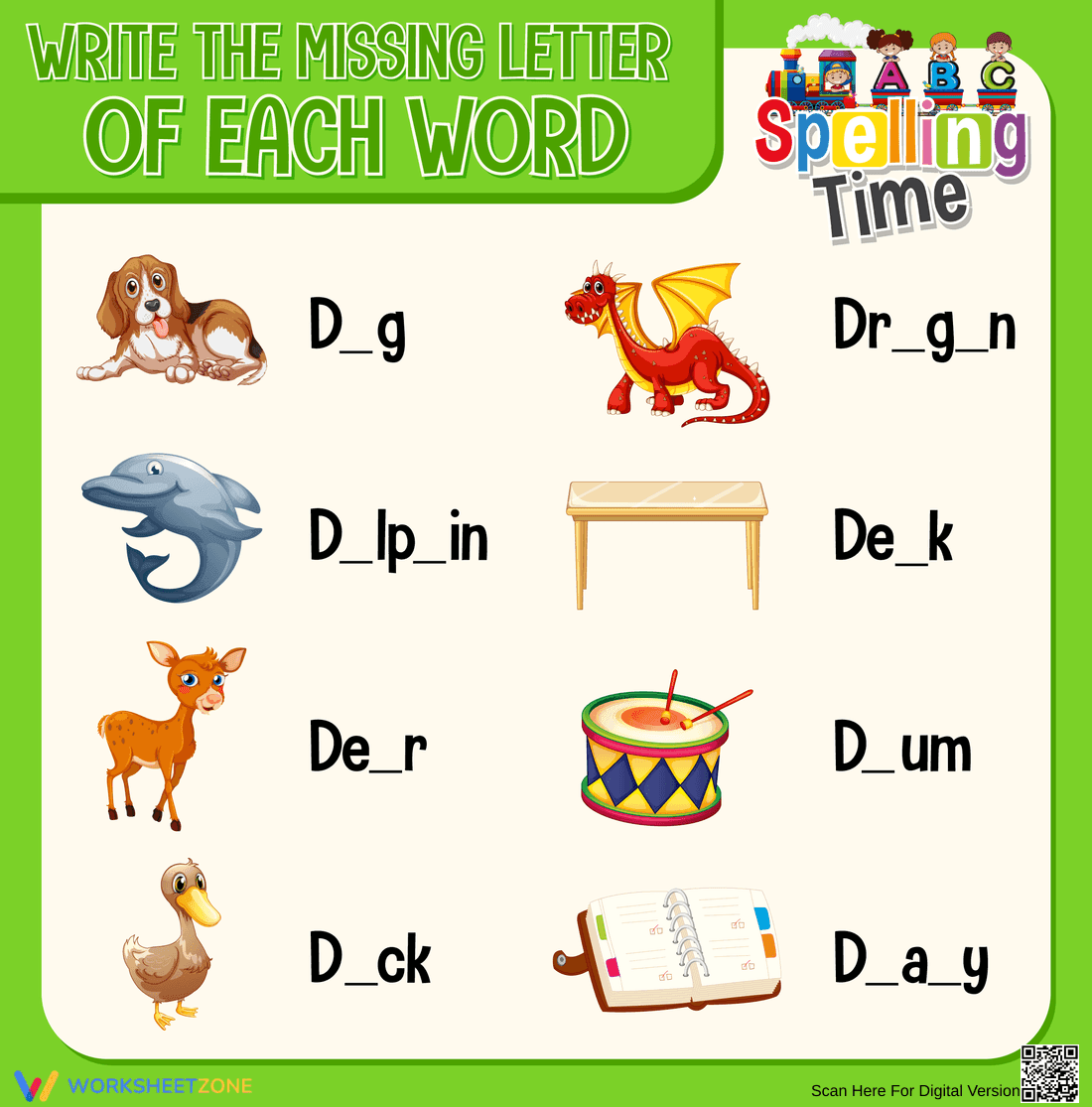
This Preschool spelling worksheet focuses on letter-sound correspondence and phonemic awareness. Students identify missing vowels and consonants in common words starting with the letter 'D', such as dog and duck. By filling in the blanks, young learners strengthen their ability to connect spoken sounds to written symbols, building a foundation for early literacy.
At a Glance
- Grade: Preschool · Subject: ELA
- Standard:
CCSS.ELA-LITERACY.RF.K.3.A— Demonstrate basic knowledge of one-to-one letter-sound correspondences by producing the primary sound- Skill Focus: Letter 'D' Phonics & Spelling
- Format: 1 page · 8 problems · Answer key included · PDF
- Best For: Early phonics practice and letter recognition
- Time: 10–15 minutes
This single-page PDF features 8 vibrant illustrations paired with partially spelled words. Each word begins with the letter 'D', providing a consistent phonetic anchor for the student. The layout includes clear blanks for missing letters, encouraging fine motor development alongside spelling. A full answer key is provided to facilitate quick checking or self-correction by the teacher or parent.
- Guided Practice: Students begin by identifying the familiar dog and duck images, using the visual cue to predict the missing vowel sound in these simple CVC words.
- Supported Practice: Learners move to multi-syllabic words like dolphin and dragon, where the missing letter is embedded within a more complex sequence of letters.
- Independent Practice: The final tasks require students to independently recall the letter-sound relationship for desk and drum without teacher prompting or heavy scaffolding.
This worksheet follows a gradual-release model, moving from high-frequency words to more challenging vocabulary to ensure student confidence.
This resource aligns with `CCSS.ELA-LITERACY.RF.K.3.A`, focusing on the primary sounds of consonants and vowels. It also supports RF.K.1.B by demonstrating that sequences of letters represent spoken words. Both standard codes can be copied directly into lesson plans, IEP goals, or district curriculum mapping tools.
Use this worksheet during small-group literacy rotations after introducing the letter 'D' sound. It serves as an excellent formative assessment; observe if students can vocalize the word before writing the letter. Expect completion within 10 to 15 minutes. It also works well as a morning work activity to reinforce phonics and vocabulary.
This is designed for preschool and early kindergarten students who are beginning to blend sounds. It is particularly helpful for English Language Learners (ELLs) who benefit from the direct image-to-word association. Pair this with a letter 'D' anchor chart or a tactile sand-writing activity for a multi-sensory lesson.
According to the RAND AIRS 2024 report, early exposure to phoneme-grapheme mapping is a critical predictor of later reading fluency. This worksheet addresses that need by providing 8 targeted opportunities for students to practice letter-sound correspondence within a structured, visually supported framework. By isolating the missing letter in familiar D words, the activity reduces cognitive load, allowing preschoolers to focus specifically on the relationship between the spoken phoneme and the written grapheme. Research from Fisher & Frey (2014) emphasizes that such scaffolded practice, combining visual cues with phonetic tasks, accelerates the transition from letter recognition to functional spelling. This resource provides the necessary repetition for mastery of the CCSS.ELA-LITERACY.RF.K.3.A standard, ensuring that young learners develop the foundational decoding skills required for more complex literacy tasks in subsequent grades.


