


























Views
Downloads

Letter D Phonics Worksheet | Grade K-1 Printable
Paste this activity's link or code into your existing LMS (Google Classroom, Canvas, Teams, Schoology, Moodle, etc.).
Students can open and work on the activity right away, with no student login required.
You'll still be able to track student progress and results from your teacher account.
This essential Letter D phonics worksheet provides Kindergarten and Grade 1 students with comprehensive practice in letter recognition, formation, and phonemic awareness. By engaging with multiple modalities—coloring, tracing, and sorting—learners build the foundational literacy skills necessary for early reading success. Students will confidently identify the /d/ sound in various contexts.
At a Glance
- Grade: K-2 · Subject: ELA Phonics
- Standard:
CCSS.ELA-LITERACY.RF.K.1.D— Recognize and name all upper- and lowercase letters of the alphabet- Skill Focus: Letter D identification and formation
- Format: 2 pages · 45 tasks · Answer key included · PDF
- Best For: Independent literacy centers or morning work
- Time: 15–20 minutes
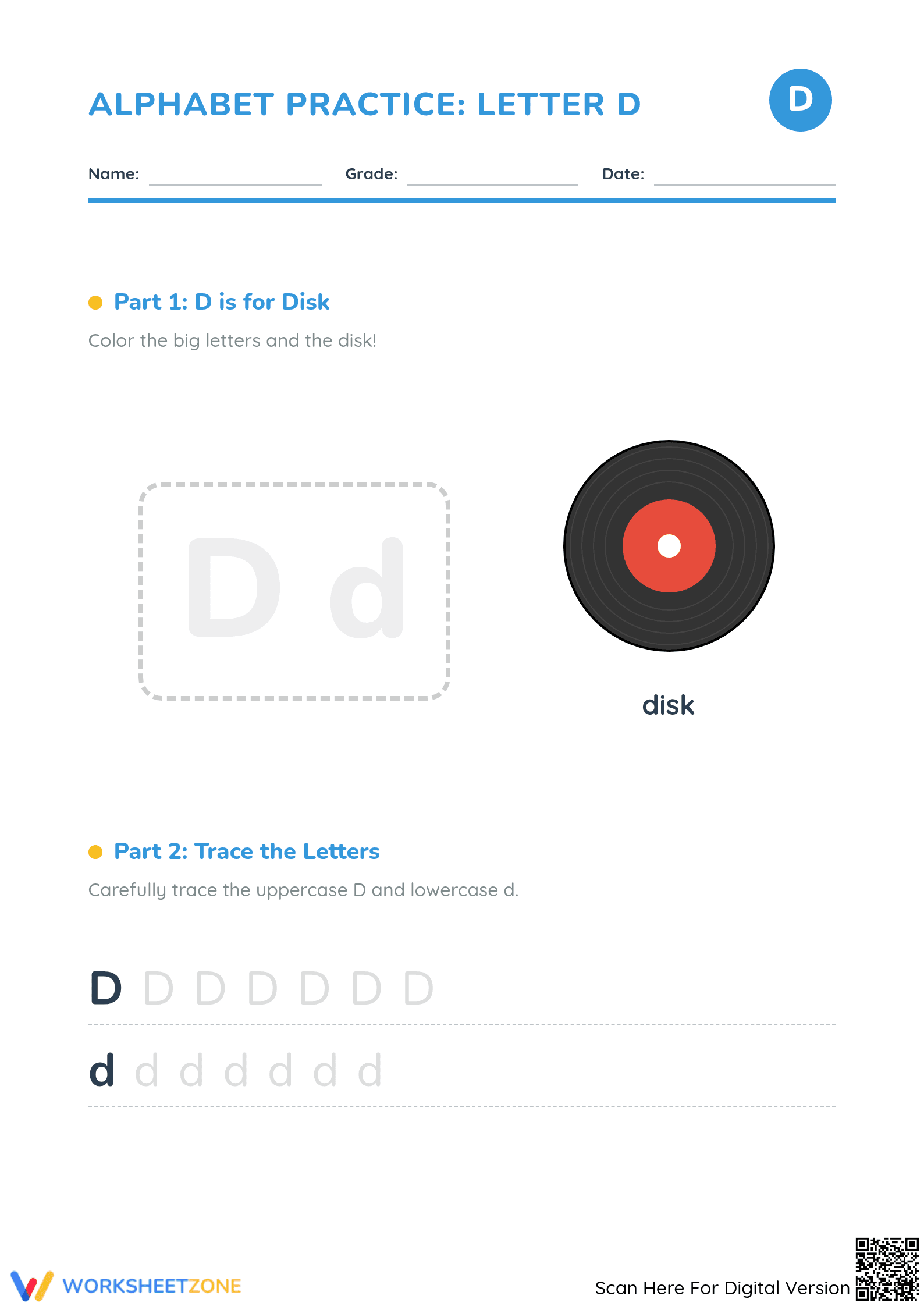
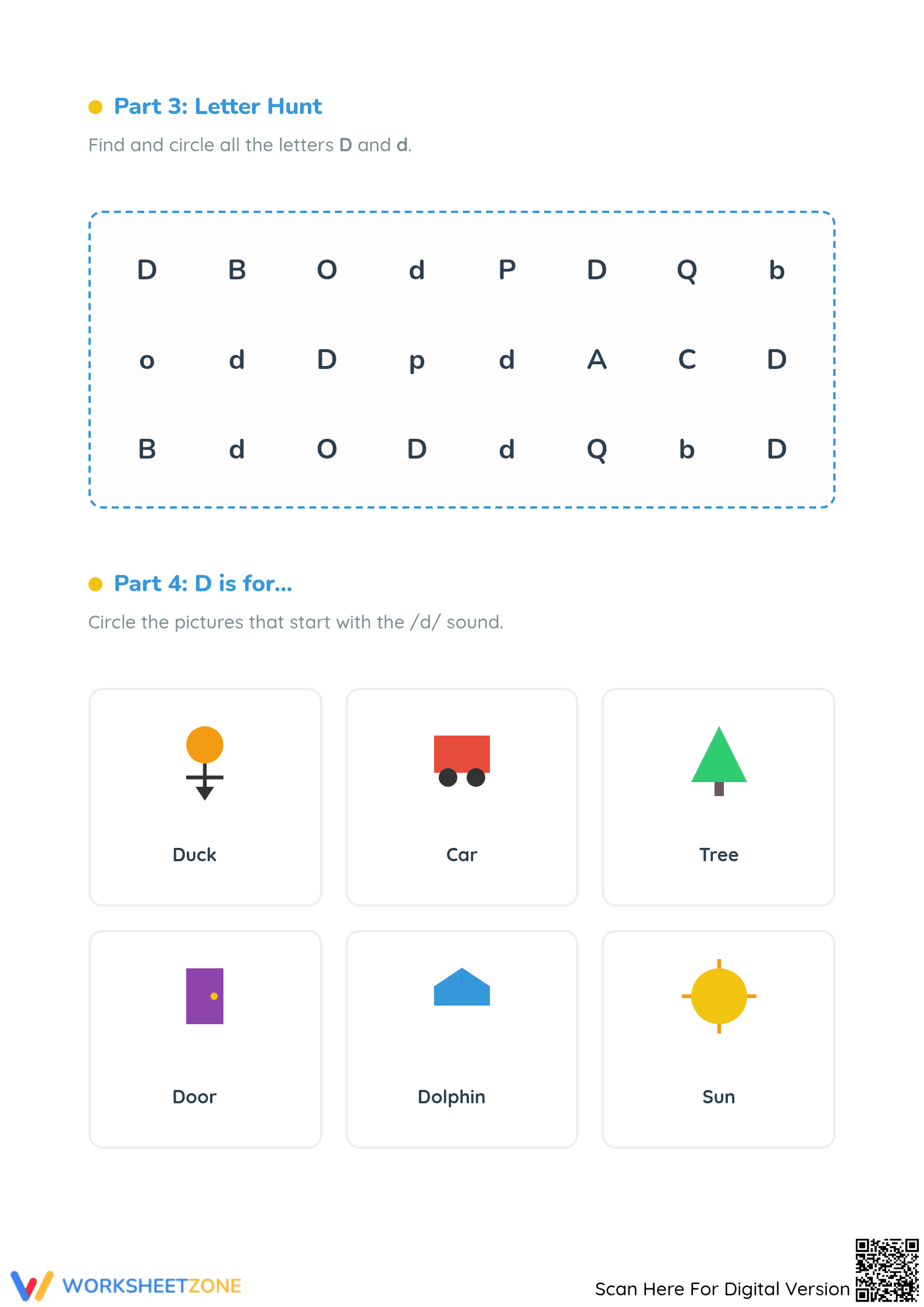
This 2-page PDF includes four distinct sections designed to reinforce the letter D. Page one features a large-format coloring area for uppercase and lowercase D alongside a "disk" visual, followed by structured tracing lines for handwriting practice. Page two contains a letter hunt grid with 24 characters and a phonemic awareness task where students evaluate six different images to identify the initial /d/ sound.
Zero-Prep Workflow
- Print: Select the 2-page PDF and print enough copies for your class in under 30 seconds.
- Distribute: Hand out the worksheets during your phonics block or as a quiet morning activity.
- Review: Use the provided answer key to quickly check student work or display it on a projector for a whole-class check.
Total teacher preparation time is under two minutes, making this an ideal resource for busy classrooms or emergency sub plans.
Standards Alignment
The primary focus is `CCSS.ELA-LITERACY.RF.K.1.D`, which requires students to recognize and name all upper- and lowercase letters. Additionally, the "D is for..." section supports `CCSS.ELA-LITERACY.RF.K.3.A` by asking students to demonstrate knowledge of one-to-one letter-sound correspondences. Both standard codes can be copied directly into lesson plans, IEP goals, or district curriculum mapping tools.
How to Use It
Assign this worksheet during the independent practice phase of a lesson on the letter D. It serves as an excellent formative assessment tool; observe students during the letter hunt to see if they confuse 'd' with 'b' or 'p'. The expected completion time is 15 to 20 minutes, depending on the student's fine motor speed and familiarity with the alphabet.
Who It's For
This resource is designed for Kindergarten students just beginning their phonics journey, though it provides valuable remediation for Grade 1 or Grade 2 students working on letter reversals. It pairs naturally with a "Letter of the Week" anchor chart or a read-aloud focused on alliteration to reinforce the /d/ sound in a broader context.
According to research by Fisher & Frey (2014) on the gradual release of responsibility, providing students with structured, independent practice following direct instruction is critical for skill retention. This worksheet facilitates that transition by moving from guided tracing to independent identification. The inclusion of both uppercase and lowercase forms aligns with NAEP findings suggesting that early mastery of letter names is one of the strongest predictors of later reading achievement. By requiring students to discriminate between similar-looking letters in the letter hunt section, the resource addresses common developmental hurdles in visual processing. The standard CCSS.ELA-LITERACY.RF.K.1.D is central to this activity, ensuring that students meet the benchmark for alphabet recognition. This printable tool offers a high-utility, evidence-based approach to early literacy that can be integrated into any phonics-based curriculum without additional teacher preparation.


