


























Views
Downloads

Letter D Beginning Sound Worksheet | Grade K Printable
Paste this activity's link or code into your existing LMS (Google Classroom, Canvas, Teams, Schoology, Moodle, etc.).
Students can open and work on the activity right away, with no student login required.
You'll still be able to track student progress and results from your teacher account.
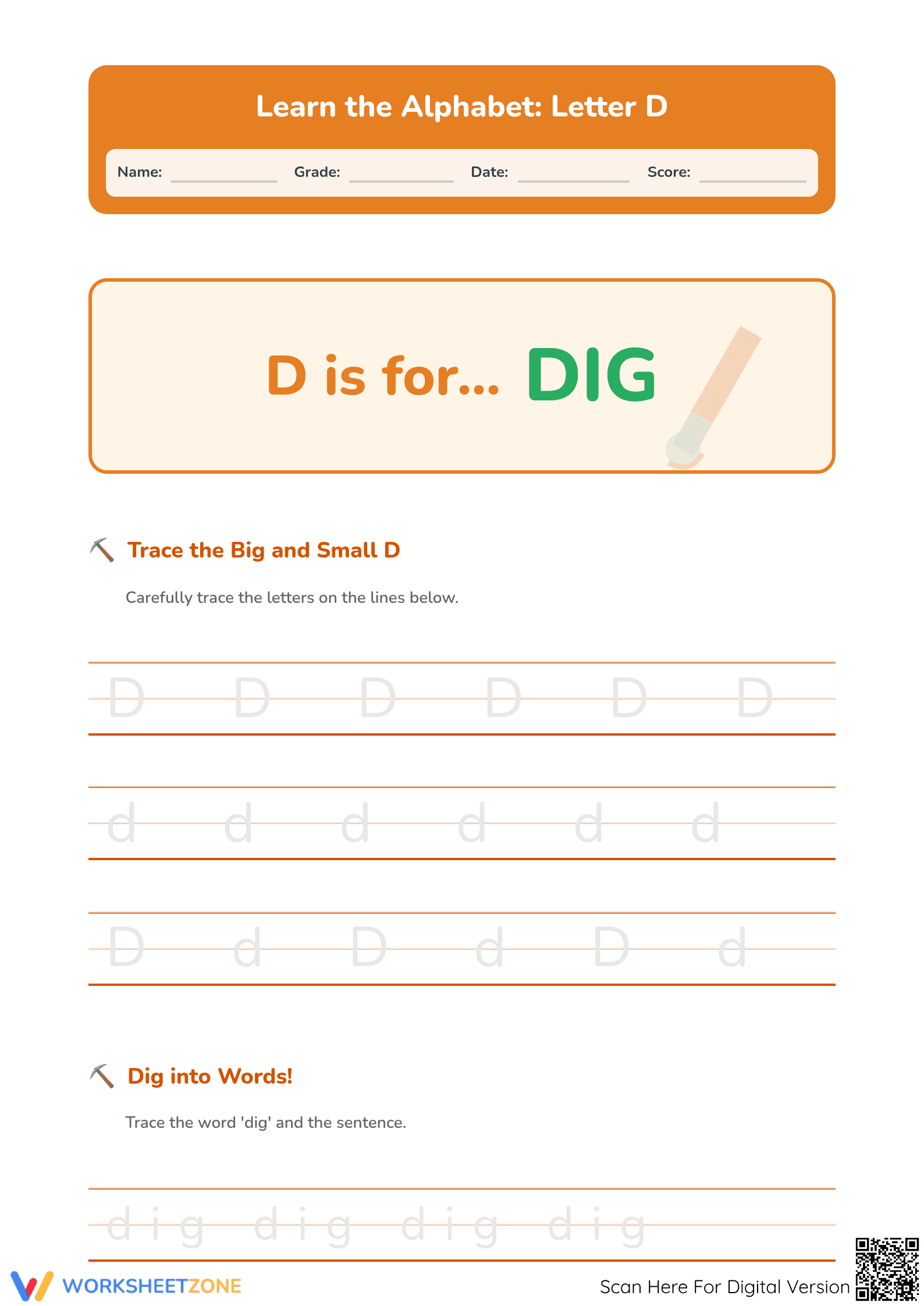
This Kindergarten letter D worksheet provides comprehensive practice for early learners to master alphabet recognition and phonemic awareness. Students engage in multi-sensory activities including tracing, visual discrimination, and initial sound categorization. By completing these tasks, children build the foundational literacy skills necessary for fluent reading and legible handwriting in primary grades.
At a Glance
- Grade: Kindergarten · Subject: ELA Phonics
- Standard:
CCSS.ELA-LITERACY.RF.K.1.D— Recognize and name all upper- and lowercase letters of the alphabet- Skill Focus: Letter D formation and beginning sounds
- Format: 2 pages · 45 tasks · Answer key included · PDF
- Best For: Morning work or phonics centers
- Time: 15–20 minutes
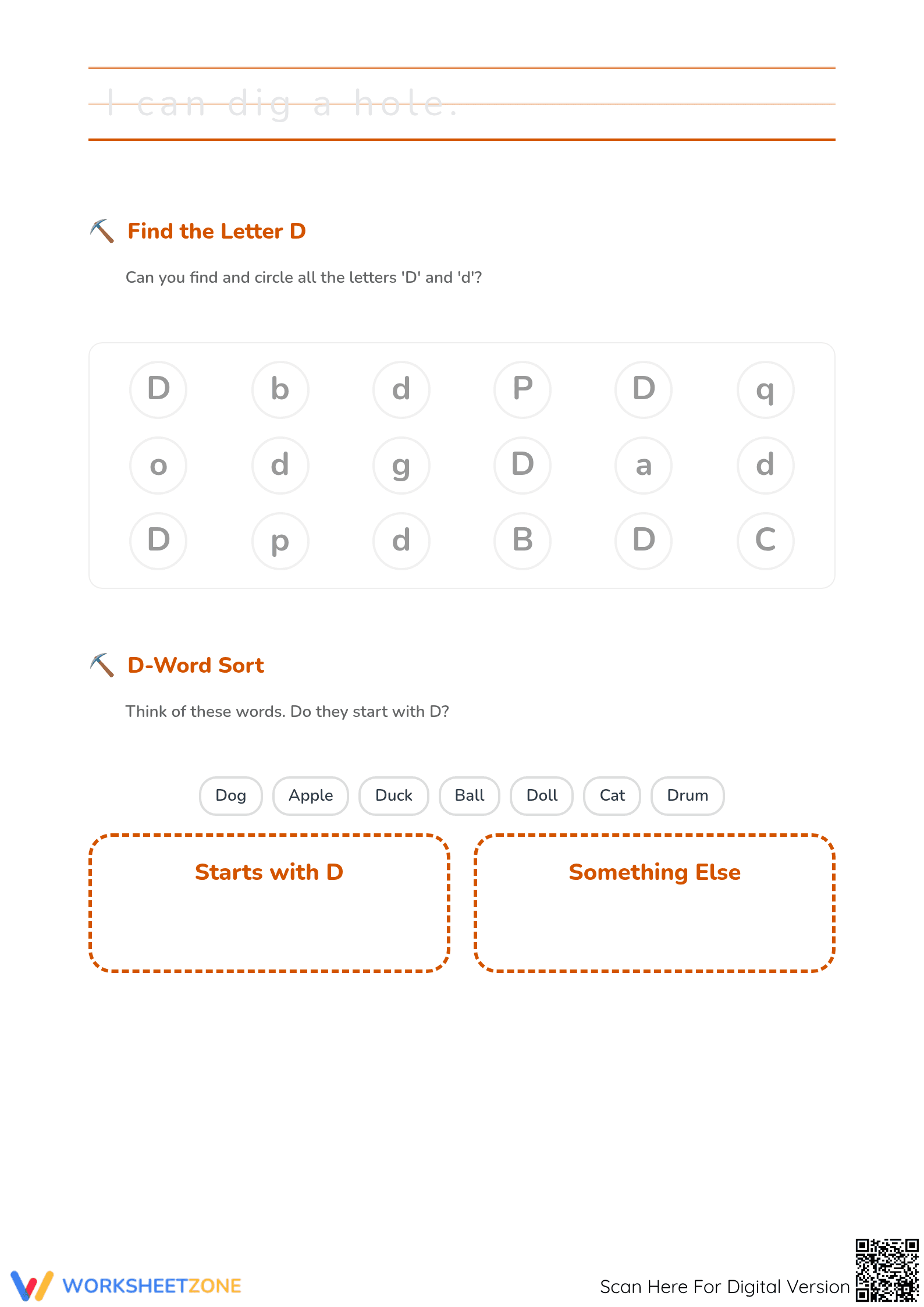
What's Inside: This two-page PDF includes four distinct instructional zones. The first page features dedicated lines for tracing uppercase "D" and lowercase "d," followed by word-level tracing for "dig" and a complete sentence. The second page shifts to visual discrimination with a letter-finding grid and a conceptual sorting task where students categorize seven different words based on their initial phoneme.
Zero-Prep Workflow
- Print: Open the PDF and print the two-page set for your class (30 seconds).
- Distribute: Hand out the sheets with pencils and crayons for the sorting activity (1 minute).
- Review: Use the included answer key to quickly check the letter search and word sort (30 seconds).
Total teacher preparation time is under two minutes, making it an ideal choice for emergency sub plans or busy morning transitions.
Standards Alignment: The primary focus is CCSS.ELA-LITERACY.RF.K.1.D, which requires students to recognize and name all upper- and lowercase letters. It also supports CCSS.ELA-LITERACY.RF.K.3.A by reinforcing the one-to-one correspondence between the letter D and its initial sound. Both standard codes can be copied directly into lesson plans, IEP goals, or district curriculum mapping tools.
How to Use It: Use this worksheet during the independent practice phase of a lesson on the letter D. It works effectively as a formative assessment after an anchor chart introduction. Teachers should observe students during the sorting task to identify those struggling with the /d/ sound versus the /b/ or /p/ sounds. Completion typically takes 15 to 20 minutes.
Who It's For: This resource is tailored for Kindergarten students, though it serves as an excellent intervention for Grade 1 learners needing phonics reinforcement. It pairs naturally with a "Letter of the Week" curriculum or a read-aloud focused on words starting with D. The clear visual cues support English Language Learners in identifying common vocabulary.
According to the RAND AIRS 2024 report on early literacy, structured practice in letter-sound correspondence is a critical predictor of later reading success. This worksheet directly addresses the CCSS.ELA-LITERACY.RF.K.1.D standard by providing 45 discrete opportunities for students to interact with the letter D through tracing, identification, and phonemic sorting. Research from Fisher & Frey (2014) emphasizes that the gradual release of responsibility—moving from guided tracing to independent sorting—helps solidify alphabetic principles in young minds. By integrating visual discrimination tasks with handwriting practice, this resource ensures that students develop both the motor skills and the cognitive recognition required for literacy. The inclusion of a sentence-level trace further bridges the gap between isolated letter knowledge and contextual reading. This evidence-based approach provides the repetitive, high-quality exposure necessary for Kindergarteners to achieve mastery of the alphabet.


