


























Views
Downloads
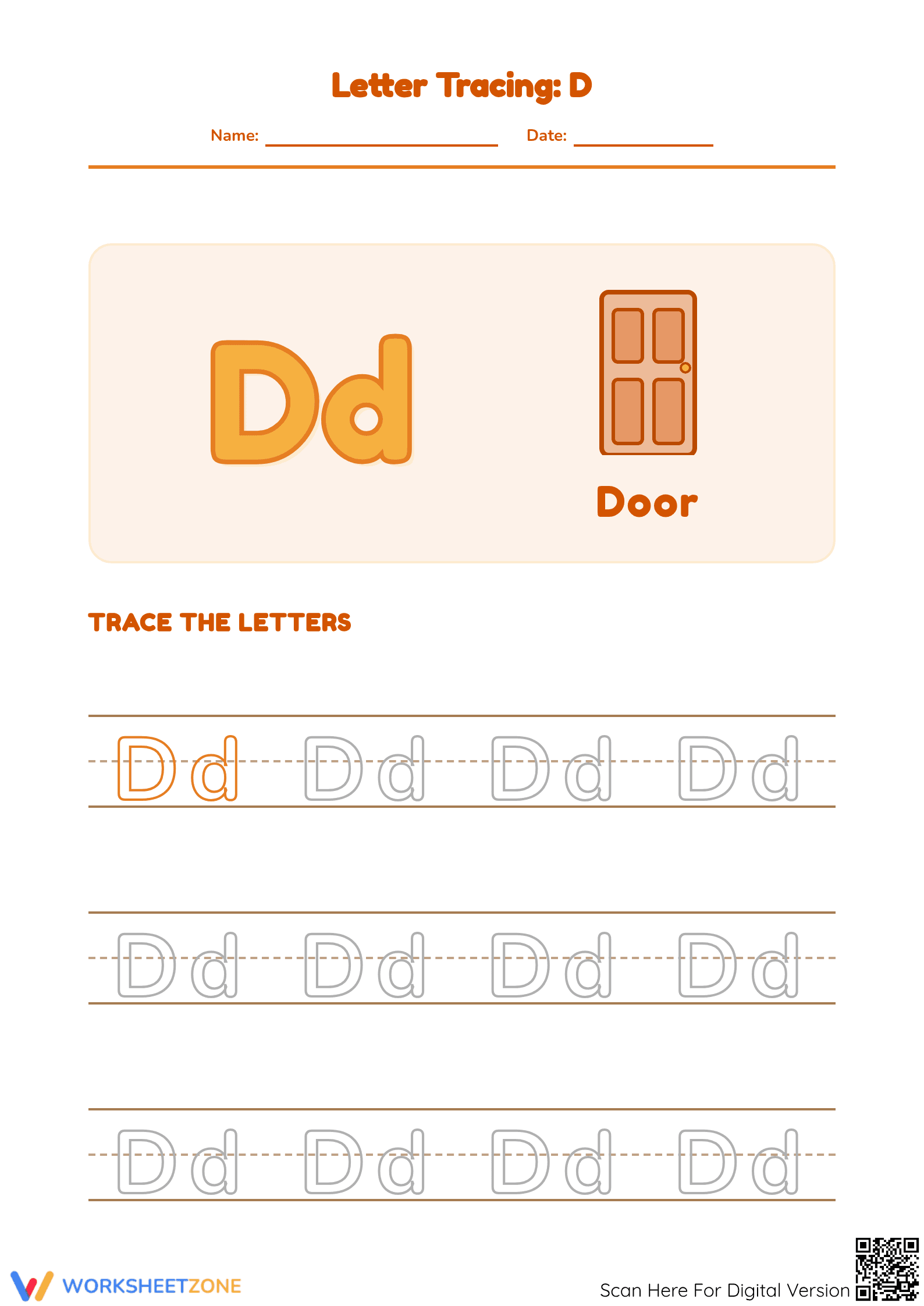


Letter D Tracing Worksheet | Essential Kindergarten Phonics
Paste this activity's link or code into your existing LMS (Google Classroom, Canvas, Teams, Schoology, Moodle, etc.).
Students can open and work on the activity right away, with no student login required.
You'll still be able to track student progress and results from your teacher account.
This Kindergarten Letter D worksheet provides foundational phonics practice by helping students recognize, trace, and write the letter D. By connecting the letter sound to a familiar object like a door, learners build essential phonemic awareness while developing the fine motor skills necessary for legible handwriting and early literacy success.
At a Glance
- Grade: Kindergarten · Subject: ELA Phonics
- Standard:
CCSS.ELA-LITERACY.RF.K.1.D— Recognize and name all upper- and lowercase letters of the alphabet- Skill Focus: Letter D Formation
- Format: 2 pages · 13 tasks · No answer key needed · PDF
- Best For: Daily morning work or literacy centers
- Time: 10–15 minutes
This two-page PDF features a clear visual anchor—a door—to reinforce the "d" sound. The first page contains 12 pairs of uppercase and lowercase "Dd" for guided tracing on primary lines. The second page transitions to independent practice, providing a dedicated "Write Your Own" section where students can demonstrate mastery without dashed guides, ensuring they internalize the correct stroke order for both letter cases.
The zero-prep design allows for immediate classroom implementation. 1. Print: Select the two pages and print enough copies for your group (30 seconds). 2. Distribute: Hand out the sheets during your phonics block or as a quiet transition activity (1 minute). 3. Review: Walk the room to check for proper pencil grip and stroke order (ongoing). Total teacher prep time is under 2 minutes, making it an ideal resource for busy mornings or unexpected sub plans.
Primary standards alignment is focused on `CCSS.ELA-LITERACY.RF.K.1.D`, which requires students to recognize and name all upper- and lowercase letters of the alphabet. This worksheet specifically targets the letter D through repetitive formation and visual identification. Both standard codes can be copied directly into lesson plans, IEP goals, or district curriculum mapping tools to ensure compliance with state and national literacy frameworks.
Use this as a formative assessment after introducing the letter D sound. Observe students as they trace to ensure they start at the top line, a key indicator of handwriting readiness. It also serves as an excellent literacy center activity or a homework assignment to reinforce classroom instruction. The 13 total tasks provide enough repetition to build muscle memory without overwhelming young learners.
This resource is designed for Kindergarten students, but it is also suitable for Pre-K learners ready for writing or Grade 1 students needing remedial handwriting support. Pair this with a "Letter D" anchor chart or a read-aloud book featuring words that start with the /d/ sound to create a comprehensive multi-sensory learning experience for your students.
Research by Fisher & Frey (2014) emphasizes the importance of the gradual release of responsibility model in early childhood education. This worksheet follows that framework by moving from highly supported tracing on page one to independent production on page two. By isolating the letter D, students can focus on the specific motor patterns required for `CCSS.ELA-LITERACY.RF.K.1.D` without the cognitive load of complex sentences. Studies in the NAEP framework suggest that early mastery of letter-name knowledge is one of the strongest predictors of later reading achievement. This resource provides the structured, repetitive practice necessary to move letter recognition from short-term memory to long-term fluency. Teachers can use the 13 distinct tasks to track progress over time, ensuring that every student meets foundational literacy benchmarks before advancing to more complex phonics blends or CVC word construction.


