


























Views
Downloads

Grade K Letter E Sounds — Printable No-Prep Worksheet
Paste this activity's link or code into your existing LMS (Google Classroom, Canvas, Teams, Schoology, Moodle, etc.).
Students can open and work on the activity right away, with no student login required.
You'll still be able to track student progress and results from your teacher account.
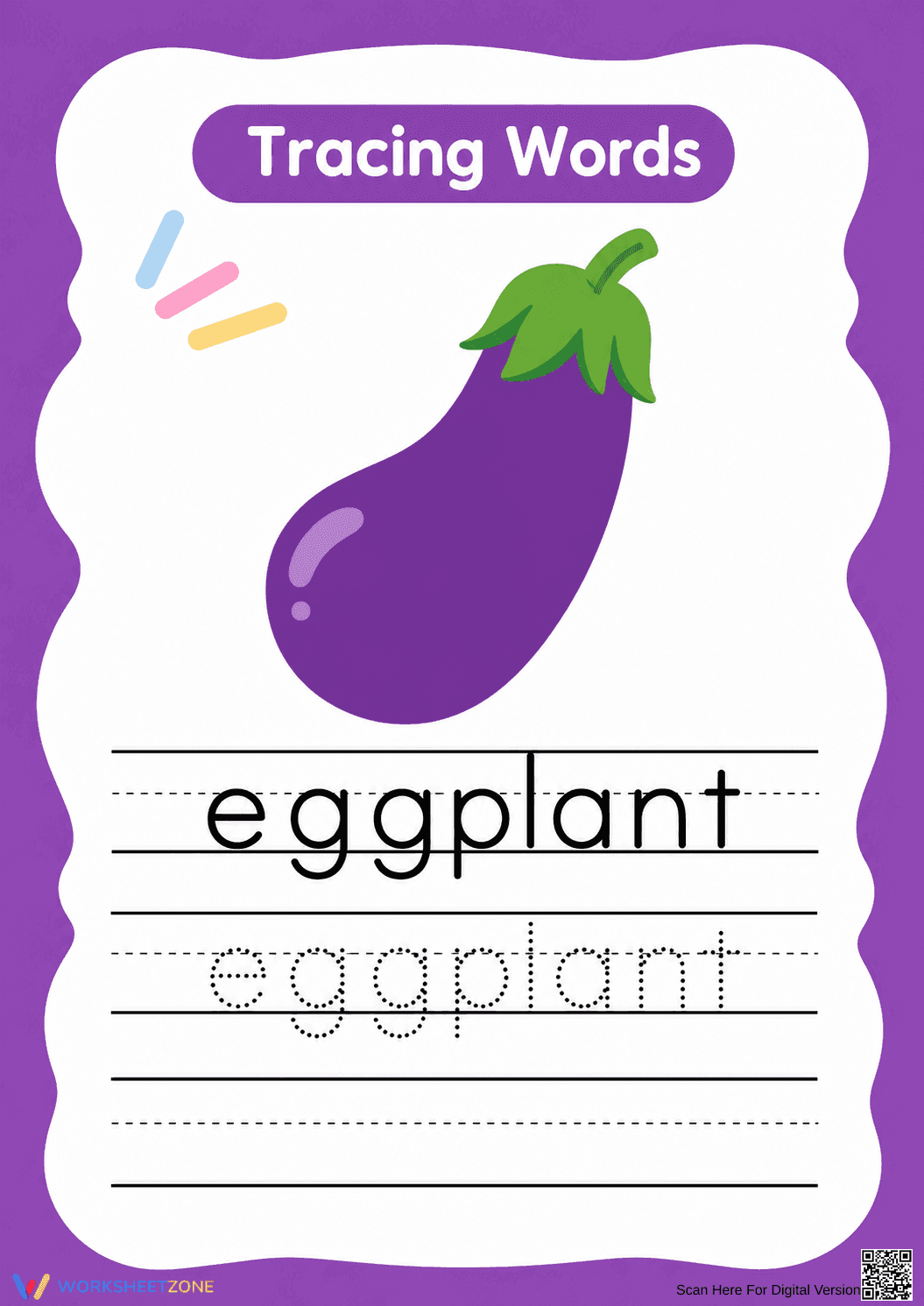
This foundational phonics worksheet helps early learners master the short vowel sound for the letter E while building essential fine motor skills. Students practice identifying the beginning sound of the word "eggplant" and develop proper letter formation through guided tracing exercises, setting the stage for confident handwriting and reading fluency.
At a Glance
- Grade: K · Subject: ELA
- Standard:
CCSS.ELA-LITERACY.RF.K.3.B— Associate short vowel sounds with common spellings.- Skill Focus: Letter E Beginning Sound & Tracing
- Format: 1 page · 3 handwriting tasks · No answer key needed · PDF
- Best For: Morning work or literacy centers
- Time: 5–10 minutes
This single-page resource features an eggplant illustration to visually reinforce the target beginning sound. Below the image, students find three handwriting lines for progressive practice. The first line provides a solid word for visual reference, the second offers dotted letters for guided tracing, and the final blank line encourages independent writing. Primary-ruled lines with dashed midlines ensure structural support for correct letter height.
This resource requires minimal teacher preparation.
- Print (1 minute): Simply download the PDF and print the required number of copies. The high-contrast design ensures crisp printing in both color and black-and-white.
- Distribute (1 minute): Hand out the worksheets along with pencils or crayons. The intuitive layout means students can begin working immediately.
- Review (1 minute): Quickly scan student work to check for proper pencil grip and correct letter formation along the dashed midlines.
Total teacher prep time is under two minutes, making this an excellent option for sub plans or literacy centers.
This worksheet is directly aligned to CCSS.ELA-LITERACY.RF.K.3.B, requiring students to associate the long and short sounds with common spellings (graphemes) for the five major vowels. It also supports foundational handwriting standards by having students print lowercase letters accurately. Both standard codes can be copied directly into lesson plans, IEP goals, or district curriculum mapping tools.
This tracing activity fits perfectly into morning work routines, allowing students to settle in with a structured task. Alternatively, use it as an independent station during literacy centers after explicitly teaching the short "e" sound. Teachers can conduct quick formative assessments by observing pencil grip and letter formation directionality. Expected completion time ranges from five to ten minutes.
This resource is primarily designed for kindergarten students, but it also serves as an excellent intervention tool for first and second graders who need additional fine motor or phonics reinforcement. For students requiring extra scaffolding, teachers can highlight the dotted lines with a yellow marker before tracing. Pair this worksheet with a whole-class anchor chart featuring other short "e" words like elephant, egg, and envelope to solidify the phonetic concept.
Mastering the connection between spoken sounds and written letters is a critical milestone in early childhood literacy. Activities that combine phonemic awareness with physical handwriting practice reinforce neural pathways essential for reading development. By targeting CCSS.ELA-LITERACY.RF.K.3.B to associate short vowel sounds with common spellings, this worksheet provides targeted, multimodal instruction. According to a comprehensive RAND AIRS 2024 study on early literacy interventions, students who engage in simultaneous letter-sound vocalization and physical letter tracing demonstrate a significantly higher retention rate of phonetic rules compared to those using visual-only methods. The physical act of tracing the word "eggplant" while pronouncing the initial vowel sound helps solidify the grapheme-phoneme correspondence in young learners' memories. This integrated approach ensures that foundational skills are deeply embedded, providing a robust platform for future decoding and encoding success in the primary grades.


