


























Views
Downloads
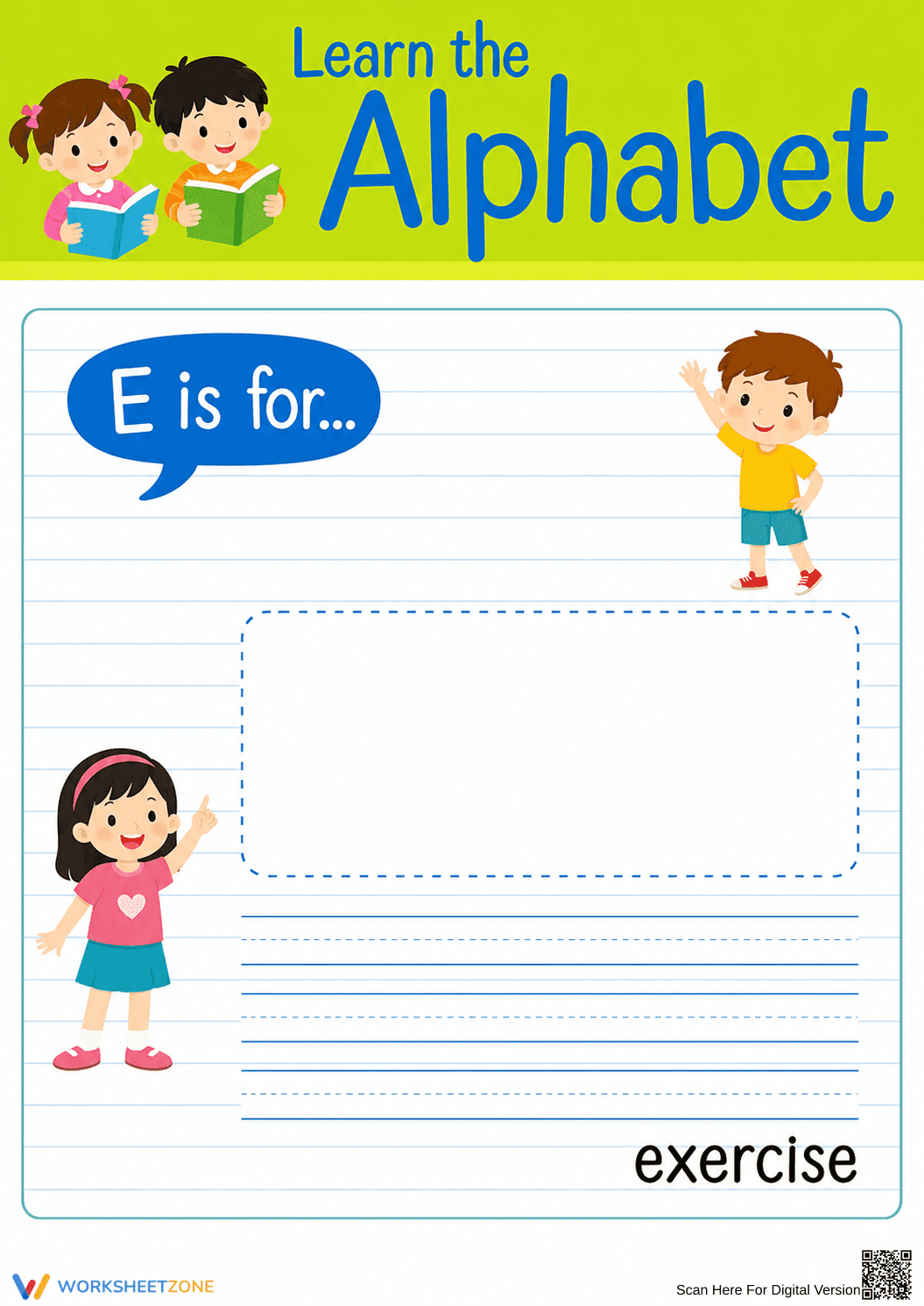

Letter E Beginning Sound Worksheet | Essential Phonics
Paste this activity's link or code into your existing LMS (Google Classroom, Canvas, Teams, Schoology, Moodle, etc.).
Students can open and work on the activity right away, with no student login required.
You'll still be able to track student progress and results from your teacher account.
This Letter E beginning sound worksheet provides early learners with a creative way to connect the letter E to its initial sound. By combining visual representation with handwriting practice, students solidify their phonemic awareness and letter formation skills. It is designed to bridge the gap between recognizing a letter and applying it in context through a simple, engaging format.
At a Glance
- Grade: Kindergarten · Subject: ELA Phonics
- Standard:
CCSS.ELA-LITERACY.RF.K.3.A— Produce the primary sound or many of the most frequent sounds for each consonant.- Skill Focus: Letter E Initial Sound
- Format: 1 page · 2 tasks · No answer key needed · PDF
- Best For: Morning work or phonics centers
- Time: 10–15 minutes
The worksheet features a large "E is for..." prompt accompanied by a spacious drawing box. Below the creative area, students find primary-ruled handwriting lines specifically designed for practicing the word "exercise." The layout is clean and student-friendly, featuring engaging illustrations of children reading and playing to encourage a positive learning environment while focusing on the specific phonics goal.
The zero-prep workflow for this resource is designed for maximum efficiency in a busy classroom. First, print the single-page PDF (30 seconds). Second, distribute the sheets to students along with crayons and pencils (1 minute). Third, review the drawings and letter formations as a quick formative check during independent work time. This makes it an ideal choice for emergency sub plans or transition periods where meaningful work is required.
This resource aligns with `CCSS.ELA-LITERACY.RF.K.3.A`, focusing on the production of the primary sound for the letter E. It also supports `CCSS.ELA-LITERACY.L.K.1.A` by requiring students to print upper- and lowercase letters correctly on the provided lines. Both standard codes can be copied directly into lesson plans, IEP goals, or district curriculum mapping tools to ensure compliance with state frameworks.
Use this worksheet during the independent practice phase of a phonics lesson after introducing the short E sound. It works exceptionally well as a formative assessment; observe if students draw an object that actually starts with E (like an egg, elephant, or envelope) to gauge their phonemic grasp. Expected completion time ranges from 10 to 15 minutes depending on the detail of the student's drawing.
This is primarily for Kindergarten students, though it serves as excellent remediation for Grade 1 or Grade 2 students struggling with letter-sound consistency. Pair this with a physical alphabet anchor chart or a short E phonics reader to provide a comprehensive literacy experience for diverse learners, including English Language Learners who benefit from the visual-to-text connection.
According to research from Fisher & Frey (2014), the integration of visual arts with literacy tasks significantly improves retention of phonemic concepts in early childhood education. This worksheet applies those findings by requiring students to generate a mental image associated with the letter E before performing the fine motor task of writing. By engaging both the creative and linguistic centers of the brain, the resource helps cement the CCSS.ELA-LITERACY.RF.K.3.A standard. Data from NAEP suggests that early mastery of letter-sound correspondence is one of the strongest predictors of future reading fluency. This printable provides the structured, repetitive practice necessary for that mastery without overwhelming the student with complex instructions. It ensures that the initial sound of the letter E is reinforced through multiple modalities, including auditory, visual, and kinesthetic pathways, making it a reliable tool for foundational literacy development.


