


























Views
Downloads


Essential Letter E Tracing & Recognition Worksheet | Grade K
Paste this activity's link or code into your existing LMS (Google Classroom, Canvas, Teams, Schoology, Moodle, etc.).
Students can open and work on the activity right away, with no student login required.
You'll still be able to track student progress and results from your teacher account.
This Kindergarten Letter E worksheet provides students with focused practice in recognizing and forming both uppercase and lowercase versions of the letter. By combining tactile tracing with visual discrimination tasks, students develop the foundational phonics skills necessary for early reading success. This resource ensures students can confidently identify the letter E in various contexts.
At a Glance
- Grade: Kindergarten · Subject: ELA
- Standard:
CCSS.ELA-LITERACY.RF.K.1.D— Recognize and name all upper- and lowercase letters of the alphabet- Skill Focus: Letter E Formation and Identification
- Format: 2 pages · 25 tasks · Answer key included · PDF
- Best For: Morning work or phonics centers
- Time: 10–15 minutes
What's Inside
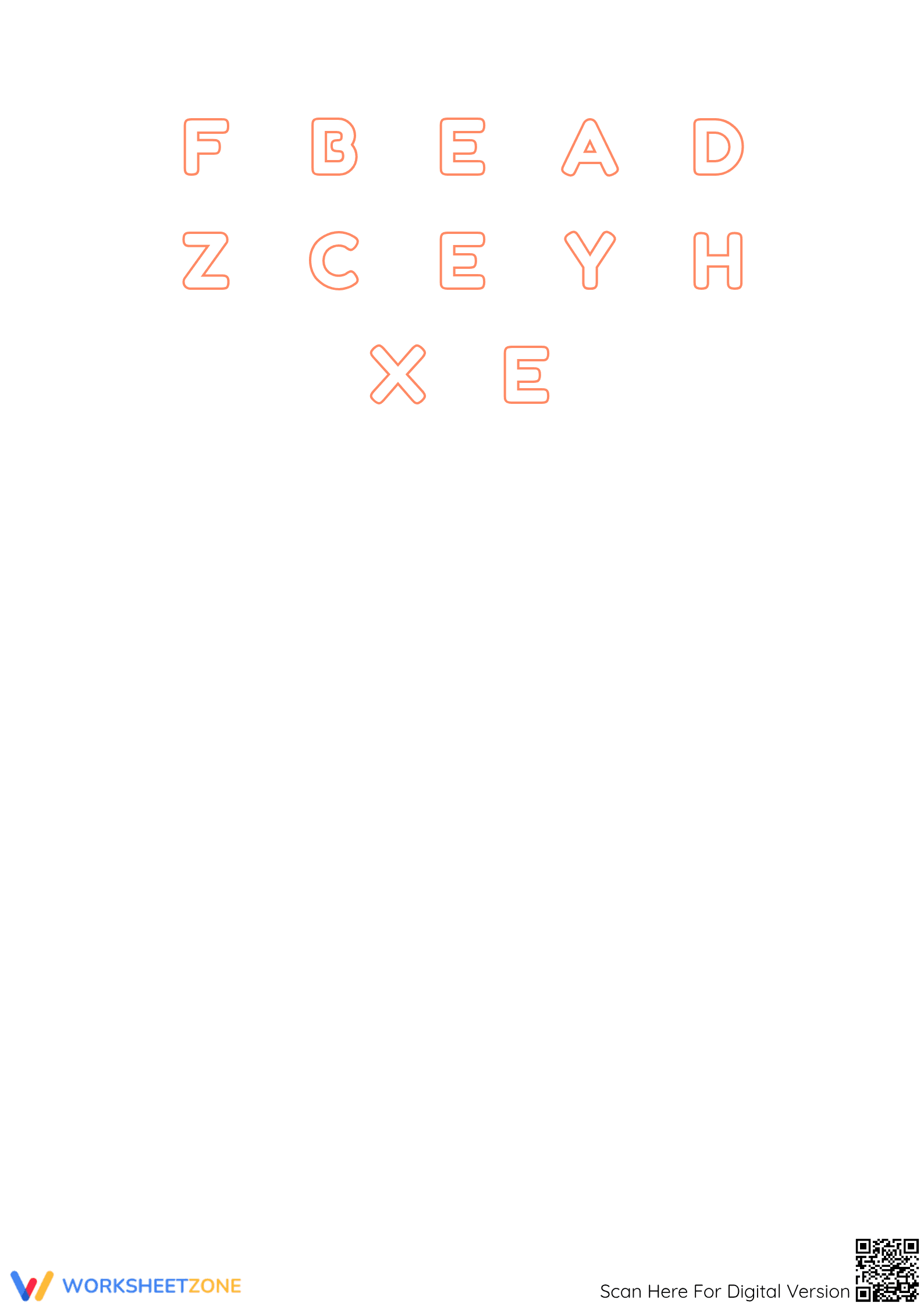
This two-page PDF includes a dedicated tracing section for uppercase 'E' and lowercase 'e' with guided dashed lines to support proper stroke order. The second page features a letter-search grid where students must distinguish the letter E from other similar-looking characters. The layout is clean and distraction-free, featuring a large coloring element to engage young learners while reinforcing the letter's shape.
Zero-Prep Workflow
- Print: Select the 2-page PDF and print enough copies for your small group or whole class in under 30 seconds.
- Distribute: Hand out worksheets with crayons or pencils for the tracing and coloring components with no additional materials required.
- Review: Walk the room to check for proper stroke order during tracing and correct letter identification, taking less than 2 minutes of total teacher prep.
Standards Alignment
This resource aligns directly with `CCSS.ELA-LITERACY.RF.K.1.D`, which requires students to recognize and name all upper- and lowercase letters of the alphabet. It also supports initial print concepts by reinforcing left-to-right progression during the tracing exercises. Both standard codes can be copied directly into lesson plans, IEP goals, or district curriculum mapping tools.
How to Use It
Use this worksheet during the "You Do" phase of a gradual release lesson on the letter E. It serves as an excellent formative assessment tool; observe students as they complete the letter-search grid to identify who may need additional intervention with visual discrimination. The expected completion time is 12 minutes, making it ideal for transition periods or independent station rotations.
Who It's For
This resource is designed for Kindergarten students, though it is highly effective for Pre-K students ready for letter formation or Grade 1 students requiring remedial support. It pairs naturally with alphabet anchor charts or sand-tray writing activities to provide a multi-sensory approach to phonics instruction.
According to research by Fisher & Frey (2014), the gradual release of responsibility begins with clear modeling of foundational skills like letter formation. This worksheet supports that transition by providing explicit tracing paths for both uppercase 'E' and lowercase 'e', followed by an independent identification task. Early childhood literacy development relies heavily on the ability to recognize and name all upper- and lowercase letters of the alphabet, a core requirement of CCSS.ELA-LITERACY.RF.K.1.D. By engaging in tactile tracing and visual discrimination, students build the orthographic mapping skills necessary for later decoding and fluency. This resource provides 25 distinct opportunities for students to interact with the letter 'E', ensuring that the visual representation of the phoneme is reinforced through multiple modalities. Such structured practice is essential for Kindergarten students as they move from basic letter awareness to phonological mastery in a classroom setting.


