


























Views
Downloads

Beginning Sounds Worksheet | Essential Preschool ELA
Paste this activity's link or code into your existing LMS (Google Classroom, Canvas, Teams, Schoology, Moodle, etc.).
Students can open and work on the activity right away, with no student login required.
You'll still be able to track student progress and results from your teacher account.
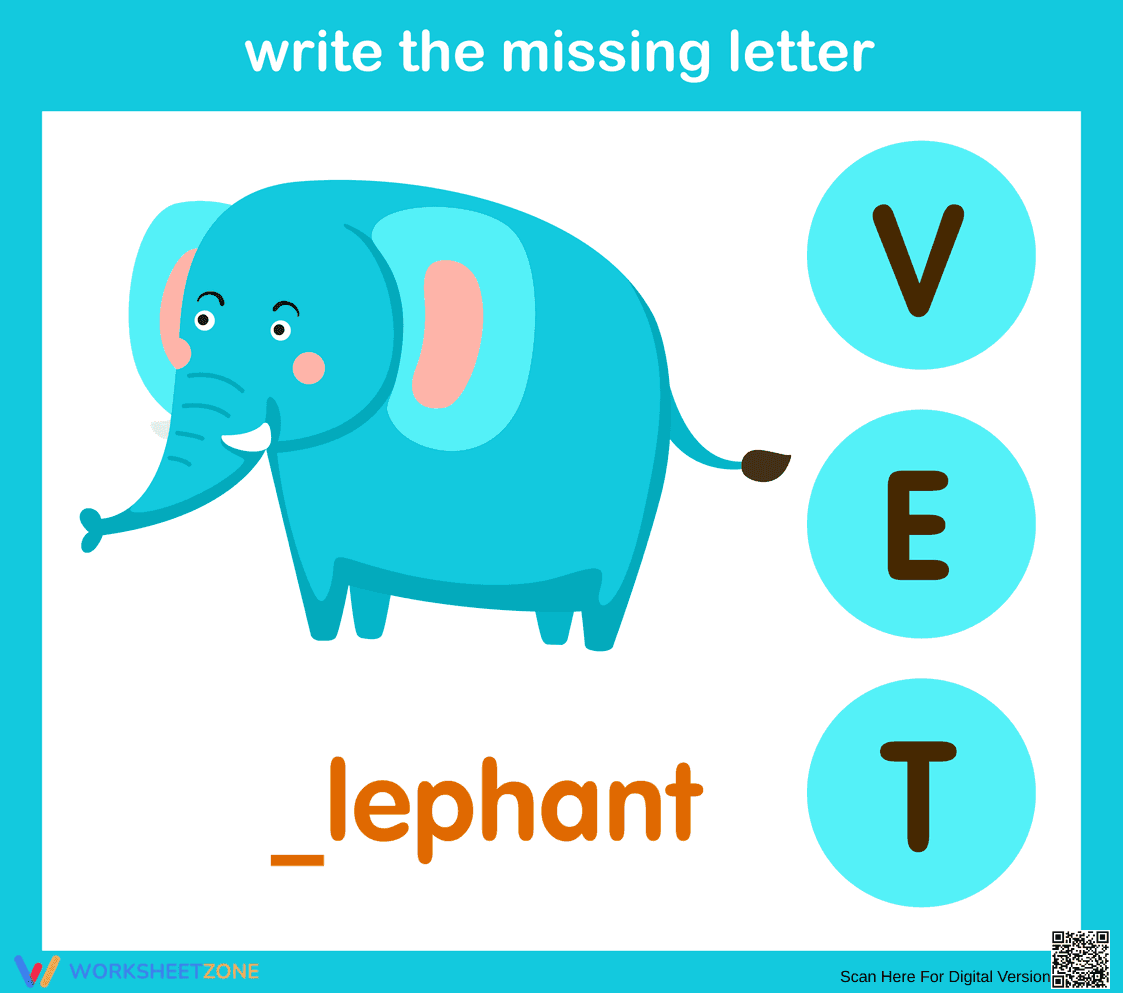
This preschool phonics worksheet focuses on initial sound isolation, a critical precursor to reading. By identifying the missing letter in the word elephant, students practice matching auditory phonemes with visual graphemes. This activity strengthens the foundational connection between spoken language and written symbols, ensuring early learners develop the phonemic awareness necessary for kindergarten success.
At a Glance
- Grade: Preschool · Subject: ELA Phonics
- Standard:
CCSS.ELA-LITERACY.RF.K.2.D— Isolate and pronounce the initial sounds in spoken words- Skill Focus: Beginning Letter Identification
- Format: 1 page · 1 primary task · Visual cues · PDF
- Best For: Early literacy centers and morning work
- Time: 5–10 minutes
The worksheet features a high-quality illustration of an elephant to provide immediate context for the learner. Below the image, the word "_lephant" is presented with a clear blank space for the missing initial letter. To support emerging readers, three large, circular letter options (V, E, and T) are provided on the right side, allowing students to choose the correct grapheme through visual discrimination and phonetic matching.
Zero-Prep Workflow:
- Print: Select the PDF and print in color to maintain the visual engagement of the elephant illustration (30 seconds).
- Distribute: Hand out the single-page sheet to students during small group rotations or as a quiet-time activity (1 minute).
- Review: Check for understanding by having the student say the word aloud and point to the letter "E" before writing it (1 minute).
Total teacher preparation time is under 3 minutes, making this an ideal resource for busy classrooms or unexpected sub plans.
Standards Alignment
This resource aligns with `CCSS.ELA-LITERACY.RF.K.2.D`, which requires students to isolate and pronounce the initial, medial vowel, and final sounds (phonemes) in words. While elephant is a multi-syllabic word, the focus remains strictly on the initial vowel sound, providing a bridge to more complex phonics patterns. This standard code can be copied directly into lesson plans, IEP goals, or district curriculum mapping tools.
How to Use It
Use this worksheet during a "Letter of the Week" unit focusing on the letter E. It serves as an excellent formative assessment tool; observe if the student can independently produce the short /e/ sound when looking at the elephant. Expected completion time ranges from 5 to 10 minutes depending on the student's fine motor skills and familiarity with the alphabet.
Who It's For
This activity is designed for preschool and early kindergarten students who are beginning to recognize that letters represent specific sounds. It is particularly effective for English Language Learners (ELLs) who benefit from the clear visual-to-word association. Pair this worksheet with a physical alphabet manipulative or a beginning sounds anchor chart to reinforce the concept.
Phonemic awareness is the strongest predictor of later reading success in early childhood education. This worksheet targets CCSS.ELA-LITERACY.RF.K.2.D by requiring students to isolate the initial phoneme in a familiar word. According to Fisher & Frey (2014), the use of visual scaffolds—such as the elephant illustration provided here—helps young learners bridge the gap between abstract sounds and concrete symbols. By limiting the choice to three distinct letters (V, E, T), the task reduces cognitive load while maintaining focus on the target skill of beginning sound identification. Research from the RAND AIRS 2024 report suggests that consistent, short-burst practice with initial sounds significantly improves decoding speed in subsequent grades. This printable resource provides a structured, low-stakes environment for students to master the essential skill of matching the /e/ sound to the letter E, facilitating a smooth transition into formal reading instruction.


