


























Views
Downloads
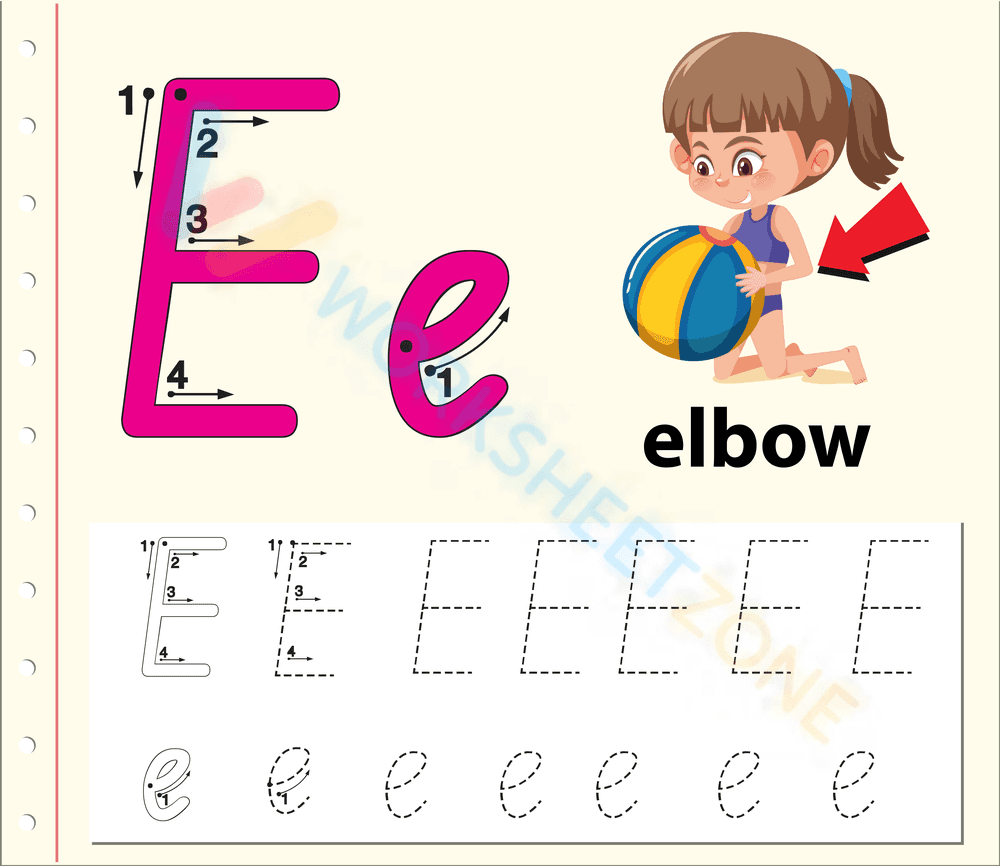

Grade K Letter E Beginning Sound — Printable Worksheet
Paste this activity's link or code into your existing LMS (Google Classroom, Canvas, Teams, Schoology, Moodle, etc.).
Students can open and work on the activity right away, with no student login required.
You'll still be able to track student progress and results from your teacher account.
This foundational phonics worksheet establishes essential letter-sound correspondence for the letter E. Students connect uppercase and lowercase E with its short initial phoneme using the anchor word elbow. The structured tracing exercises build fine motor skills while reinforcing letter recognition.
At a Glance
- Grade: Kindergarten · Subject: ELA
- Standard:
CCSS.ELA-LITERACY.RF.K.3.A— Demonstrate basic knowledge of one-to-one letter-sound correspondences- Skill Focus: Letter E Beginning Sound and Tracing
- Format: 1 page · 14 problems · Answer key included · PDF
- Best For: Independent practice and morning work
- Time: 10–15 minutes
This single-page resource features a clear layout for early learners. Large model letters display numbered directional arrows showing exact stroke order for uppercase and lowercase E, paired with an illustration representing the elbow phoneme. The bottom section provides 14 structured tracing opportunities transitioning from directional guides to dashed lines. Answer key included.
Designed for maximum instructional efficiency, this worksheet requires zero teacher preparation and fits perfectly into daily routines or sub plans:
- Print (30 seconds): Generate the single-page PDF for immediate distribution.
- Distribute (30 seconds): Hand out during morning work or literacy centers. Visual cues allow immediate engagement.
- Review (1 minute): Monitor pencil grip and stroke direction, or use the included key for rapid verification.
Total teacher preparation time is under two minutes, making it an ideal grab-and-go resource.
This worksheet aligns directly to primary standard CCSS.ELA-LITERACY.RF.K.3.A, requiring students to demonstrate basic knowledge of one-to-one letter-sound correspondences. It also supports foundational handwriting goals by reinforcing proper letter formation on guided lines. Both standard codes can be copied directly into lesson plans, IEP goals, or district curriculum mapping tools.
Teachers can deploy this resource during two instructional moments: following a whole-group phonics mini-lesson, or as an independent literacy center activity. As a formative assessment observation tip, watch students complete the 14 tracing practice items to ensure they start each letter at the top guide line rather than forming strokes from the bottom up. Expected completion time ranges from 10 to 15 minutes.
This resource is tailored for Kindergarten and Grade 1 students mastering foundational phonics. It also serves as an intervention tool for Grade 2 students requiring targeted remediation in letter reversal and stroke automaticity. This worksheet pairs naturally with an interactive anchor chart displaying other short /e/ vocabulary words like elephant and egg.
Establishing robust letter-sound correspondence and automatic letter formation is essential for early literacy development in primary classrooms. Aligning daily instruction to CCSS.ELA-LITERACY.RF.K.3.A ensures students demonstrate basic knowledge of one-to-one letter-sound correspondences, effectively bridging visual symbols with phonemic awareness. According to foundational research from Fisher & Frey (2014), structured, gradual-release practice formats significantly enhance student retention and skill automaticity in early literacy tasks. By combining explicit stroke modeling with targeted beginning sound vocabulary like elbow, this worksheet provides the exact cognitive scaffolding young learners require. Developing motor automaticity across the 14 tracing tasks directly reduces cognitive load during subsequent word-reading exercises. Consistent, explicit phonics practice supported by clear visual models fosters long-term reading proficiency, builds essential academic confidence, and prevents early reading difficulties across diverse student populations.


