


























Views
Downloads


Cursive Letter E Practice Worksheet | Grade 2 Essential
Paste this activity's link or code into your existing LMS (Google Classroom, Canvas, Teams, Schoology, Moodle, etc.).
Students can open and work on the activity right away, with no student login required.
You'll still be able to track student progress and results from your teacher account.
This Grade 2 cursive Letter E worksheet provides students with structured handwriting practice to improve fine motor skills and letter recognition. By focusing on both uppercase and lowercase forms, learners develop the muscle memory required for fluid script writing. The inclusion of vocabulary words reinforces the beginning sound of the letter E in a meaningful context.
At a Glance
- Grade: 2 · Subject: ELA / Phonics
- Standard:
CCSS.ELA-LITERACY.L.2.1— Demonstrate command of standard English grammar and usage when writing- Skill Focus: Cursive Letter E Formation
- Format: 2 pages · 23 problems · Answer key included · PDF
- Best For: Independent handwriting practice and phonics reinforcement
- Time: 15–20 minutes
What's Inside
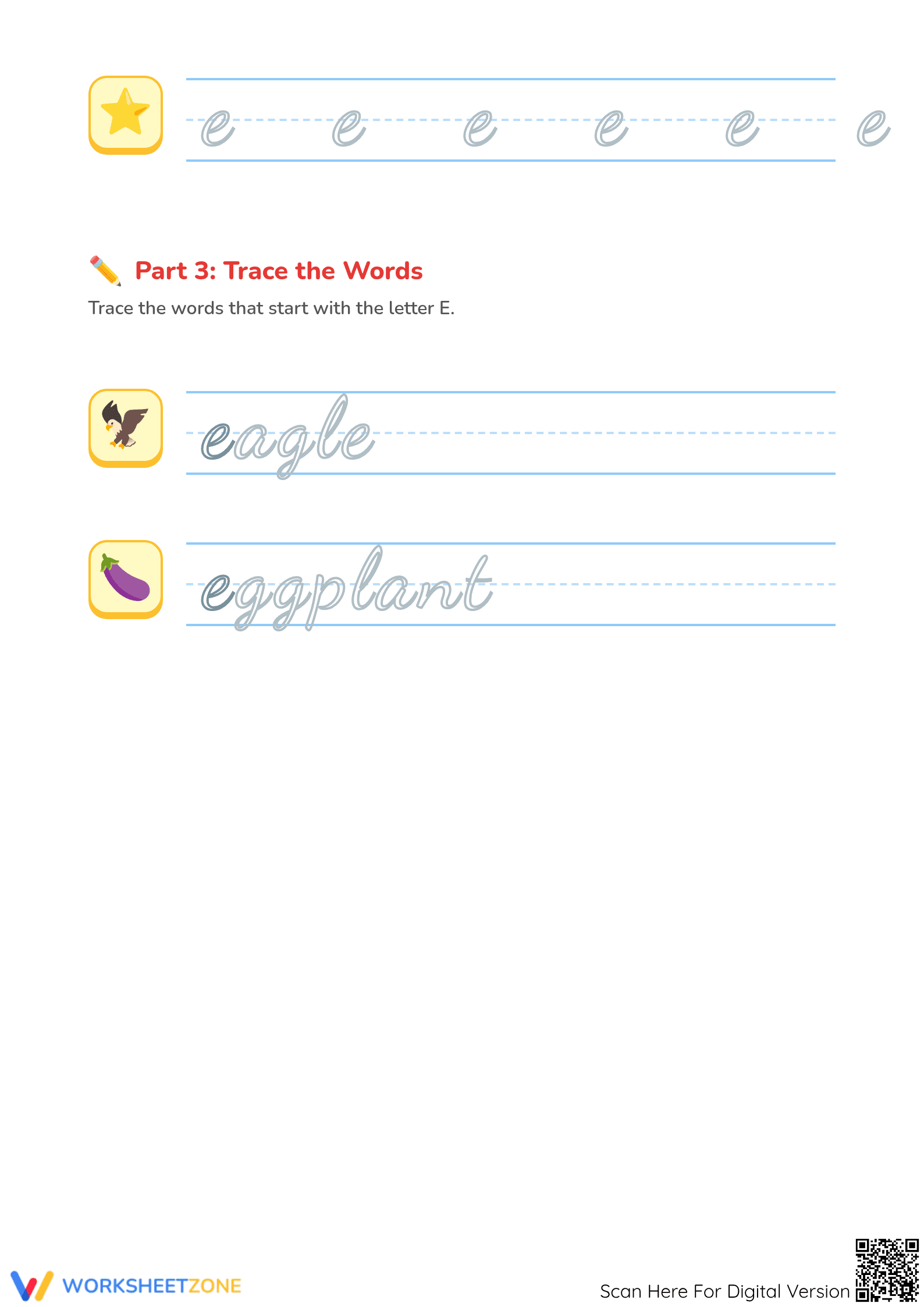
This comprehensive 2-page PDF contains three distinct sections designed for gradual skill acquisition. Page one features ten uppercase "E" tracing opportunities and five lowercase "e" prompts. Page two continues with six additional lowercase letters and two full-word tracing tasks: "eagle" and "eggplant." The layout uses clear dotted lines and directional cues to ensure proper stroke order for young writers.
Zero-Prep Workflow
- Print: Generate copies of the 2-page document for each student in under 1 minute.
- Distribute: Hand out sheets during morning work or a dedicated literacy block.
- Review: Quickly check for consistent slant and connection points during independent work time.
This worksheet is an ideal candidate for emergency sub plans due to its self-explanatory nature and clear visual instructions.
Standards Alignment
The primary standard addressed is `CCSS.ELA-LITERACY.L.2.1`, which requires students to demonstrate command of the conventions of standard English grammar and usage when writing. Specifically, it supports the transition from manuscript to cursive script. This standard code can be copied directly into lesson plans, IEP goals, or district curriculum mapping tools to ensure instructional compliance.
How to Use It
Assign this worksheet during the independent practice phase of a handwriting lesson after demonstrating the loops of the cursive "E" on the whiteboard. It also serves as an effective formative assessment tool; observe students as they trace to identify those struggling with pencil grip or letter orientation. Most students will complete both pages within a 20-minute window.
Who It's For
This resource is designed for second-grade students beginning their cursive journey, though it is suitable for advanced first graders or third graders needing remedial support. It pairs naturally with an anchor chart showing the cursive alphabet or a phonics lesson focused on the short and long "e" sounds in common nouns.
Handwriting instruction remains a vital component of early literacy, as the physical act of forming letters supports cognitive development and reading fluency. According to Fisher & Frey (2014), the gradual release of responsibility model—moving from guided tracing to independent word formation—is essential for mastering complex motor tasks like cursive writing. This worksheet applies these principles by providing 23 specific tracing points that scaffold the learner's experience from individual characters to complete words. By aligning with CCSS.ELA-LITERACY.L.2.1, the resource ensures that students are meeting national expectations for writing conventions. Research from the NAEP suggests that students who develop fluent handwriting can devote more cognitive resources to higher-level composition tasks. This printable tool offers a practical, research-backed method for developing the foundational script skills necessary for academic success in the upper elementary grades and beyond.


