


























Views
Downloads


Printable Letter E Sounds Worksheet | Kindergarten ELA
Paste this activity's link or code into your existing LMS (Google Classroom, Canvas, Teams, Schoology, Moodle, etc.).
Students can open and work on the activity right away, with no student login required.
You'll still be able to track student progress and results from your teacher account.
This phonics worksheet helps early learners master the letter E through targeted beginning sound recognition and handwriting practice. By connecting images to words, identifying specific letters among distractors, and tracing uppercase and lowercase forms, students build essential literacy skills required for reading readiness.
At a Glance
- Grade: Kindergarten · Subject: ELA
- Standard:
CCSS.ELA-LITERACY.RF.K.1.D— Recognize and name all upper- and lowercase letters.- Skill Focus: Letter E recognition and beginning sounds
- Format: 2 pages · 3 problems · PDF
- Best For: Independent practice or morning work
- Time: 10–15 minutes
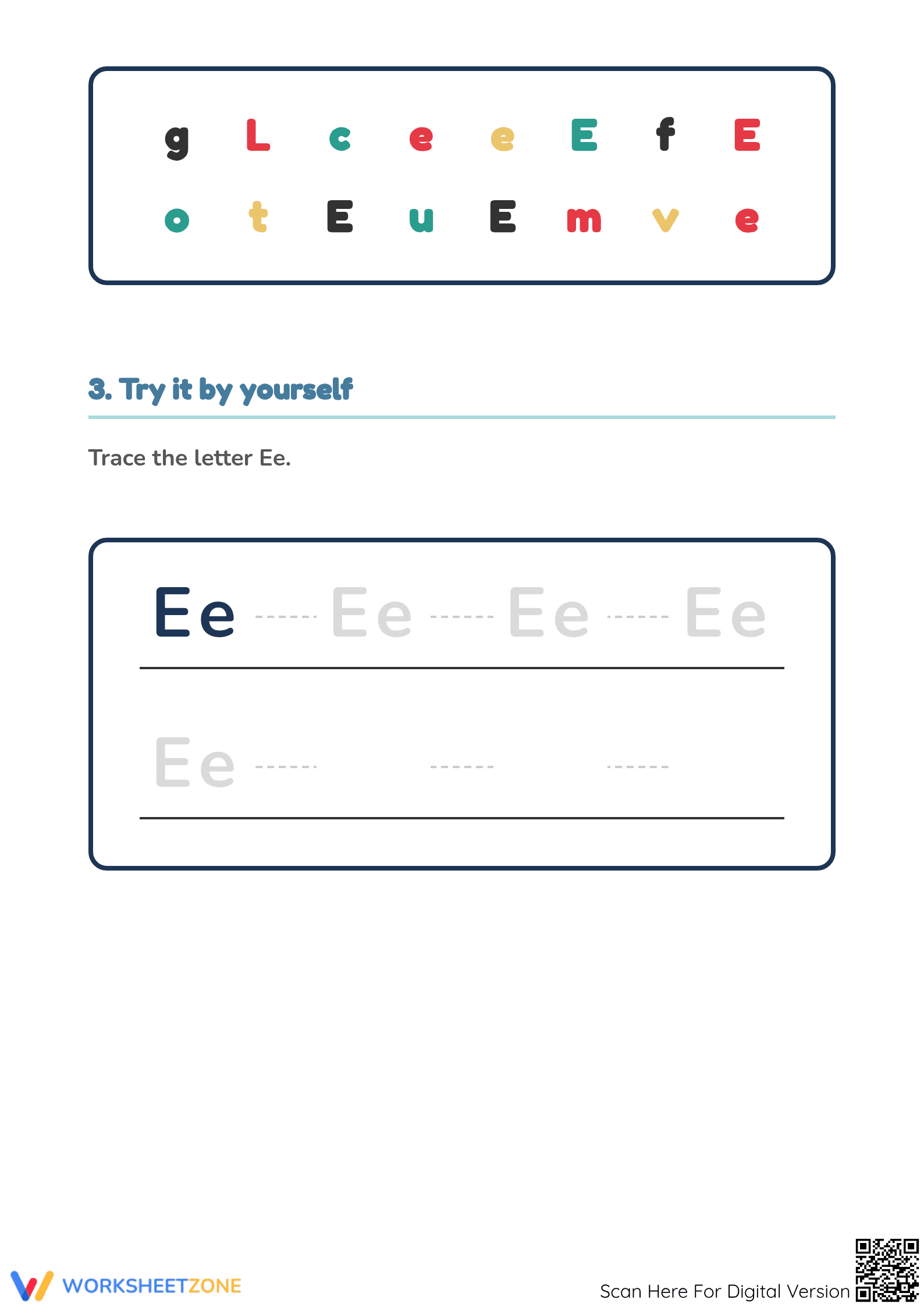
This two-page printable features three distinct task types to reinforce letter knowledge. The first section asks students to connect pictures (like an egg and ear) to their corresponding words, emphasizing beginning sounds. The second section challenges students to circle uppercase and lowercase E within a mixed visual field. Finally, the third section provides guided tracing lines for proper letter formation.
- Guided practice: Students match familiar visual vocabulary words to images, establishing the phonetic connection to the letter E.
- Supported practice: The visual discrimination task requires learners to scan and identify the target letter among distractors, reinforcing visual memory.
- Independent practice: The tracing section allows students to practice fine motor skills by writing the letter Ee with fading support.
This progression follows a gradual-release model, ensuring students build confidence moving from visual recognition to physical letter formation.
This resource is aligned to primary standard CCSS.ELA-LITERACY.RF.K.1.D, requiring students to recognize and name all upper- and lowercase letters of the alphabet. It also supports early handwriting development. Both standard codes can be copied directly into lesson plans, IEP goals, or district curriculum mapping tools.
This worksheet is effective as morning work or within a phonics center during literacy blocks. Teachers can introduce the letter E during whole-group instruction, using the picture-matching section to check for initial phonetic understanding. As a formative assessment tip, observe students during the visual discrimination task to ensure they identify both uppercase and lowercase forms accurately. Expected completion time is 10 to 15 minutes.
Designed for kindergarten students developing foundational alphabet knowledge, this resource is also appropriate for preschoolers needing an early challenge. For students requiring extra support, teachers can provide an alphabet anchor chart to reference during the visual discrimination and tracing tasks. This worksheet pairs perfectly with a read-aloud book featuring short and long E sounds.
Developing strong letter recognition and phonemic awareness is a critical stepping stone for early literacy success. This resource directly supports CCSS.ELA-LITERACY.RF.K.1.D by helping students recognize and name all upper- and lowercase letters. According to Fisher & Frey (2014), providing students with structured, multimodal opportunities to interact with letters—such as matching sounds to images, visually scanning for specific characters, and physically tracing them—significantly improves their retention and reading readiness. By combining visual discrimination tasks with fine motor handwriting practice, this worksheet ensures young learners build a robust understanding of the letter E, reducing cognitive load during later decoding tasks.


