


























Views
Downloads


Letter Y Sounds Printable Worksheet | Grade 1 Phonics
Paste this activity's link or code into your existing LMS (Google Classroom, Canvas, Teams, Schoology, Moodle, etc.).
Students can open and work on the activity right away, with no student login required.
You'll still be able to track student progress and results from your teacher account.
This foundational phonics worksheet helps early readers master the distinct sounds of the letter Y. By engaging with both beginning and ending sounds, students build essential decoding skills necessary for reading fluency. The structured activities provide clear, focused practice to ensure learners can confidently identify and apply these phonetic patterns in everyday vocabulary.
At a Glance
- Grade: Kindergarten · Subject: Phonics
- Standard:
CCSS.ELA-LITERACY.RF.K.3.A— Produce primary sounds for consonants- Skill Focus: Letter Y Beginning and Ending Sounds
- Format: 2 pages · 12 problems · Answer key included · PDF
- Best For: Independent practice and literacy centers
- Time: 15–20 minutes
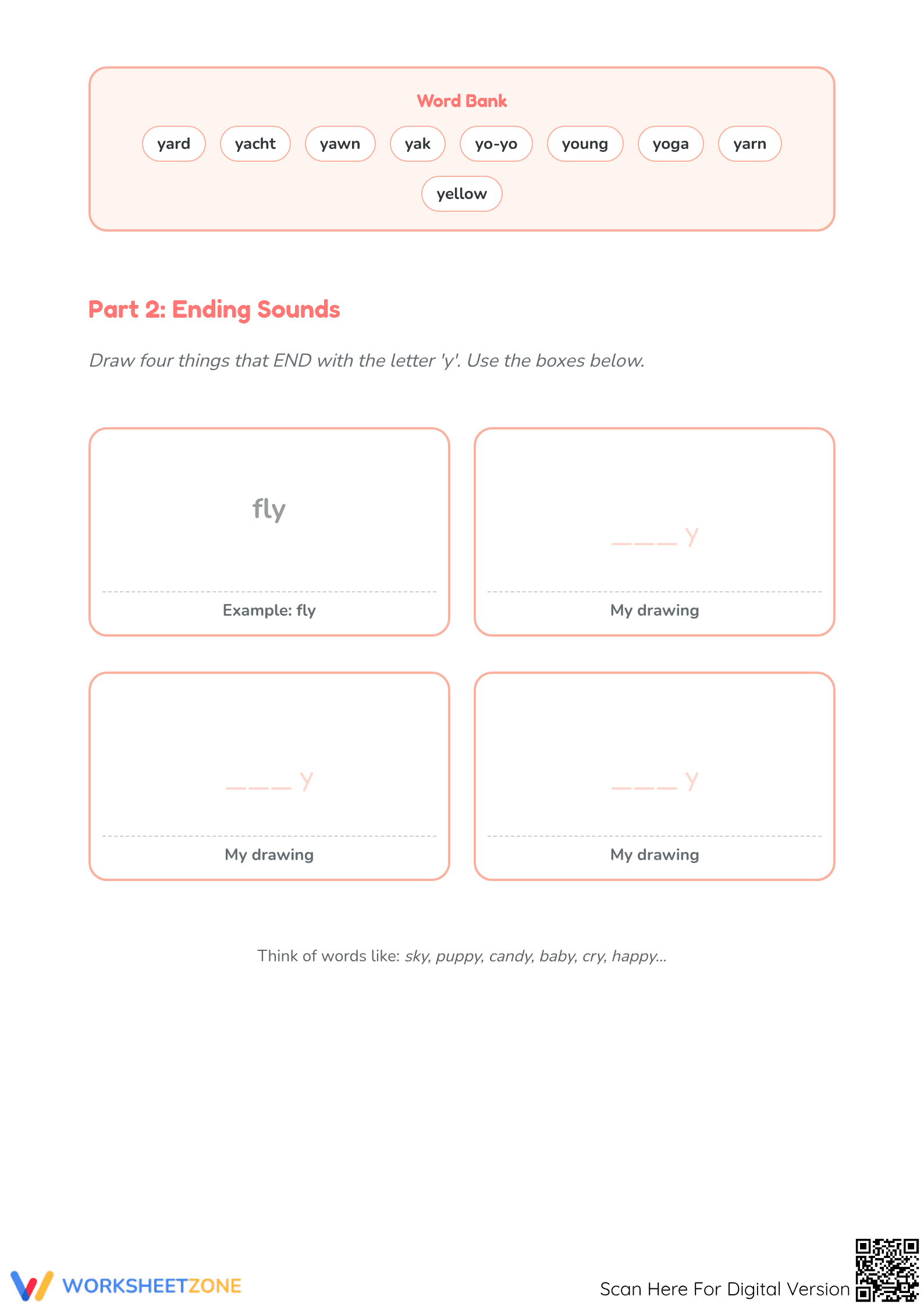
This two-page resource features a balanced mix of identification and creative application tasks. Part one includes nine picture-matching exercises where students use a provided word bank to label images starting with the letter Y, such as "yarn" and "yacht." Part two challenges students to draw three objects that end with the letter Y, using the provided example "fly" as a guide. A complete answer key is included to support quick grading and self-correction.
- Guided practice: The worksheet begins with visual picture prompts and a word bank, allowing students to match images to beginning-sound words with strong scaffolding.
- Supported practice: Students transition to ending sounds, utilizing a clear worked example ("fly") to understand the new phonetic expectation.
- Independent practice: Learners independently brainstorm and illustrate their own words ending in Y, demonstrating phonetic mastery.
This gradual-release approach ensures students progress from recognition to independent application.
This resource is directly aligned to CCSS.ELA-LITERACY.RF.K.3.A, requiring students to demonstrate basic knowledge of one-to-one letter-sound correspondences by producing the primary sound or many of the most frequent sounds for each consonant. It also supports early vocabulary development by connecting spoken words to written text. Both standard codes can be copied directly into lesson plans, IEP goals, or district curriculum mapping tools.
Deploy this worksheet during morning work or as a literacy center activity after direct instruction on the letter Y. For a formative assessment observation tip, watch how students utilize the word bank; students who sound out remaining letters demonstrate strong blending skills. The activity takes 15 to 20 minutes, making it ideal for phonics rotations.
This printable is designed for Kindergarten and first-grade students developing their foundational phonics skills. The visual supports make it highly accessible for English Language Learners and students requiring additional vocabulary scaffolding. It pairs perfectly with an anchor chart displaying common Y words or a read-aloud book heavily featuring the target letter.
Mastering consonant sounds is a critical stepping stone in early childhood literacy development. This resource specifically targets CCSS.ELA-LITERACY.RF.K.3.A, helping students produce primary sounds for consonants through targeted visual and written exercises. According to Fisher & Frey (2014), providing students with structured, gradual-release practice significantly improves their ability to transfer isolated phonics skills into authentic reading and writing tasks. By combining beginning sound identification with ending sound generation, this worksheet ensures learners process the letter Y in multiple phonetic contexts. The inclusion of a word bank and drawing prompts accommodates diverse learning styles while maintaining rigorous alignment to foundational reading standards. Consistent practice with these specific letter-sound correspondences builds the automaticity required for long-term reading comprehension and fluent decoding in later elementary grades.


