


























Views
Downloads


Beginning J Sound Worksheet | Grade 1 Printable Phonics
Paste this activity's link or code into your existing LMS (Google Classroom, Canvas, Teams, Schoology, Moodle, etc.).
Students can open and work on the activity right away, with no student login required.
You'll still be able to track student progress and results from your teacher account.
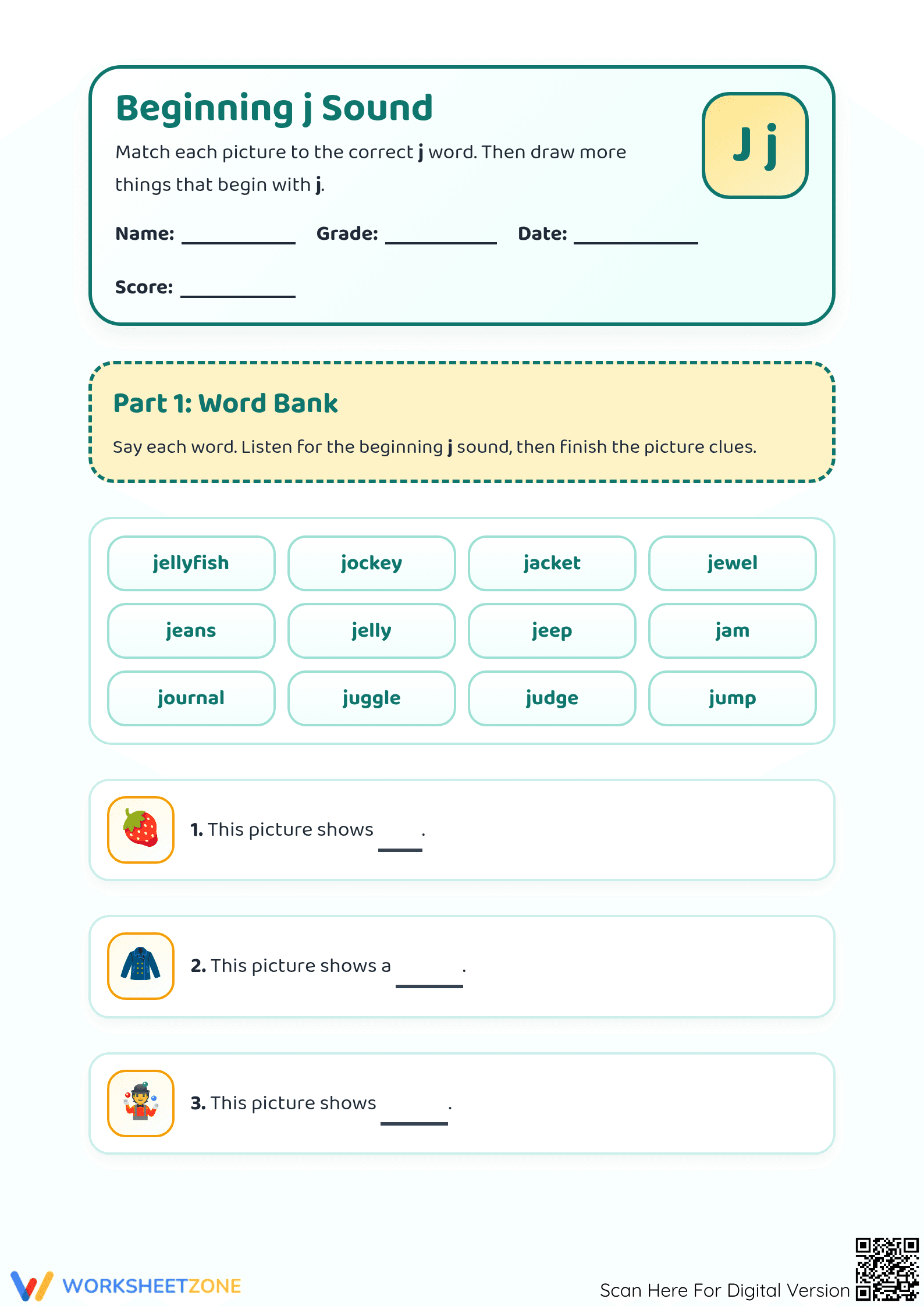
This Kindergarten and Grade 1 phonics worksheet provides comprehensive practice for the beginning "j" sound. Students identify, write, and draw objects starting with the letter J to solidify their phonemic awareness. By engaging with visual cues and word banks, learners build the foundational decoding skills necessary for early reading fluency and confident spelling.
At a Glance
- Grade: Kindergarten–2 · Subject: ELA Phonics
- Standard:
CCSS.ELA-LITERACY.RF.K.3.A— Produce the primary sound for each consonant letter-sound correspondence- Skill Focus: Beginning J Sound Identification
- Format: 3 pages · 20 problems · Answer key included · PDF
- Best For: Independent phonics practice and morning work
- Time: 15–25 minutes
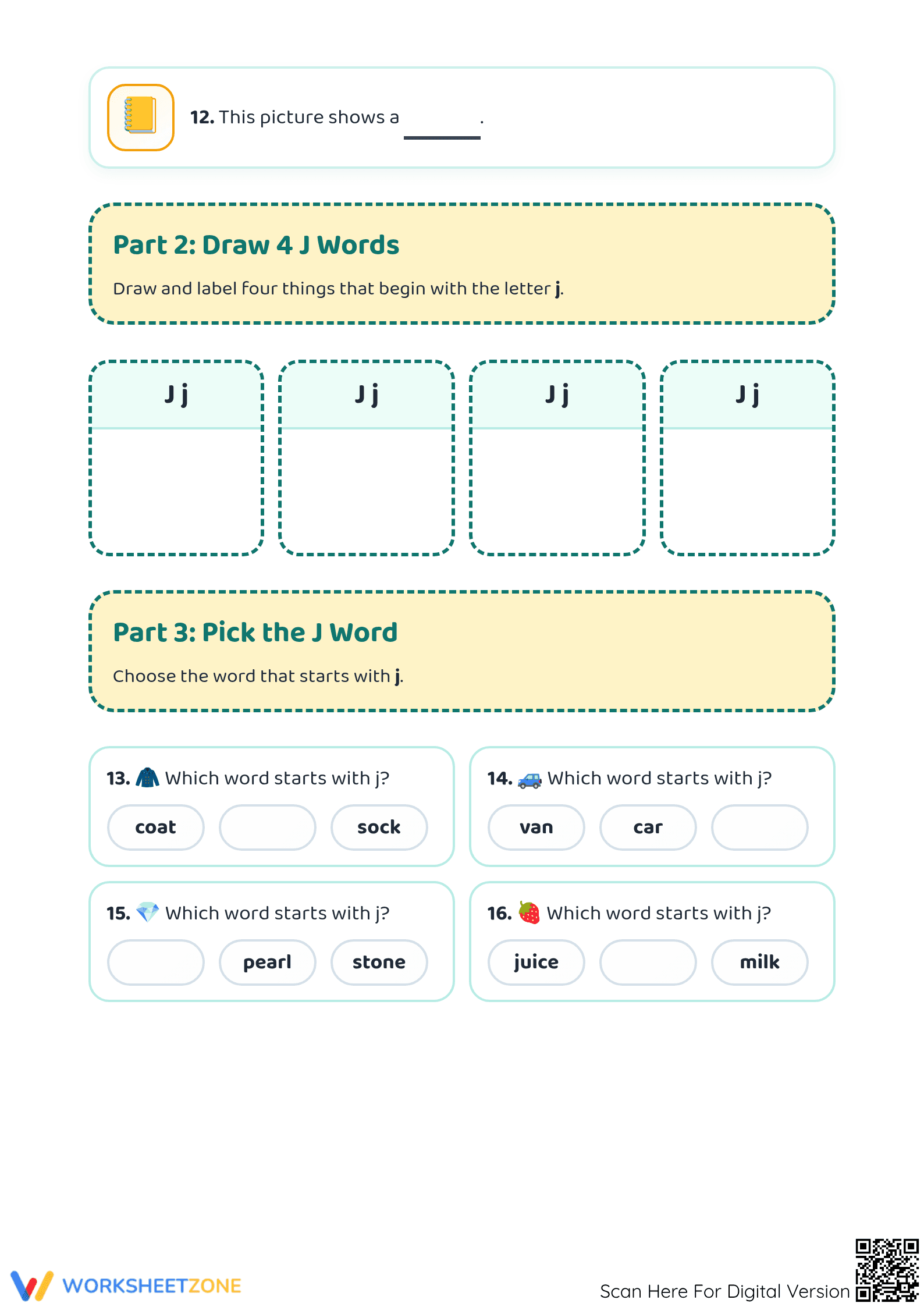
What's Inside: This three-page PDF resource features a structured approach to letter-sound mastery. Page one introduces a 12-word bank including terms like "jellyfish," "jockey," and "journal," paired with initial sentence completion tasks. Page two extends this with nine additional picture-based identification problems. The final page challenges students to draw four original "j" items and solve four multiple-choice sound discrimination questions.
Zero-Prep Workflow: This resource is designed for immediate classroom implementation with a total teacher prep time of under 2 minutes. First, print the three-page sequence for your class or select specific pages for targeted intervention. Second, distribute the sheets during your phonics block or as a reliable sub-plan activity. Finally, review student work using the included three-page answer key for rapid formative assessment and feedback.
Standards Alignment: The primary focus is `CCSS.ELA-LITERACY.RF.K.3.A`, which requires students to demonstrate basic knowledge of one-to-one letter-sound correspondences. It also supports `CCSS.ELA-LITERACY.L.K.2.C` by encouraging students to write letters for consonant sounds. Both standard codes can be copied directly into lesson plans, IEP goals, or district curriculum mapping tools.
How to Use It: Use this worksheet during the independent practice phase of a lesson after introducing the letter J. It serves as an excellent formative assessment tool; observe if students can independently map the "j" sound to the correct picture without relying on the word bank. Expect completion within 15 to 25 minutes depending on the student's writing speed and fine motor skills.
Who It's For: This resource is tailored for Kindergarten and first-grade students beginning their phonics journey. It is also suitable for second-grade students requiring RTI Tier 2 intervention for letter-sound gaps. Pair this worksheet with a letter J anchor chart or a shared reading passage featuring "j" alliteration to reinforce the auditory component of the lesson.
This phonics resource targets the specific phonemic awareness required by CCSS.ELA-LITERACY.RF.K.3.A, focusing on the beginning "j" sound through 20 distinct tasks. Research from Fisher & Frey (2014) emphasizes that the gradual release of responsibility—moving from word bank support to independent drawing and selection—is critical for early literacy acquisition. By requiring students to both recognize and produce the letter-sound correspondence, the worksheet aligns with evidence-based practices for orthographic mapping. The inclusion of visual scaffolds alongside text-based tasks ensures that emerging readers can access the content while building the cognitive pathways necessary for decoding. According to the RAND AIRS 2024 report, high-quality supplemental materials that provide repeated exposure to specific phonemes significantly improve student outcomes in foundational reading skills. This worksheet offers that necessary repetition in a structured, printable format suitable for diverse classroom environments and individual student needs.


