


























Views
Downloads



Printable Short E Phonics Worksheet | Grade 1 ELA
Paste this activity's link or code into your existing LMS (Google Classroom, Canvas, Teams, Schoology, Moodle, etc.).
Students can open and work on the activity right away, with no student login required.
You'll still be able to track student progress and results from your teacher account.
This comprehensive phonics worksheet helps early readers master the short 'e' vowel sound through engaging, multi-sensory activities. By combining word-to-picture matching, creative drawing, and sentence completion, students actively decode and apply CVC words in context, building essential foundational reading and spelling skills.
At a Glance
- Grade: 1 · Subject: Phonics
- Standard:
CCSS.ELA-LITERACY.RF.1.3.B— Decode regularly spelled one-syllable words- Skill Focus: Short 'E' Vowel Sounds
- Format: 3 pages · 17 problems · Answer key included · PDF
- Best For: Independent practice and literacy centers
- Time: 20–25 minutes
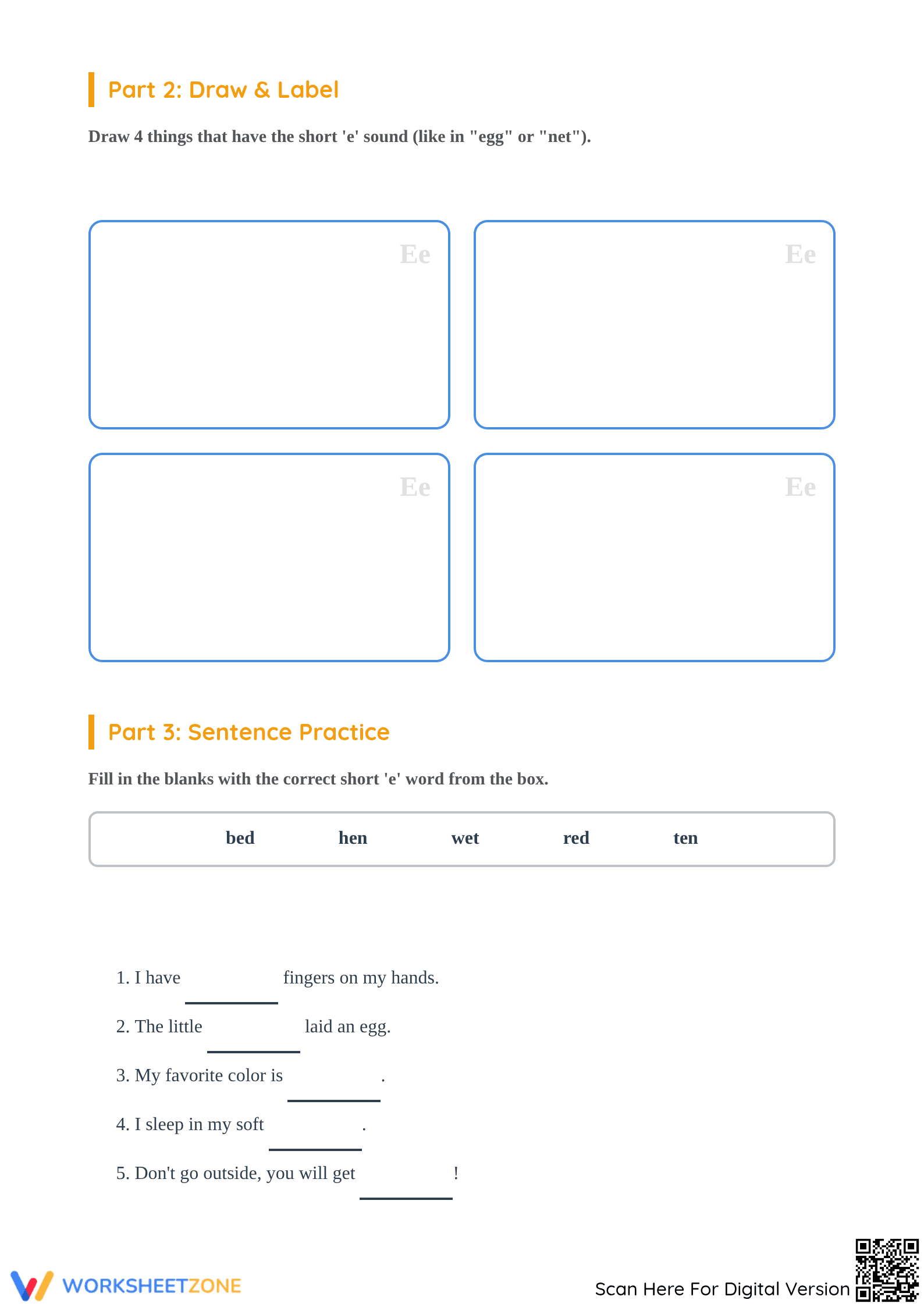
This three-page printable packet features a variety of task types to keep young learners engaged. The first section includes a word-and-picture matching activity where students can write the words or use the cut-and-paste word bank on page three. The second section encourages creativity with a draw-and-label exercise. Finally, a sentence practice section uses a word bank to help students complete five fill-in-the-blank sentences. A complete answer key is included.
- Guided practice: The word-and-picture matching activity provides strong visual scaffolds, allowing students to connect familiar images to their corresponding CVC words.
- Supported practice: The sentence completion task uses a targeted word bank, helping learners apply their decoding skills to read simple sentences and choose the correct vocabulary word.
- Independent practice: The draw-and-label section removes the scaffolds, challenging students to independently generate, illustrate, and spell four different short 'e' words from memory.
This gradual-release approach ensures students build confidence as they move from highly supported tasks to independent application.
This resource is directly aligned to CCSS.ELA-LITERACY.RF.1.3.B, which requires students to decode regularly spelled one-syllable words. It also supports early writing and vocabulary development by having students write the words they decode. Both standard codes can be copied directly into lesson plans, IEP goals, or district curriculum mapping tools.
This versatile packet is perfect for literacy centers or morning work. Teachers can introduce the short 'e' sound during whole-group instruction, then assign the matching activities for independent reinforcement. As a formative assessment tip, observe students during the sentence practice to see if they are fully decoding the medial vowel. The entire packet typically takes 20 to 25 minutes to complete.
This worksheet is designed for first-grade students, but it also serves as an excellent review for second graders or an extension activity for advanced kindergarteners. For students needing extra support, teachers can pre-cut the word tiles or read the fill-in-the-blank sentences aloud. It pairs perfectly with a short vowel anchor chart or a decodable reading passage focusing on the 'e' sound.
Mastering medial vowel sounds is a critical milestone in early literacy development. This targeted resource aligns directly with CCSS.ELA-LITERACY.RF.1.3.B, focusing on the essential skill where students decode regularly spelled one-syllable words containing the short 'e' sound. According to Fisher & Frey (2014), providing young learners with multiple modalities for practice—such as visual matching, physical cut-and-paste activities, and contextual sentence writing—significantly improves their ability to retain new phonics patterns and apply them to novel texts. By moving systematically from isolated word decoding to sentence-level comprehension, this worksheet ensures that phonics instruction remains meaningful and deeply contextualized. The inclusion of a tactile element further supports cognitive retention for early readers, making the decoding process both interactive and highly effective for building long-term reading fluency and spelling accuracy.


