


























Views
Downloads


Printable Beginning Sounds Worksheet | Grade K-2 Phonics
Paste this activity's link or code into your existing LMS (Google Classroom, Canvas, Teams, Schoology, Moodle, etc.).
Students can open and work on the activity right away, with no student login required.
You'll still be able to track student progress and results from your teacher account.
This Grade K-2 beginning sounds worksheet provides students with 21 interactive tasks to master initial consonant identification. By engaging in tactile cut-and-paste activities and visual circling exercises, learners solidify their phonemic awareness and letter-sound correspondence. It is a comprehensive resource for early literacy development and foundational reading skills.
At a Glance
- Grade: K-2 · Subject: ELA Phonics
- Standard:
CCSS.ELA-LITERACY.RF.K.3.A— Produce the primary sound for each consonant- Skill Focus: Initial Consonant Sounds (L, M, N, O, P, Q)
- Format: 4 pages · 21 problems · Answer key included · PDF
- Best For: Morning work or literacy centers
- Time: 15–25 minutes
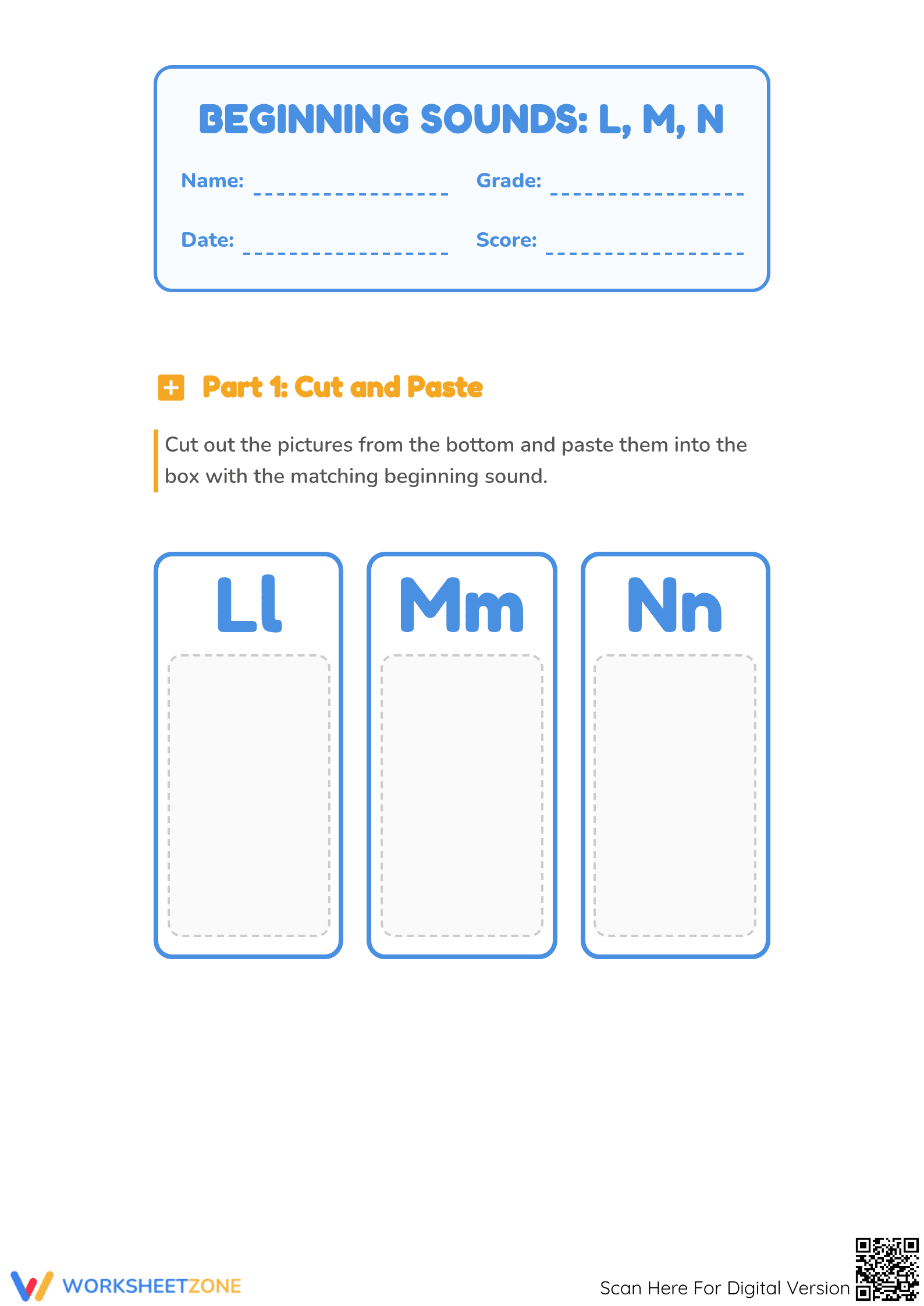
The packet contains four distinct pages of phonics practice. It features a dedicated cutting area with 12 labeled illustrations, a sorting board for letters L, M, and N, and multiple-choice circling tasks for letters O, P, and Q. A final review section ensures retention by asking students to match letters back to their corresponding images. A full 4-page answer key is included for quick grading.
This resource is designed for a 2-minute teacher setup. Simply print the four pages and provide scissors and glue. Students can work independently through the three parts: sorting, identifying, and reviewing. The clear visual cues and labeled images make it an ideal choice for emergency sub plans or quiet seatwork during small-group rotations. No additional teacher preparation is required to implement this in the classroom.
The primary focus is CCSS.ELA-LITERACY.RF.K.3.A, which requires students to demonstrate basic knowledge of one-to-one letter-sound correspondences. It also supports RF.1.2.C by helping students isolate and produce initial sounds in spoken single-syllable words. Both standard codes can be copied directly into lesson plans, IEP goals, or district curriculum mapping tools for easy documentation.
Use this worksheet during the independent practice phase of a phonics lesson after introducing the target consonants. It serves as an excellent formative assessment; observe students during the cut-and-paste phase to identify those struggling with specific phonemes. Completion typically takes 20 minutes, making it perfect for literacy blocks or as a homework assignment to reinforce classroom instruction.
This resource is tailored for Kindergarten and 1st-grade students developing foundational reading skills. It also provides valuable intervention for 2nd graders needing phonemic reinforcement. Pair this with an alphabet anchor chart or a beginning sounds picture sort for a complete instructional experience. The clear layout supports English Language Learners in building basic vocabulary alongside phonics skills.
Research from Fisher & Frey (2014) emphasizes the importance of the gradual release of responsibility, which this worksheet mirrors through its three-part structure of guided sorting and independent identification. By focusing on CCSS.ELA-LITERACY.RF.K.3.A, the material targets the critical alphabetic principle necessary for decoding fluency. Studies in the RAND AIRS 2024 report indicate that tactile engagement, such as the cut-and-paste tasks featured here, can significantly improve retention of letter-sound relationships in early childhood settings. With 21 specific tasks across 4 pages, this resource provides the high-repetition practice required for mastery. The inclusion of a comprehensive answer key ensures that educators can provide immediate feedback, a factor known to accelerate the learning curve for beginning readers. This worksheet is a reliable tool for building the phonological foundations required for long-term literacy success and reading confidence.


