


























Views
Downloads
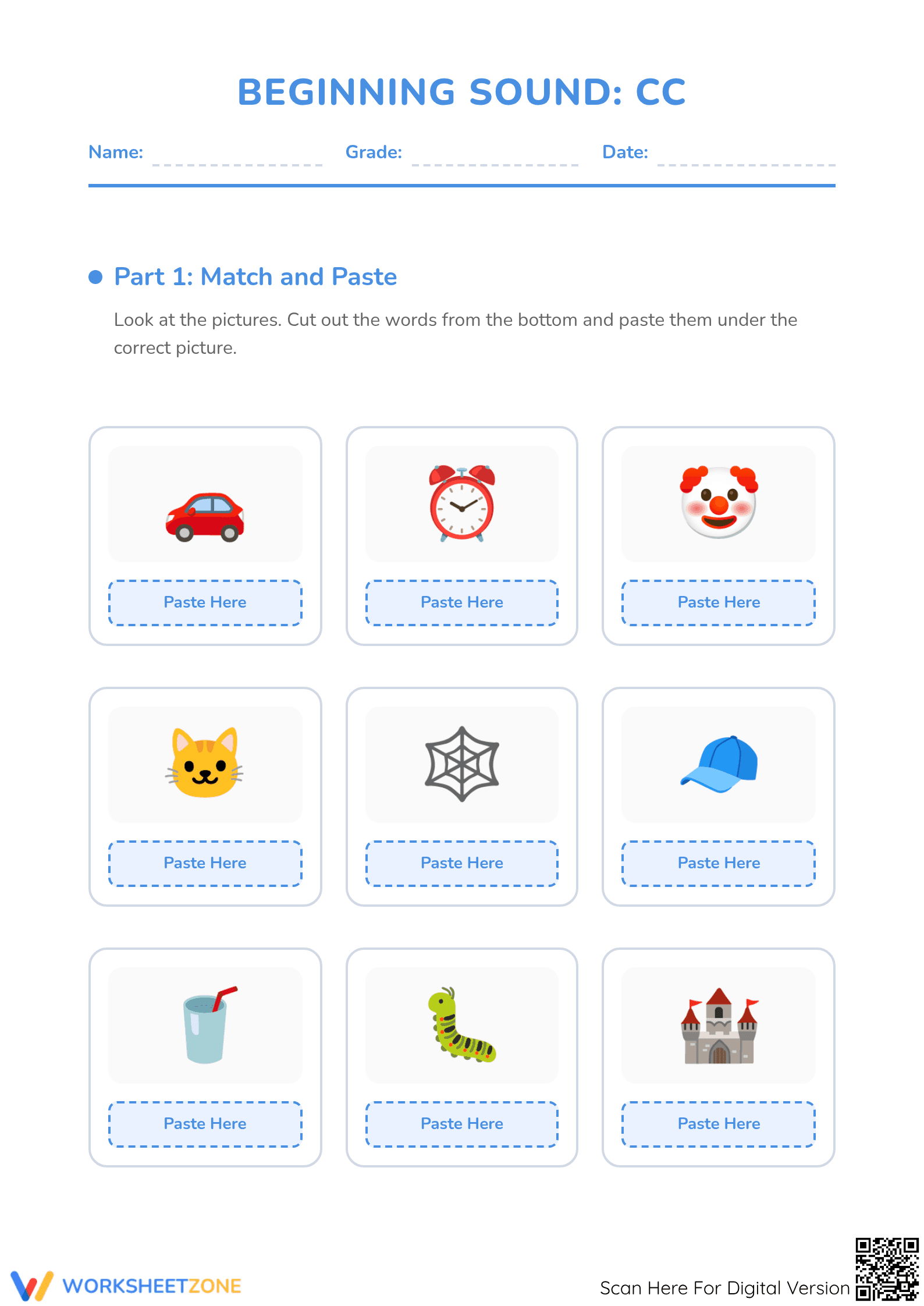


Beginning Sound C Worksheet | Grade K-2 Essential
Paste this activity's link or code into your existing LMS (Google Classroom, Canvas, Teams, Schoology, Moodle, etc.).
Students can open and work on the activity right away, with no student login required.
You'll still be able to track student progress and results from your teacher account.
This Beginning Sound C worksheet provides early learners with a structured way to identify and produce the hard /k/ sound. By engaging in tactile cut-and-paste activities, students reinforce the connection between the grapheme 'C' and its corresponding phoneme.
At a Glance
- Grade: Kindergarten–2 · Subject: ELA Phonics
- Standard:
CCSS.ELA-LITERACY.RF.K.3.A— Demonstrate basic knowledge of one-to-one letter-sound correspondences for consonants- Skill Focus: Beginning Sound /k/ (Letter C)
- Format: 3 pages · 16 problems · Answer key included · PDF
- Best For: Independent phonics practice and fine motor skills
- Time: 15–20 minutes
This 3-page PDF includes a comprehensive set of activities designed for early literacy success. The first two pages feature 12 distinct image-based matching tasks where students pair words like "caterpillar," "castle," and "clock" with their visual representations. The third page contains the word cut-outs, organized for easy scissor work. Additionally, a creative drawing section prompts students to generate four original examples of 'C' words, promoting higher-order thinking.
Zero-Prep Workflow
Teachers can implement this resource in under 2 minutes. First, print the three pages for each student or pair. Second, distribute the sheets along with scissors and glue sticks; the clear "Paste Here" indicators allow students to work with minimal guidance. Finally, review the completed work as a whole group or during small-group rotations to check for phonemic accuracy. This layout is ideal for emergency sub plans or quiet morning work.
Standards Alignment
The primary focus is `CCSS.ELA-LITERACY.RF.K.3.A`, which requires students to demonstrate basic knowledge of one-to-one letter-sound correspondences by producing the primary sound for each consonant. It also supports `CCSS.ELA-LITERACY.L.K.2.C` by encouraging students to write letters that represent phonemes. Both standard codes can be copied directly into lesson plans, IEP goals, or district curriculum mapping tools.
How to Use It
Use this worksheet during the independent practice phase of a lesson on the letter C. It serves as an excellent formative assessment tool; observe students as they match the words to ensure they are not just guessing based on picture context but are recognizing the initial letter. Expected completion time is 15 to 20 minutes depending on fine motor proficiency.
Who It's For
This resource is tailored for Kindergarten and 1st-grade students developing foundational reading skills. It is also highly effective for English Language Learners (ELLs) who benefit from the explicit pairing of vocabulary words with clear illustrations. Pair this with a "Letter C" anchor chart or a shared reading passage to provide a cohesive instructional experience.
Research by Fisher & Frey (2014) emphasizes the importance of multi-modal learning in early literacy, noting that combining visual, tactile, and linguistic tasks accelerates phonemic awareness. This worksheet applies these principles by requiring students to see the image, read the word, and physically manipulate the paper to demonstrate understanding. By focusing specifically on the hard /k/ sound of the letter C, the resource reduces cognitive load, allowing students to achieve mastery before moving to more complex blends or soft vowel sounds. According to the RAND AIRS 2024 report, consistent practice with initial consonant sounds is a primary predictor of later reading fluency and decoding speed. This worksheet provides the high-repetition, low-stakes environment necessary for students to build the confidence required for independent reading. The inclusion of a creative drawing component further solidifies the phoneme-grapheme connection by moving from recognition to production, a critical step in the literacy development hierarchy.


