































Complete Acids and Bases Worksheet | Grades 9-12 Science

Paste this activity's link or code into your existing LMS (Google Classroom, Canvas, Teams, Schoology, Moodle, etc.).
Students can open and work on the activity right away, with no student login required.
You'll still be able to track student progress and results from your teacher account.
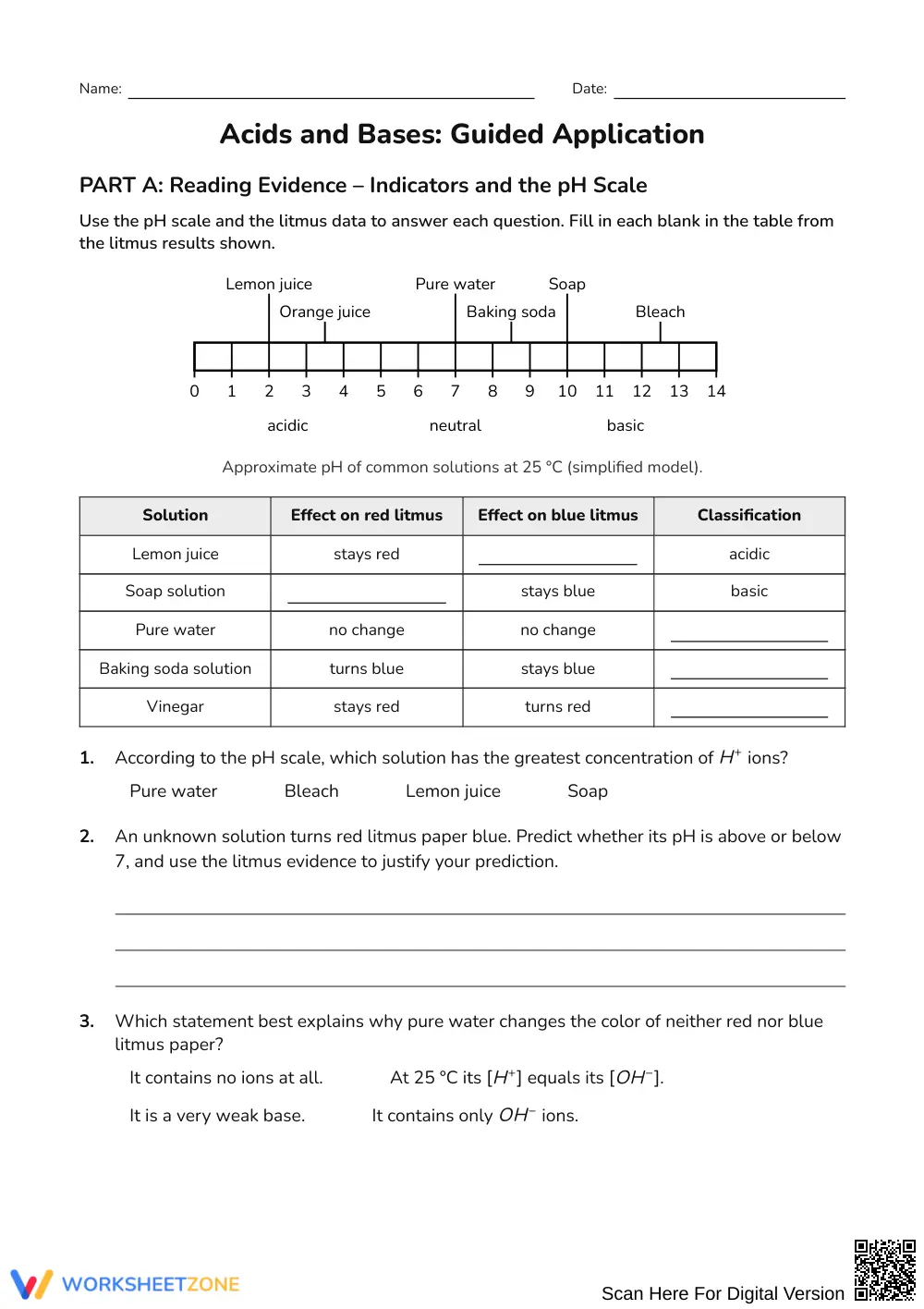
This chemistry worksheet guides high school students through foundational acids and bases concepts across 28 structured problems. Learners examine litmus indicator data, apply Brønsted-Lowry proton transfer models, calculate pH and pOH values, interpret titration curves, and calculate reaction enthalpy using calorimetry data to achieve conceptual and quantitative mastery.
At a Glance
- Grade: Grades 9–12 · Subject: Science
- Standard: High School Chemistry — Model acid-base proton transfer, calculate solution pH, and evaluate neutralization energy
- Skill Focus: Acids and Bases
- Format: 4 pages · 28 structured problems · Full answer key included · Printable PDF
- Best For: Classroom instruction, review, and lab prep
- Time: 45–60 minutes
What's Inside
This 4-page resource organizes 28 chemistry problems across five focused sections. Students analyze authentic data displays, including a litmus indicator table, Brønsted-Lowry ionization equations, a logarithmic formula reference box, a 40 mL titration curve, and a calorimetry data table. The accompanying 4-page answer key provides complete calculations, chemical equations, and sample written justifications for every task.
Skill Progression
- Guided practice: Parts A and B provide 11 tasks using reference tables and definitions to classify solutions, predict indicator colors, and compare strong versus weak acids at the particulate level.
- Supported practice: Part C offers 6 quantitative problems scaffolded with formula reference boxes, prompting students to calculate ion concentrations and logarithmic pH values with full work shown.
- Independent practice: Parts D and E present 11 advanced analytical problems requiring students to interpret titration curves, calculate neutralization moles, and determine reaction enthalpy from calorimeter data.
This sequence supports the gradual-release model, moving learners systematically from structured identification toward independent quantitative synthesis.
Standards Alignment
This worksheet aligns with high school chemistry expectations for chemical reactions, solution equilibrium, and thermochemistry. Students analyze proton transfer mechanisms, evaluate ionization, and calculate molar energy changes. These foundational chemistry expectations can be copied directly into lesson plans, IEP goals, or district curriculum mapping tools.
How to Use It
Assign Parts A through C during direct instruction as guided partner practice to solidify pH calculations and particle models before laboratory work. Alternatively, deploy Parts D and E after completing an acid-base titration lab as a summative assessment of data interpretation and calorimetry skills. During seatwork, formatively assess understanding by checking Part C to verify that students correctly evaluate negative logarithms rather than misidentifying hydronium concentrations. Expect completion within 45 to 60 minutes.
Who It's For
This activity is designed for high school chemistry and physical science students developing fluency in solution chemistry. It includes structured formula boxes for learners needing support, while offering rigorous titration and enthalpy problems for advanced students. Pair this worksheet with an indicator laboratory investigation to bridge hands-on observation with quantitative analysis.
Mastering acids and bases requires high school chemistry students to connect macroscopic observations, microscopic particle behaviors, and symbolic mathematical relationships. Research by Fisher & Frey (2014) demonstrates that structured gradual-release frameworks significantly accelerate science comprehension by systematically transferring cognitive responsibility from teacher-guided models to independent application. This 4-page instructional resource embodies that evidence-based pedagogy by guiding learners through 28 scaffolded tasks. Students analyze litmus indicator tables, model Brønsted-Lowry proton transfers, execute logarithmic pH and pOH calculations, interpret titration curves, and apply thermochemical principles to neutralization reactions. Integrating embedded formula references and real laboratory data sets enables learners to construct durable conceptual mental models while honing quantitative problem-solving skills. By pairing structured particulate reasoning with rigorous mathematical calculations, the worksheet provides high school educators with an effective, classroom-verified tool that ensures measurable mastery of acid-base chemistry across diverse learner profiles.


