































Essential Acids and Bases Worksheet | Grades 9–12 Science

Paste this activity's link or code into your existing LMS (Google Classroom, Canvas, Teams, Schoology, Moodle, etc.).
Students can open and work on the activity right away, with no student login required.
You'll still be able to track student progress and results from your teacher account.
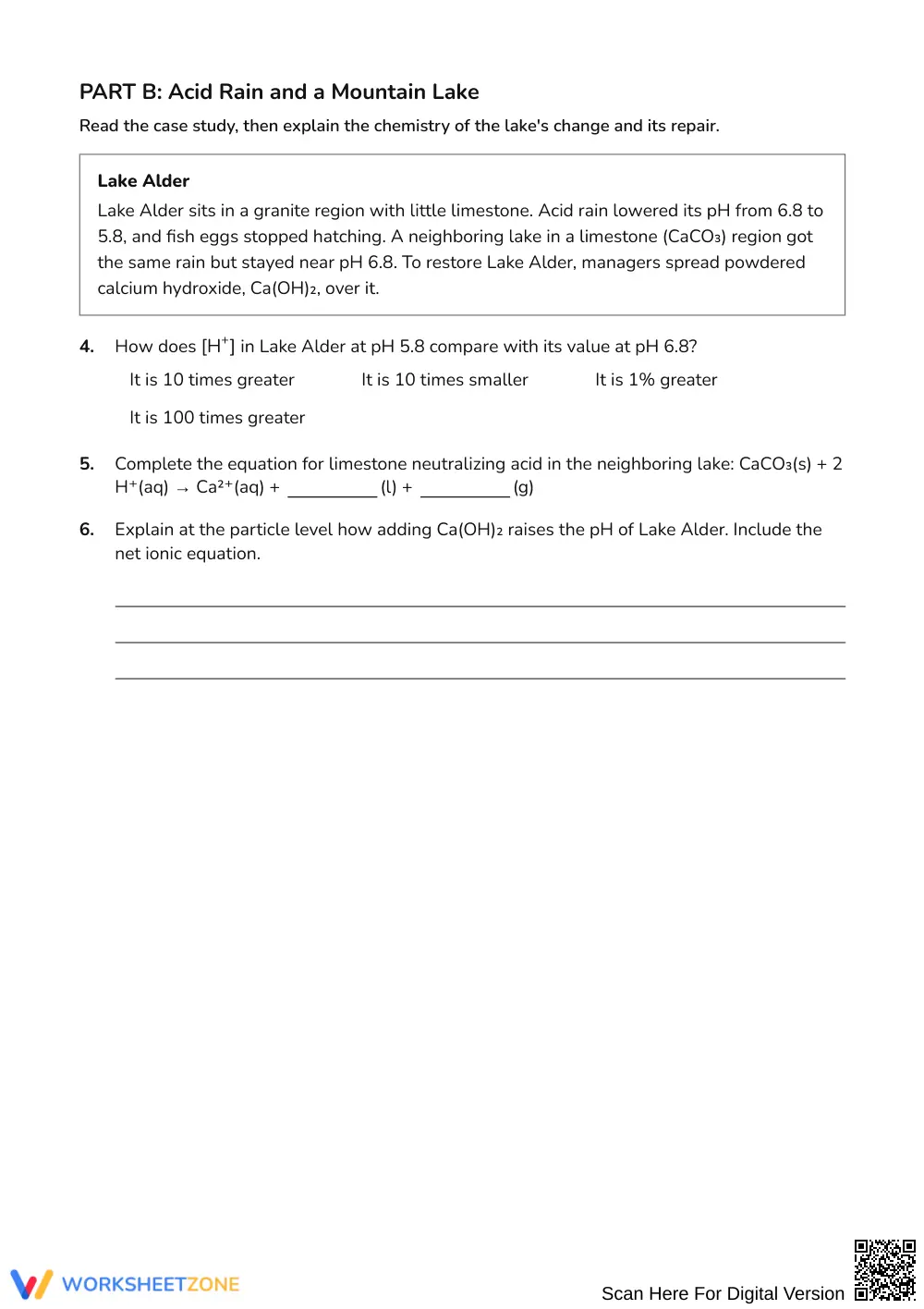
This chemistry worksheet guides high school students through real-world applications of acids and bases across 22 problems. Students analyze pH indicators, calculate hydronium concentrations, interpret lake neutralization, evaluate titration curves, and determine reaction enthalpy using calorimeter data. The activity solidifies chemical modeling and quantitative skills.
At a Glance
- Grade: Grades 9–12 · Subject: Science
- Standard: High School Chemistry — Calculate pH, model neutralization reactions, and analyze thermochemical shifts
- Skill Focus: Real-world acid-base chemistry
- Format: 4 pages · 22 problems · Answer key included · PDF
- Best For: Unit review and lab analysis
- Time: 45–60 minutes
What's Inside
The four-page student packet features four distinct parts spanning 22 structured tasks. Part A covers litmus testing and logarithmic pH values. Part B examines environmental lake remediation. Part C guides students through a weak-acid titration curve, and Part D presents quantitative calorimetry. A complete four-page answer key provides worked equations and particle explanations.
Skill Progression
- Guided Practice (Part A): Students interpret a reference pH scale, predict indicator color changes, calculate hydrogen ion concentration, and evaluate pure water autoionization.
- Supported Practice (Parts B & C): Learners analyze acid rain neutralization in lakes, balance net ionic equations, and read a titration graph to calculate acid concentration.
- Independent Practice (Part D): Working with calorimeter data, students calculate thermal energy transfer, determine molar neutralization enthalpy, and evaluate industrial neutralization safety.
This gradual-release progression moves students from basic definitions to advanced thermodynamics.
Standards Alignment
This worksheet addresses high school physical science expectations focusing on chemical reactions, reaction stoichiometry, and energy conservation. Students construct explanations, balance ionic equations, and analyze system energy transfer. These standards can be copied directly into lesson plans, IEP goals, or district curriculum mapping tools.
How to Use It
Administer this resource after introducing pH calculations and acid-base theories as post-lab review or unit consolidation. For formative assessment, check student explanations on Part C regarding why weak-acid titrations produce an equivalence point above pH 7. Students typically complete the 22 tasks within 45 to 60 minutes.
Who It's For
This resource supports on-grade high school chemistry, AP Chemistry prep, and general physical science classes. Structured questions scaffold core calculations, while thermodynamic tasks challenge advanced learners. Pair this worksheet with a neutralization calorimetry lab to reinforce theoretical concepts with hands-on laboratory evidence.
Developing quantitative literacy alongside microscopic particle modeling is essential for rigorous secondary science mastery. Findings highlighted in the RAND AIRS 2024 report demonstrate that high school science tasks requiring students to synthesize experimental data, algorithmic calculations, and atomic-scale representations yield significantly higher conceptual retention than isolated algorithmic drill. This 22-task worksheet reinforces real-world acid-base chemistry by challenging learners to translate between visible chemical phenomena and submicroscopic particle behavior. Across four comprehensive sections, students calculate hydronium concentrations, predict indicator reactions, model environmental neutralization, analyze titration curves, and compute reaction enthalpy from raw calorimeter measurements. Grounding chemical equilibria and thermodynamics in authentic environmental remediation and industrial wastewater management cultivates durable scientific literacy. Consequently, this instructional resource provides educators with structured, verifiable evidence of student proficiency across physical science modeling and quantitative chemical analysis.


