


























Views
Downloads
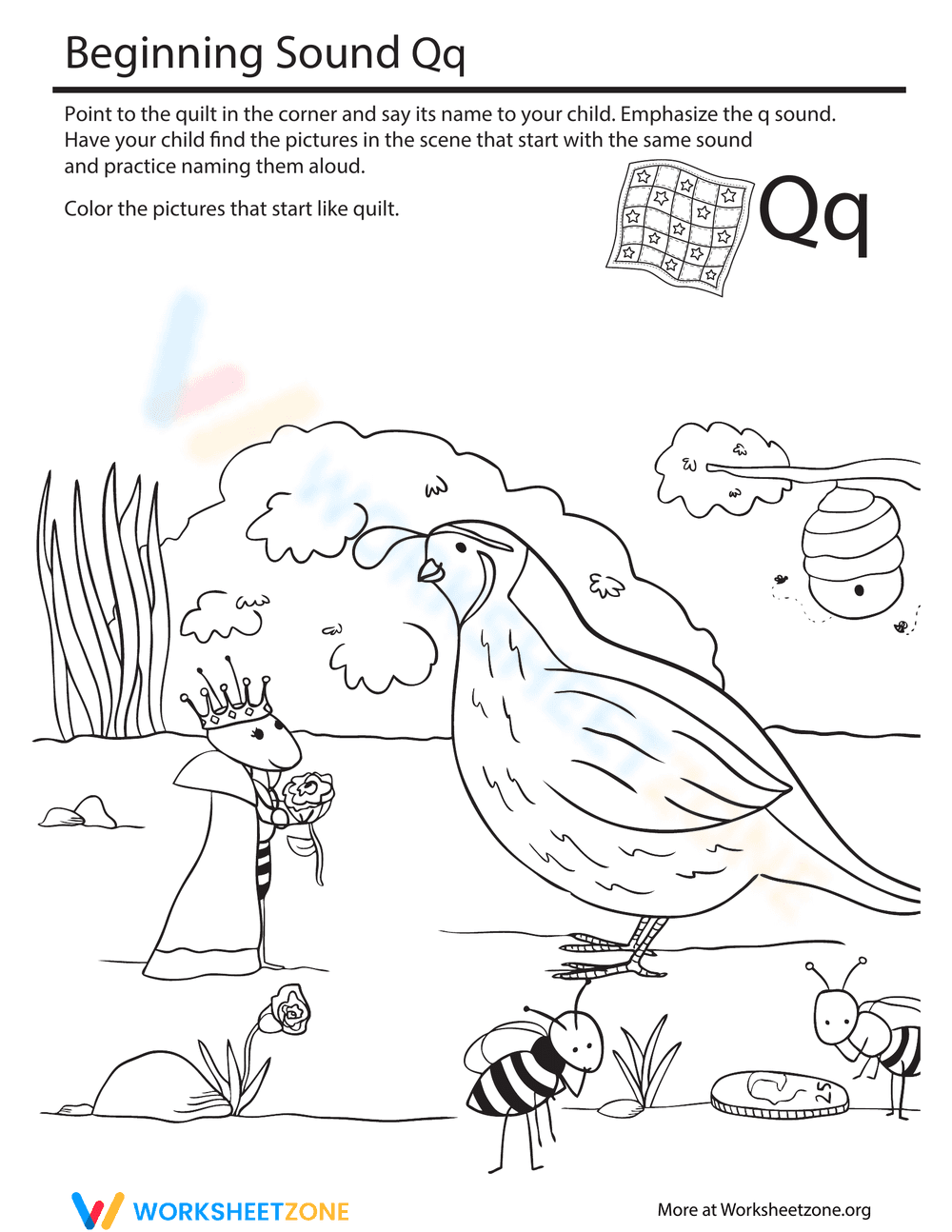

Beginning Sounds Coloring: Quilt | Printable
Paste this activity's link or code into your existing LMS (Google Classroom, Canvas, Teams, Schoology, Moodle, etc.).
Students can open and work on the activity right away, with no student login required.
You'll still be able to track student progress and results from your teacher account.
This preschool beginning sounds worksheet builds phonemic awareness by asking students to identify and color pictures that share the same starting sound as "quilt." Children practice isolating the initial /kw/ sound, strengthening the letter-sound connections that underpin early reading success.
At a Glance
- Grade: Preschool · Subject: ELA / Phonics
- Standard:
RF.K.3.A— Demonstrate knowledge of one-to-one letter-sound correspondences for consonants- Skill Focus: Identifying beginning sounds — initial /kw/ as in "quilt"
- Format: 1 page · 1 coloring task · No answer key · PDF
- Best For: Phonics warm-up or independent center work
- Time: 10–15 minutes
Inside this single-page PDF, students see a set of illustrated pictures and must color only those whose names begin with the same sound as "quilt." The clean, picture-only format removes reading barriers, making it fully accessible to pre-readers. No word bank or sentence frames are needed — the coloring action itself is the response.
Skill Progression
- Guided practice: Teacher names each picture aloud; students repeat and listen for the /kw/ onset before touching crayons. Whole-group modeling takes roughly 3 minutes.
- Supported practice: Partners take turns saying picture names and deciding together whether the sound matches "quilt" before coloring — peer scaffolding replaces written prompts.
- Independent practice: Students complete the page solo, coloring all /kw/ pictures without prompting. This mirrors the gradual-release (I Do, We Do, You Do) sequence and gives teachers a quick formative snapshot of each child's phoneme isolation skill.
Standards Alignment
Primary standard: RF.K.3.A — "Demonstrate basic knowledge of one-to-one letter-sound correspondences by producing the primary sound or many of the most frequent sounds for each consonant." Supporting standard RF.K.2.C (isolate and pronounce initial sounds in spoken single-syllable words) is naturally addressed when students say each picture name aloud before coloring. Both standard codes can be copied directly into lesson plans, IEP goals, or district curriculum mapping tools.
How to Use It
Use before direct instruction as a pre-assessment: observe which students self-correct and which conflate /kw/ with /k/ alone — that distinction reveals phoneme-level readiness. Use after a letter-Qq introduction lesson as guided release; expect most students to finish in 10–15 minutes. As a formative tip: circulate and ask one student per table to say a colored picture's name aloud — oral confirmation catches guessers who colored by picture theme rather than sound.
Who It's For
Designed for preschool and early kindergarten learners building initial phoneme awareness. Works equally well for kindergartners needing review of the /kw/ digraph sound. Pairs naturally with an anchor chart showing the letter Qq alongside /kw/ picture examples, or with a read-aloud featuring "qu" words (e.g., The Quiltmaker's Gift) to prime auditory recognition before students pick up crayons.
Beginning sound identification is a foundational phonics skill directly tied to early decoding outcomes. Standard RF.K.3.A requires students to produce primary consonant sounds, and activities that pair auditory discrimination with a motor response — such as coloring matching pictures — reinforce the sound-symbol link through dual encoding. Fisher & Frey (2014) document that gradual-release structures, even in brief single-page tasks, increase skill retention when students move from modeled to independent response within one session. NAEP data consistently show that students who enter kindergarten with strong phoneme isolation skills outperform peers in decoding fluency by Grade 2. This one-page, print-ready worksheet targets the initial /kw/ sound through picture-sort coloring, giving teachers a low-prep, high-signal formative tool aligned to RF.K.3.A for preschool and early kindergarten phonics instruction.


