


























Views
Downloads

Letter Q Beginning Sound Printable | Grade K-2 Phonics
Paste this activity's link or code into your existing LMS (Google Classroom, Canvas, Teams, Schoology, Moodle, etc.).
Students can open and work on the activity right away, with no student login required.
You'll still be able to track student progress and results from your teacher account.
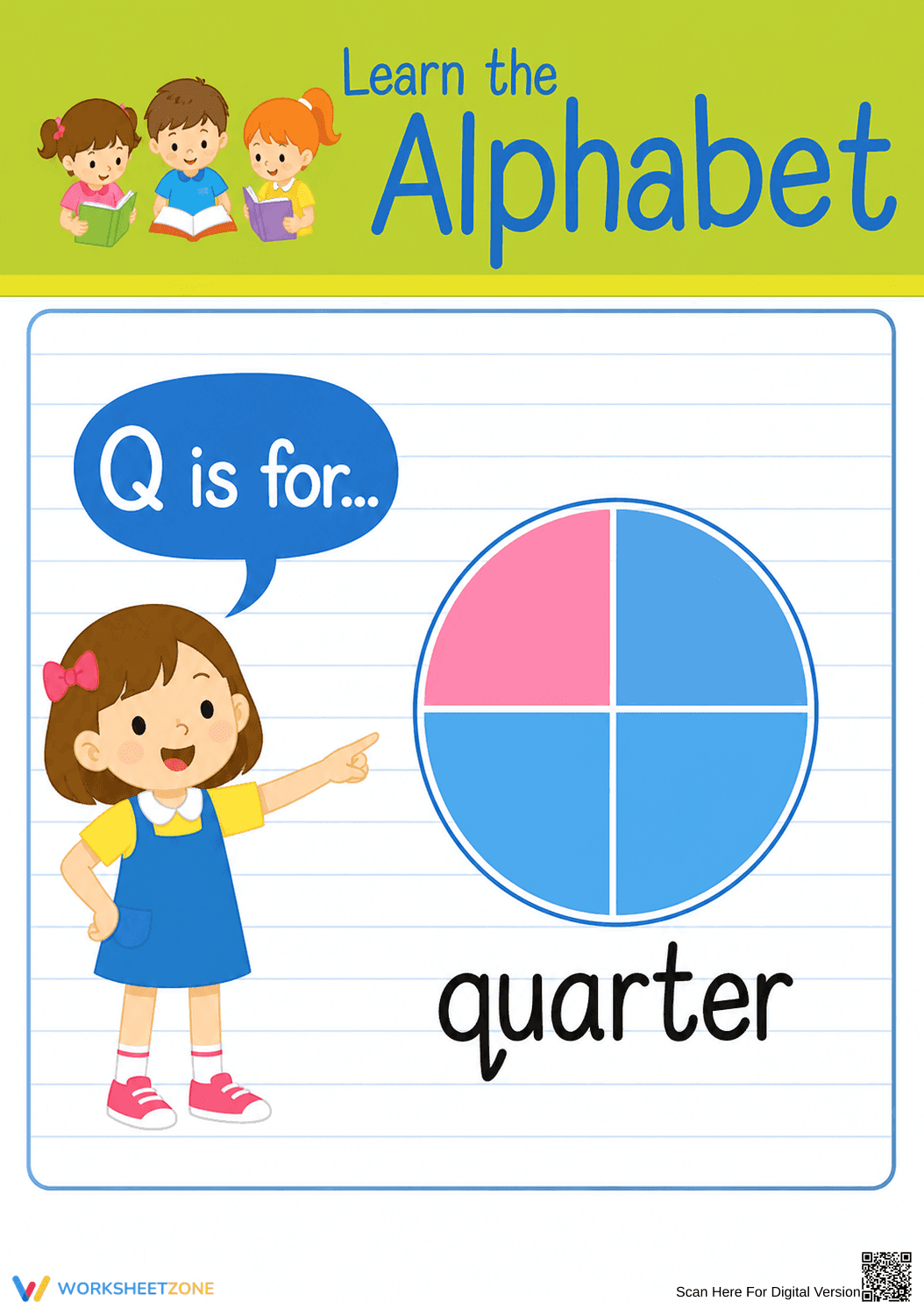
This Grade K-2 Letter Q beginning sound worksheet helps students master the unique phoneme through visual association. By connecting the letter Q to the word quarter, students develop essential phonemic awareness and vocabulary. This resource provides a clear, high-contrast visual anchor that ensures students can identify and produce the initial sound of the letter Q with confidence.
At a Glance
- Grade: K-2 · Subject: ELA Phonics
- Standard:
CCSS.ELA-LITERACY.RF.K.3.A— Demonstrate basic knowledge of one-to-one letter-sound correspondences for consonants- Skill Focus: Letter Q Beginning Sound
- Format: 1 page · 1 visual task · Answer key included · PDF
- Best For: Morning meeting or phonics centers
- Time: 5–10 minutes
Inside this resource, you will find a single-page visual anchor designed for maximum clarity. It features a large, friendly character pointing to a fractional quarter circle, explicitly linking the letter Q to its beginning sound. The text uses a clean, sans-serif font suitable for early readers, and the layout is designed to be used as either a printable worksheet or a classroom poster.
Zero-Prep Workflow
- Print: Generate the single-page PDF in under 30 seconds.
- Distribute: Hand out the sheet to students or display it on a smartboard during your phonics block.
- Review: Practice the sound together by having students repeat the phrase Q is for quarter for 1 minute.
Total teacher preparation time is under two minutes, making it an ideal sub-plan addition or quick warm-up activity.
Standards Alignment
This resource is aligned to `CCSS.ELA-LITERACY.RF.K.3.A`, which requires students to demonstrate basic knowledge of one-to-one letter-sound correspondences. Specifically, it targets the initial consonant sound for the letter Q. Both standard codes can be copied directly into lesson plans, IEP goals, or district curriculum mapping tools.
How to Use It
Use this worksheet as a formative assessment during your morning meeting. Show the image and ask students to brainstorm other words that start with the same sound as quarter. Alternatively, place it in a phonics center as a reference guide for students practicing their letter formation. Completion time ranges from 5 to 10 minutes depending on the depth of the accompanying discussion.
Who It's For
This resource is designed for Kindergarten and Grade 1 students who are beginning their phonics journey. It is particularly effective for English Language Learners (ELLs) who benefit from the direct visual-to-word connection. Pair this worksheet with a letter Q tracing activity or a short reading passage featuring qu words to reinforce the lesson.
Research from Fisher & Frey (2014) emphasizes the importance of visual anchors in early literacy development. By pairing the grapheme Q with a high-frequency or recognizable concept like a quarter, students build stronger phonemic associations. This worksheet supports CCSS.ELA-LITERACY.RF.K.3.A by providing a clear, singular focus on the initial sound, which is a critical precursor to decoding and reading fluency. According to NAEP data, early mastery of letter-sound correspondence is one of the strongest predictors of later reading success. This resource provides the necessary scaffolding for Kindergarten and Grade 1 students to transition from letter recognition to phonemic production. The use of clear, uncluttered visuals reduces cognitive load, allowing students to focus entirely on the phonetic relationship between the letter and the spoken word. This approach is consistent with evidence-based practices for early childhood education and English language learners.


