


























Views
Downloads

Letter Q Beginning Sounds Worksheet | Essential Grade K
Paste this activity's link or code into your existing LMS (Google Classroom, Canvas, Teams, Schoology, Moodle, etc.).
Students can open and work on the activity right away, with no student login required.
You'll still be able to track student progress and results from your teacher account.
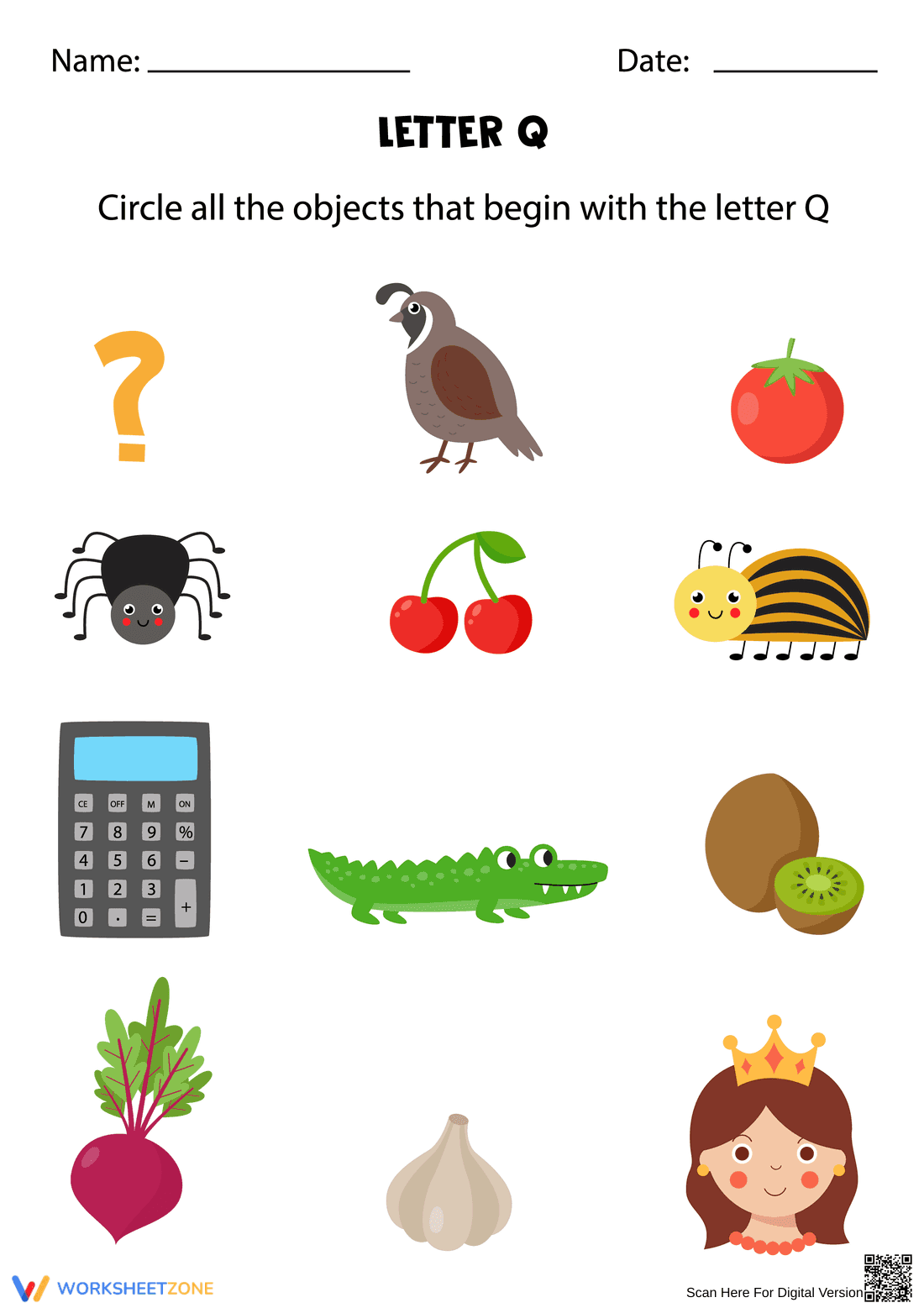
This Kindergarten phonics worksheet provides targeted practice for identifying the beginning sound of the letter Q. Students develop phonemic awareness by discriminating between various objects and selecting only those that start with the "kw" sound. This focused activity ensures students master one-to-one letter-sound correspondence, a vital precursor to successful decoding and early reading fluency.
At a Glance
- Grade: Kindergarten · Subject: ELA Phonics
- Standard:
CCSS.ELA-LITERACY.RF.K.3.A— Produce the primary sound for each consonant including the letter Q- Skill Focus: Beginning Sound Identification
- Format: 1 page · 12 problems · Answer key included · PDF
- Best For: Independent morning work or phonics centers
- Time: 10–15 minutes
What's Inside
The worksheet features a clean, student-friendly layout with 12 distinct illustrations. Students are tasked with circling objects such as a quail, a queen, and a question mark while ignoring distractors like a tomato or a spider. A comprehensive answer key is provided to facilitate quick assessment and immediate feedback for learners.
Zero-Prep Workflow
This resource is designed for immediate classroom implementation with a total teacher preparation time of under 2 minutes. Follow these three steps for a smooth experience:
- Print (1 minute): Download the PDF and print enough copies for your class or small group.
- Distribute (30 seconds): Hand out the sheets during your phonics block or as a transition activity.
- Review (30 seconds): Use the included answer key for rapid grading or project the worksheet onto a whiteboard for a collective check.
Standards Alignment
This resource is primarily aligned with `CCSS.ELA-LITERACY.RF.K.3.A`: "Demonstrate basic knowledge of one-to-one letter-sound correspondences by producing the primary sound or many of the most frequent sounds for each consonant." It also supports phonological awareness by requiring students to isolate initial sounds. Both standard codes can be copied directly into lesson plans, IEP goals, or district curriculum mapping tools.
How to Use It
Use this worksheet during direct instruction as a guided practice tool after introducing the letter Q. Alternatively, assign it as a formative assessment to gauge which students need additional intervention. Observe if students whisper object names to identify sounds. Completion typically takes 10 to 15 minutes.
Who It's For
This activity is tailored for Preschool, Kindergarten, and Grade 1 students who are building their foundational literacy skills. It is particularly effective for English Language Learners (ELLs) who benefit from the visual representation of vocabulary words. Pair this worksheet with a letter Q anchor chart or a short reading passage featuring Quentin the Quail to reinforce the sound in context.
This letter-sound correspondence resource aligns with CCSS.ELA-LITERACY.RF.K.3.A, focusing on the specific phonemic identification of the "kw" sound associated with the letter Q. According to the RAND AIRS 2024 report on foundational literacy, early exposure to isolated consonant sounds through visual-auditory pairing significantly improves decoding speed in later primary grades. By requiring students to discriminate between 12 distinct objects—such as a quail and a queen versus distractors like a tomato—this worksheet builds the phonological awareness necessary for early reading fluency. The structured layout supports cognitive load management for Preschool and Kindergarten learners, ensuring that the primary focus remains on the phonemic task rather than complex instructions. Educators can utilize this tool to gather formative data on student mastery of low-frequency consonants, which is a critical milestone in the alphabetic principle. This evidence-based approach ensures that students transition from simple letter recognition to functional phonetic application in diverse linguistic contexts.


