


























Views
Downloads

Essential Letter Q Beginning Sound Worksheet | Grade K-2
Paste this activity's link or code into your existing LMS (Google Classroom, Canvas, Teams, Schoology, Moodle, etc.).
Students can open and work on the activity right away, with no student login required.
You'll still be able to track student progress and results from your teacher account.
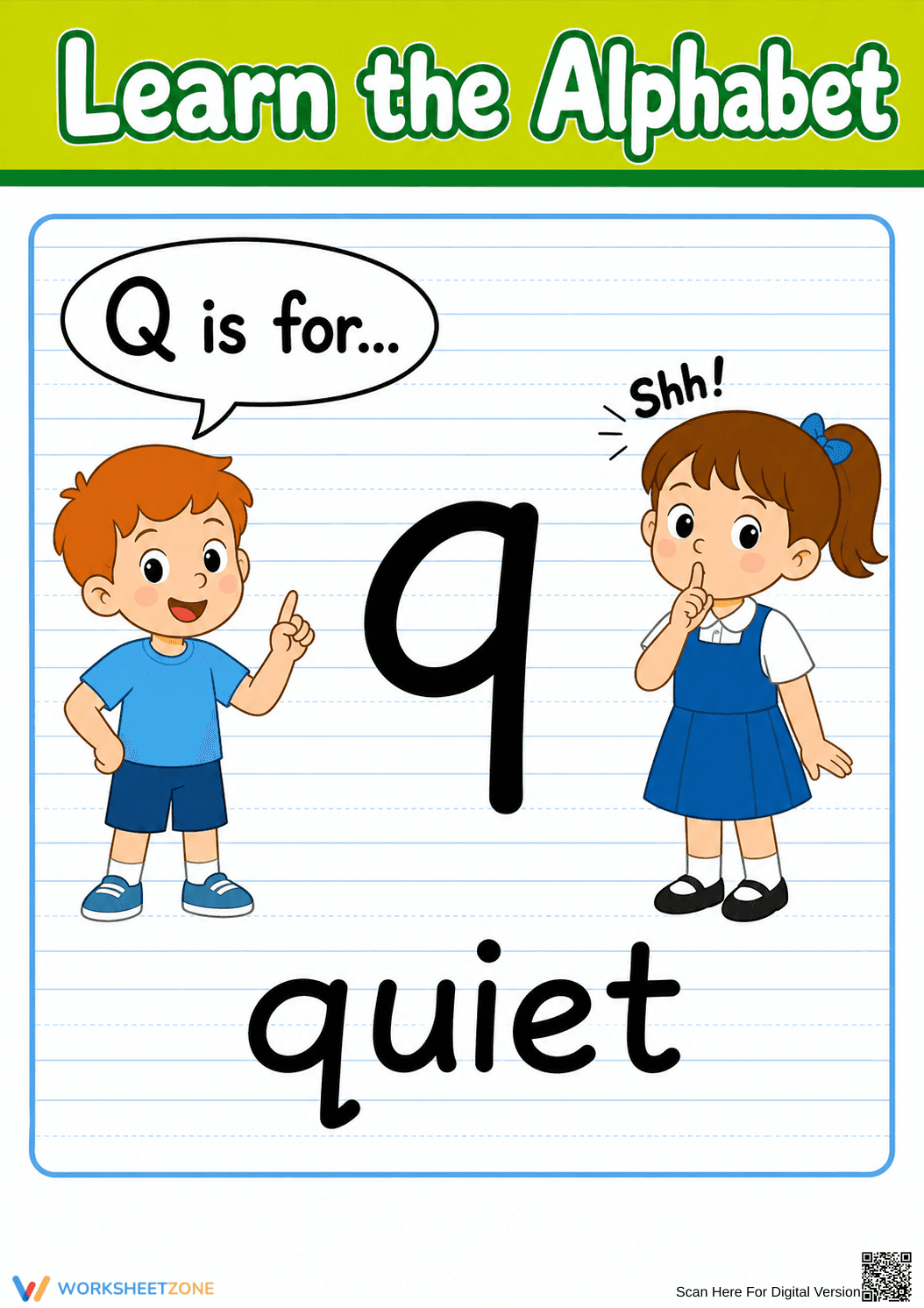
This foundational phonics resource helps early learners identify the Letter Q beginning sound through clear visual associations. By connecting the lowercase letterform with the keyword "quiet," students build the phonemic awareness necessary for decoding and early reading success. It serves as a primary anchor for introducing the unique sound-letter relationship.
At a Glance
- Grade: Kindergarten · Subject: ELA Phonics
- Standard:
CCSS.ELA-LITERACY.RF.K.3.A— Demonstrate basic knowledge of one-to-one letter-sound correspondences for consonants- Skill Focus: Letter Q Beginning Sound
- Format: 1 page · 1 visual task · Anchor Chart · PDF
- Best For: Initial sound introduction and classroom display
- Time: 5–10 minutes
This printable features a high-contrast layout designed for young eyes. It includes a large lowercase "q," a speech bubble prompt, and a relatable illustration of the word "quiet." The page functions as both a direct instruction tool and a classroom reference poster, ensuring students have a constant visual reminder of the sound-letter relationship during their phonics block.
Skill Progression
- Guided Practice: Teachers lead the class in identifying the letter "q" and mimicking the "shh" gesture to reinforce the "quiet" keyword association.
- Supported Practice: Students trace the letterform with their fingers while repeating the sound, using the 1 visual cue as a mnemonic device.
- Independent Practice: Learners identify the letter "q" in environmental print or other texts, referencing this sheet as their primary guide.
This resource follows a gradual-release model by providing a strong initial anchor before moving to broader phonemic tasks.
Standards Alignment
This resource is aligned with `CCSS.ELA-LITERACY.RF.K.3.A`, which requires students to demonstrate basic knowledge of one-to-one letter-sound correspondences. It also supports `CCSS.ELA-LITERACY.RF.1.2.C`, focusing on isolating and producing initial sounds in spoken single-syllable words. Both standard codes can be copied directly into lesson plans, IEP goals, or district curriculum mapping tools.
How to Use It
Use this as a "hook" during your morning meeting or phonics block. Display it on the interactive whiteboard while students practice the "qu" sound together. For a formative assessment, ask students to find three other objects in the room that start with the same sound. Expected completion for the introductory discussion is 8 minutes.
Who It's For
This is ideal for Kindergarten students just starting their alphabet journey, as well as Grade 1 and 2 students requiring RTI or phonics intervention. It pairs naturally with a "Letter Q" alphabet tracing sheet or a beginning sounds sorting center to reinforce the concept.
Phonemic awareness is the strongest predictor of later reading success, particularly when students can map sounds to specific letterforms like the Letter Q. This worksheet targets CCSS.ELA-LITERACY.RF.K.3.A by providing a clear, singular focus on the initial "q" sound through the keyword "quiet." According to research by Fisher & Frey (2014), visual anchors and clear modeling are essential for students to move from letter recognition to fluent decoding. By isolating the beginning sound in a high-frequency word, this resource reduces cognitive load for early readers. The 1-page format ensures that the instructional focus remains sharp, allowing teachers to integrate it into a 10-minute phonics routine without overwhelming the learner. This evidence-based approach to letter-sound correspondence provides the necessary scaffolding for Kindergarten and Grade 1 students to master the complexities of the English alphabet.


