


























Views
Downloads

Letter Q Beginning Sound Worksheet | Printable Grade K
Paste this activity's link or code into your existing LMS (Google Classroom, Canvas, Teams, Schoology, Moodle, etc.).
Students can open and work on the activity right away, with no student login required.
You'll still be able to track student progress and results from your teacher account.
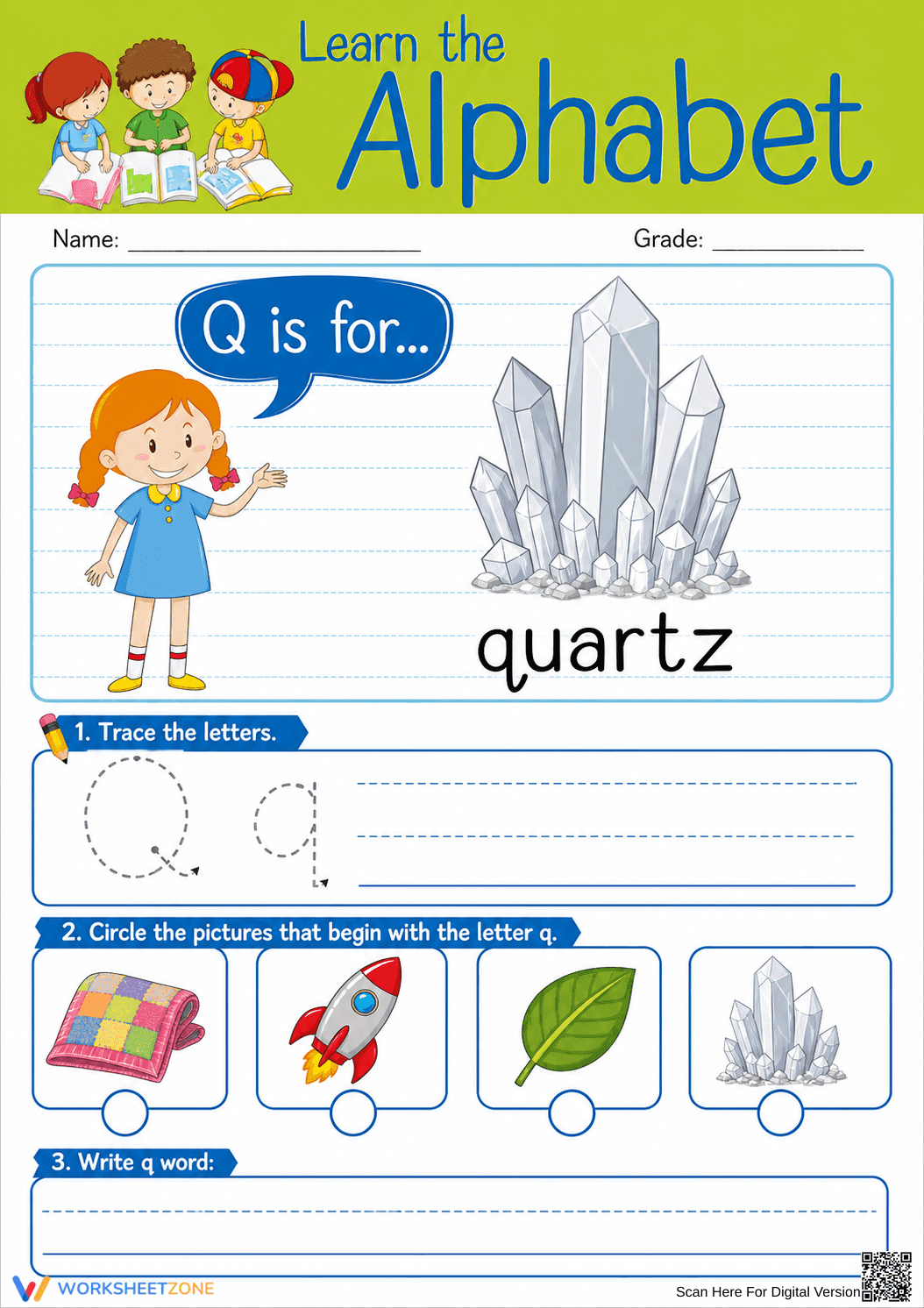
This Kindergarten phonics worksheet helps young learners master the letter Q beginning sound and practice proper letter formation. Students will identify words starting with Q, trace uppercase and lowercase letters, and write their own Q words, building essential early literacy skills through focused, engaging practice.
At a Glance
- Grade: K · Subject: ELA
- Standard:
CCSS.ELA-LITERACY.RF.K.3.A— Produce primary sounds for consonants- Skill Focus: Letter Q Beginning Sound
- Format: 1 page · 3 problems · PDF
- Best For: Independent practice
- Time: 10–15 minutes
This single-page resource features three distinct task types designed to reinforce letter recognition and phonemic awareness. The worksheet includes a guided tracing section for both uppercase and lowercase Q, a visual discrimination activity where students circle pictures starting with the target sound (like "quilt" and "quartz"), and a writing prompt to independently produce a Q word. A clear visual anchor of a quartz crystal provides immediate context for the letter sound.
Zero-Prep Workflow
This resource is designed for immediate classroom implementation with minimal teacher preparation.
- Print (1 minute): Simply download the PDF and print the required number of copies. The black-and-white friendly design ensures crisp reproduction.
- Distribute (1 minute): Hand out the worksheets during morning work, literacy centers, or as a quick transition activity.
- Review (3 minutes): Quickly check student work for correct letter formation and accurate picture identification.
With under two minutes of total teacher prep time, this worksheet is an excellent addition to emergency sub plans or last-minute phonics review sessions.
Standards Alignment
This worksheet is directly aligned to CCSS.ELA-LITERACY.RF.K.3.A, requiring students to demonstrate basic knowledge of one-to-one letter-sound correspondences by producing the primary sound or many of the most frequent sounds for each consonant. It also supports handwriting standards by having students print upper- and lowercase letters. Both standard codes can be copied directly into lesson plans, IEP goals, or district curriculum mapping tools.
How to Use It
Integrate this worksheet into your daily literacy block as an independent practice activity following direct instruction on the letter Q. It works exceptionally well as a morning work assignment, allowing students to settle in while reinforcing recent phonics lessons. Alternatively, use it as a targeted intervention tool for small groups struggling with consonant sounds. While students work, observe their pencil grip during the tracing section and ask them to verbally identify the pictures they circle to assess their phonemic awareness formatively. Expected completion time ranges from 10 to 15 minutes.
Who It's For
This resource is primarily designed for Kindergarten students developing early literacy skills, but it also serves as a valuable review for first graders needing extra phonics support. The clear visuals and structured tracing lines provide built-in scaffolding for English Language Learners and students requiring occupational therapy support for handwriting. Pair this worksheet with a read-aloud book featuring Q words or a classroom alphabet anchor chart to maximize instructional impact.
Mastering the letter Q beginning sound is a critical step in early reading development. According to a 2024 report by EdReports, explicit instruction in phonemic awareness and letter-sound correspondence is foundational for decoding skills. When students engage with targeted materials aligned to CCSS.ELA-LITERACY.RF.K.3.A, they learn to produce primary sounds for consonants with greater accuracy and fluency. This worksheet provides the necessary repetition and visual association required to solidify these early literacy concepts. By combining handwriting practice with phoneme identification, educators can address multiple learning modalities simultaneously. Consistent practice with specific letter sounds builds the automaticity necessary for future reading comprehension and spelling proficiency. This resource supports evidence-based literacy instruction by offering structured, focused practice on essential phonics skills.


