


























Views
Downloads

Grade K Letter Q Sound — Printable No-Prep Worksheet
Paste this activity's link or code into your existing LMS (Google Classroom, Canvas, Teams, Schoology, Moodle, etc.).
Students can open and work on the activity right away, with no student login required.
You'll still be able to track student progress and results from your teacher account.
This foundational phonics worksheet helps early learners master the beginning sound of the letter Q. By connecting the visual representation of the letter with a familiar vocabulary word, students build essential phonemic awareness. This resource provides a clear, engaging visual to reinforce letter-sound correspondence in the primary classroom.
At a Glance
- Grade: Kindergarten · Subject: ELA
- Standard:
CCSS.ELA-LITERACY.RF.K.3.A— Produce primary sounds for consonants- Skill Focus: Letter Q Beginning Sound
- Format: 1 page · 1 visual task · No answer key needed · PDF
- Best For: Phonics introduction
- Time: 5–10 minutes
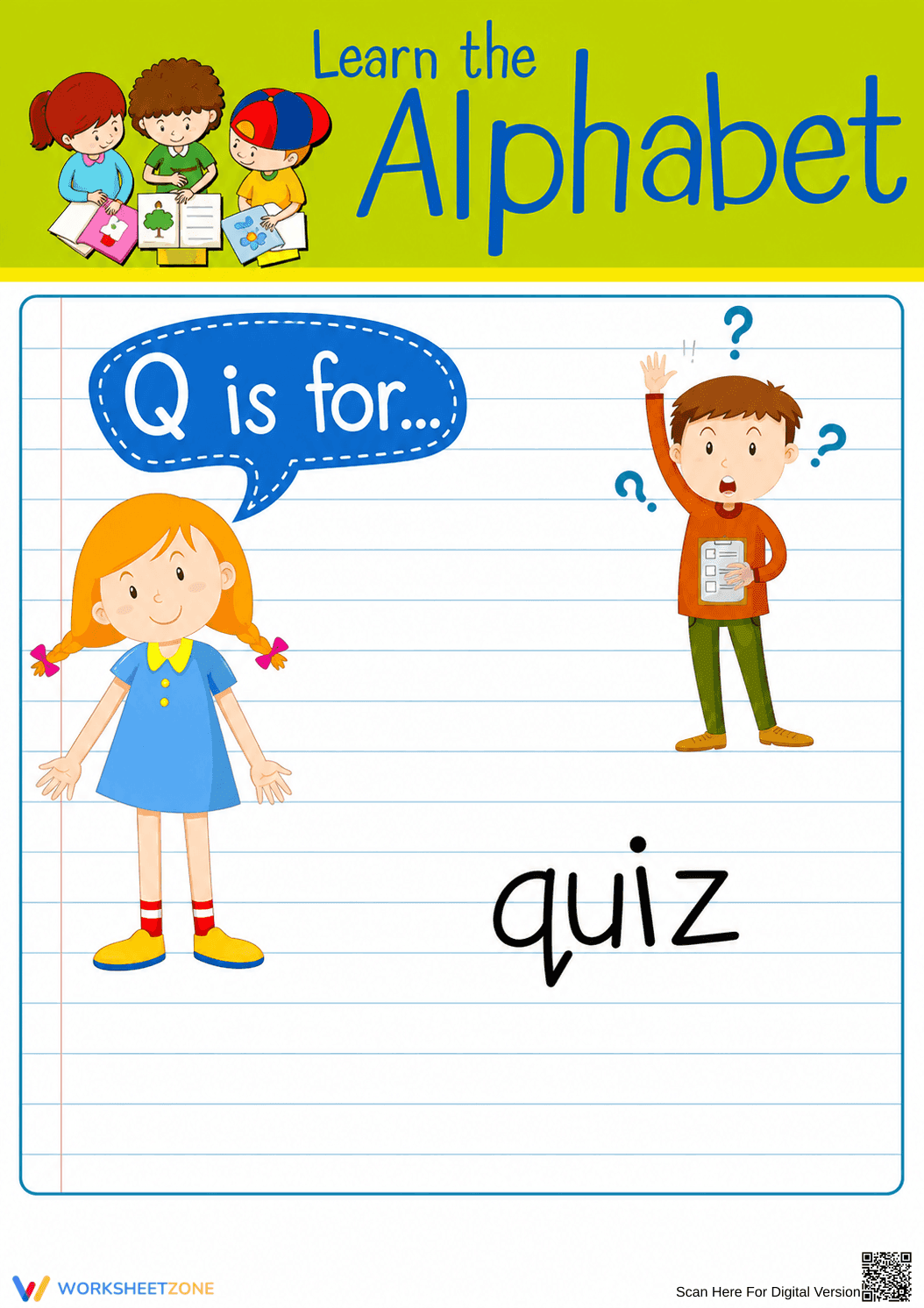
Inside this single-page resource, educators will find a vibrant, student-friendly anchor chart and practice page focused entirely on the letter Q. The page features a clear illustration of a child asking a question to represent the word "quiz," alongside the uppercase and lowercase letter forms. This layout provides a direct visual scaffold, helping young readers associate the unique /kw/ sound with its corresponding letter symbol without overwhelming them with text.
Zero-Prep Workflow
This resource is designed for immediate classroom implementation, requiring under two minutes of teacher preparation.
- Print (1 minute): Simply download the PDF and print the required number of copies. The bold graphics print clearly in both color and grayscale.
- Distribute (1 minute): Hand out the page during morning work, literacy centers, or small group phonics instruction.
- Review (3 minutes): Guide students to point to the letter Q, say the /kw/ sound, and trace or read the word "quiz" together.
Standards Alignment
This phonics resource is directly aligned to CCSS.ELA-LITERACY.RF.K.3.A, which requires students to demonstrate basic knowledge of one-to-one letter-sound correspondences by producing the primary sound or many of the most frequent sounds for each consonant. By isolating the letter Q and pairing it with a concrete example, the material supports early decoding skills. Both standard codes can be copied directly into lesson plans, IEP goals, or district curriculum mapping tools.
How to Use It
Teachers can utilize this page as a focal point during whole-group direct instruction when introducing the letter Q. Alternatively, place it inside a clear plastic sleeve in a literacy center, allowing students to trace the word "quiz" with a dry-erase marker. As a formative assessment tip, observe whether students can independently point to the letter Q and produce the correct /kw/ sound before moving on to the next activity. Expected completion time ranges from 5 to 10 minutes.
Who It's For
This material is primarily designed for Kindergarten students developing their foundational phonics skills. It also serves as an effective intervention tool for first-grade students who need additional reinforcement with less common consonant sounds. This resource pairs perfectly with a tactile alphabet tracing activity or a read-aloud focused on the letter Q.
Mastering the letter Q beginning sound is a critical step in early literacy development. According to the RAND AIRS 2024 report on foundational reading skills, explicit instruction in letter-sound correspondence significantly improves subsequent decoding and reading comprehension outcomes in primary grades. This resource targets CCSS.ELA-LITERACY.RF.K.3.A, ensuring students can produce primary sounds for consonants accurately. By providing a clear, unambiguous visual anchor for the /kw/ sound, educators can reduce cognitive load and help students form strong neural pathways linking orthography to phonology. Consistent practice with isolated phonemes, particularly less frequent letters like Q, prevents future decoding errors and builds reading fluency. Incorporating this targeted visual practice into daily literacy routines ensures that early learners establish the robust phonemic foundation necessary for long-term academic success.


