




























Views
Downloads

Letter M Beginning Sound Worksheet | Essential Grade K-2

Paste this activity's link or code into your existing LMS (Google Classroom, Canvas, Teams, Schoology, Moodle, etc.).
Students can open and work on the activity right away, with no student login required.
You'll still be able to track student progress and results from your teacher account.
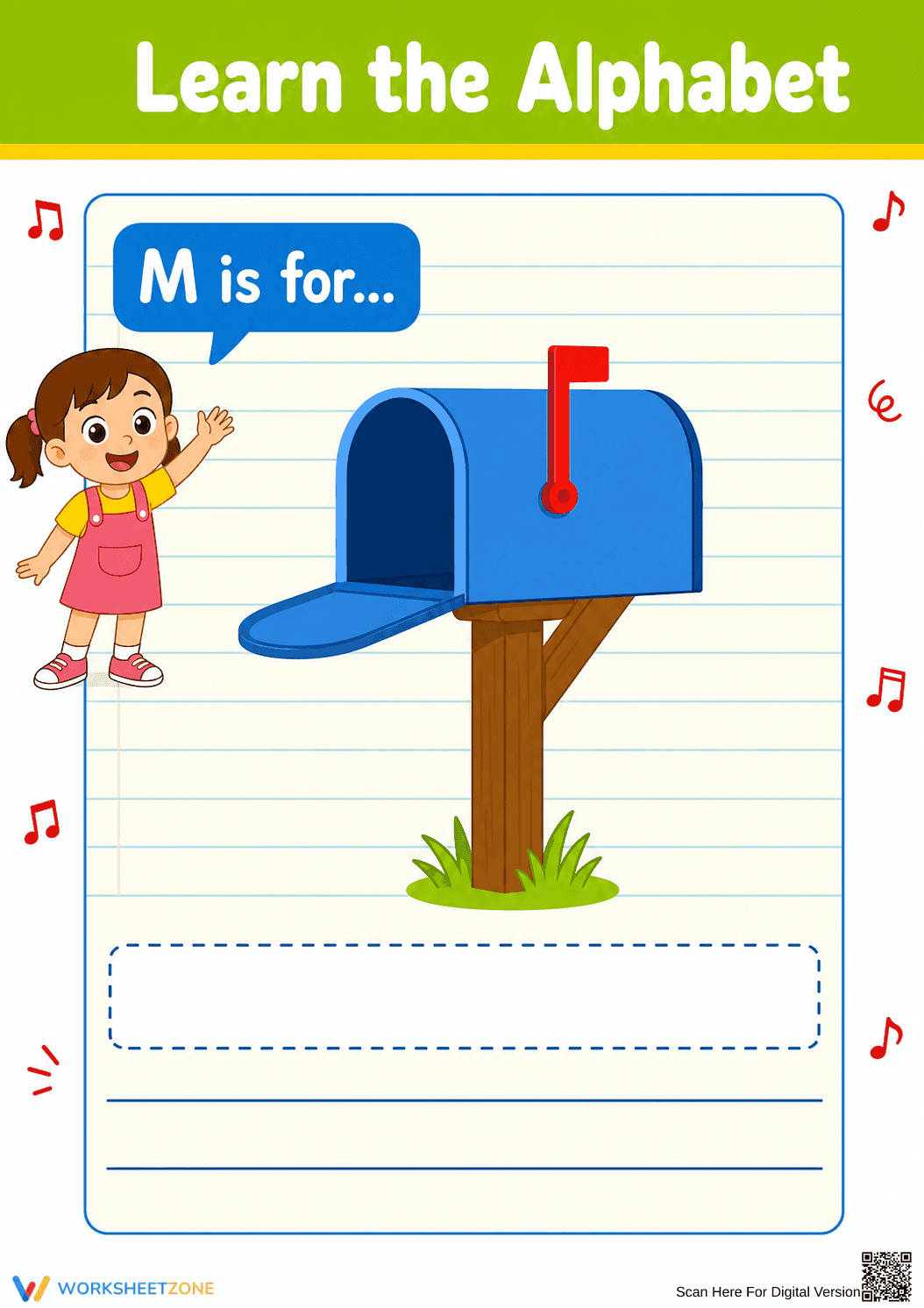
This Grade K-2 phonics worksheet helps early learners master the letter M beginning sound through visual association and writing practice. Students identify the mailbox illustration, connect the initial phoneme to the letter M, and practice writing the corresponding word or letter. It provides a clear path toward phonemic awareness and early literacy success.
At a Glance
- Grade: K-2 · Subject: ELA Phonics
- Standard:
CCSS.ELA-LITERACY.RF.K.3.A— Demonstrate basic knowledge of one-to-one letter-sound correspondences for consonants- Skill Focus: Letter M Beginning Sound
- Format: 1 page · 1 task · Answer key included · PDF
- Best For: Initial phonics instruction and letter recognition
- Time: 5–10 minutes
This single-page PDF features a vibrant "Learn the Alphabet" header and a large, recognizable illustration of a mailbox to anchor the "M" sound. Below the visual prompt, students find a dedicated tracing box and primary writing lines. The layout is designed to reduce cognitive load, focusing entirely on the relationship between the phoneme /m/ and its grapheme.
The worksheet follows a gradual release model. First, students engage in guided practice by identifying the mailbox and vocalizing the /m/ sound with teacher support. Next, they move to supported practice by tracing the letter or word within the dashed box. Finally, independent practice occurs on the solid writing lines, where students demonstrate mastery of the letter M formation and its association with the beginning sound.
This resource aligns with `CCSS.ELA-LITERACY.RF.K.3.A`, which requires students to demonstrate basic knowledge of one-to-one letter-sound correspondences. It also supports RF.1.2.C by helping students isolate and pronounce initial sounds in spoken single-syllable words. Both standard codes can be copied directly into lesson plans, IEP goals, or district curriculum mapping tools.
Use this worksheet during the "You Do" portion of a phonics lesson after introducing the letter M. It serves as an excellent formative assessment tool; observe if students can independently name the object and produce the correct initial sound. It is also ideal for morning work or as a quick exit ticket to verify daily learning.
This resource is designed for Kindergarten and 1st-grade students beginning their phonics journey, as well as 2nd graders needing targeted intervention. It pairs naturally with an alphabet anchor chart or a read-aloud book focusing on the letter M. The visual cues make it accessible for English Language Learners (ELL) developing basic vocabulary.
According to the RAND AIRS 2024 report, explicit phonics instruction that links visual symbols with auditory sounds is a cornerstone of effective early literacy programs. This worksheet facilitates that connection by using a high-frequency object—a mailbox—to reinforce the `CCSS.ELA-LITERACY.RF.K.3.A` standard. Research from Fisher & Frey (2014) emphasizes that providing students with clear, uncluttered spaces for writing practice after visual modeling significantly improves grapheme-phoneme acquisition. By focusing on a single beginning sound, this tool prevents cognitive overstimulation, allowing students to build the neural pathways necessary for fluent decoding. Educators can use this resource to provide the repeated exposure required for mastery, ensuring that students move from simple recognition to independent production of the letter M sound. This targeted approach is essential for meeting NAEP benchmarks in early reading proficiency and supporting long-term academic growth in language arts.


