




























Views
Downloads
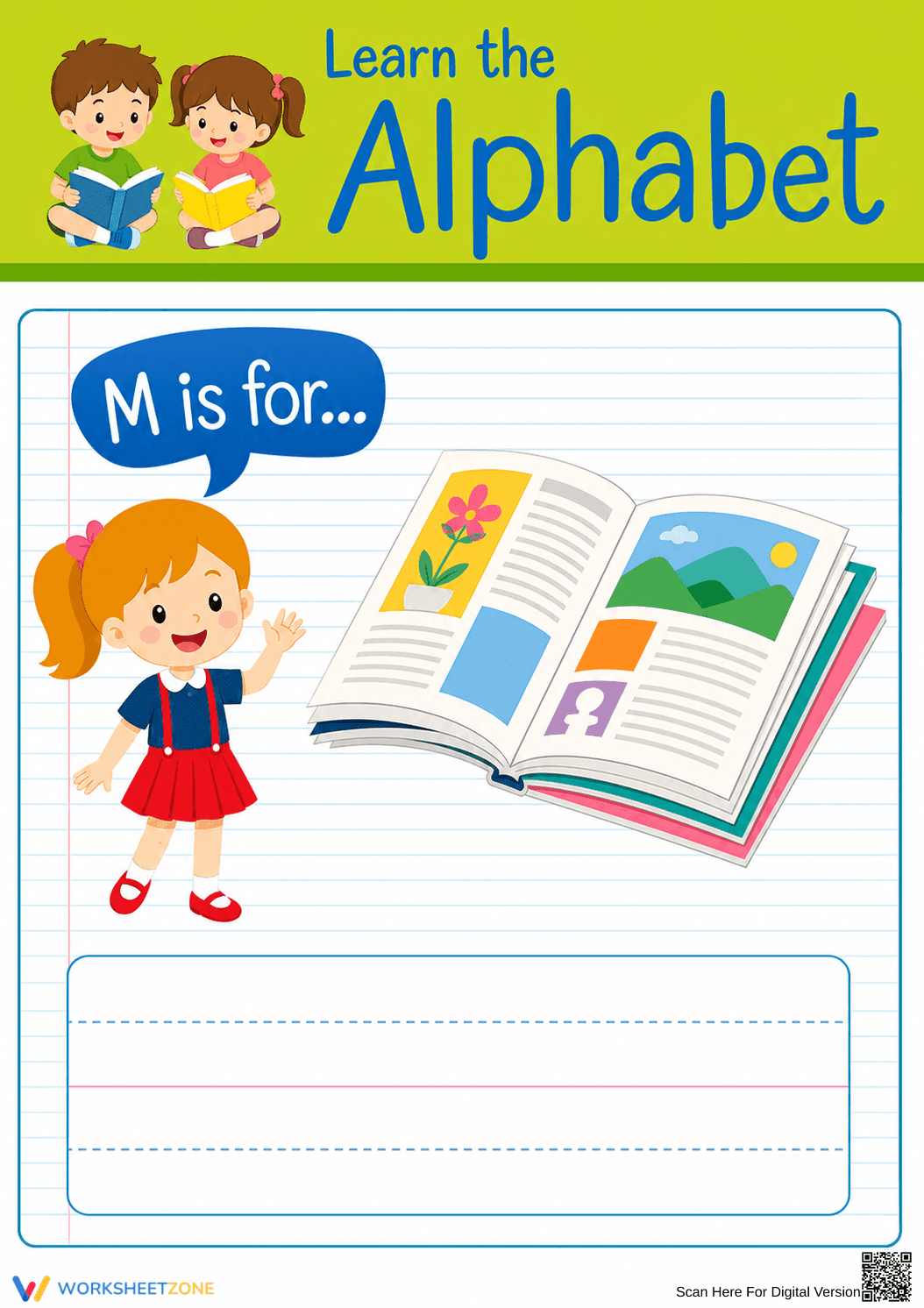

Grade K Letter M Sound — Printable No-Prep Worksheet

Paste this activity's link or code into your existing LMS (Google Classroom, Canvas, Teams, Schoology, Moodle, etc.).
Students can open and work on the activity right away, with no student login required.
You'll still be able to track student progress and results from your teacher account.
This foundational phonics worksheet helps early learners master the beginning sound of the letter M. By connecting visual cues with handwriting practice, students develop essential letter-sound correspondence and fine motor skills. This resource provides a straightforward, engaging way to reinforce early literacy concepts in the classroom or at home.
At a Glance
- Grade: K · Subject: ELA
- Standard:
CCSS.ELA-LITERACY.RF.K.3.A— Produce the primary sound for each consonant- Skill Focus: Letter M Beginning Sound
- Format: 1 page · 1 problem · No answer key · PDF
- Best For: Independent practice
- Time: 5–10 minutes
Inside this single-page resource, educators will find a vibrant, student-friendly layout featuring a clear "M is for..." prompt. The page includes an engaging illustration of a book to prompt vocabulary recognition, followed by primary handwriting lines. This structure allows students to practice writing the target letter or word while reinforcing the phonetic connection to the visual cue.
This resource requires minimal effort.
- Print (1 minute): Simply download the PDF and print the required number of copies. The bold graphics print clearly in both color and grayscale.
- Distribute (1 minute): Hand out the sheets along with pencils or crayons. The intuitive design means students immediately understand the task.
- Review (3 minutes): Quickly check student handwriting and ask them to vocalize the "M" sound as they point to the illustration.
Total teacher preparation time is under two minutes, making this an excellent addition to any emergency sub plan or morning work routine.
This worksheet is directly aligned with CCSS.ELA-LITERACY.RF.K.3.A, requiring students to demonstrate basic knowledge of one-to-one letter-sound correspondences by producing the primary sound for consonants. It also supports early handwriting standards by providing structured primary lines for letter formation. Both standard codes can be copied directly into lesson plans, IEP goals, or district curriculum mapping tools.
This resource fits perfectly into morning work routines; place it on desks before the bell rings for immediate phonics practice. Alternatively, use it during small group centers after direct instruction. As a formative assessment tip, observe students as they write; ask them to say the letter sound out loud to verify phonetic understanding. Expected completion time is 5 to 10 minutes.
This worksheet is designed primarily for Kindergarten students building foundational phonics and handwriting skills. It also serves as an effective intervention tool for first-grade students needing extra reinforcement with consonant sounds. For differentiation, teachers can provide a word bank on the board for advanced students to write full words, while beginners focus solely on tracing or writing the uppercase and lowercase letter M. Pair this activity with a read-aloud book that heavily features the target letter.
Mastering letter-sound correspondence, such as the skills practiced in this CCSS.ELA-LITERACY.RF.K.3.A aligned activity, is a critical predictor of future reading success. When students produce the primary sound for each consonant, they build the decoding foundation necessary for fluent reading. According to a recent EdReports 2024 analysis of early literacy curricula, integrating visual vocabulary cues with immediate handwriting application significantly improves phonemic retention in early childhood learners. This dual-modality approach ensures that students actively connect auditory phonemes to their written grapheme counterparts. By providing structured primary lines alongside clear phonetic prompts, this resource supports cognitive mapping between spoken and written language. Consistent practice with targeted beginning sound activities reduces cognitive load during later blending tasks, setting a strong trajectory for literacy development.


