




























Views
Downloads

Essential Letter M Beginning Sound Worksheet | Grade K

Paste this activity's link or code into your existing LMS (Google Classroom, Canvas, Teams, Schoology, Moodle, etc.).
Students can open and work on the activity right away, with no student login required.
You'll still be able to track student progress and results from your teacher account.
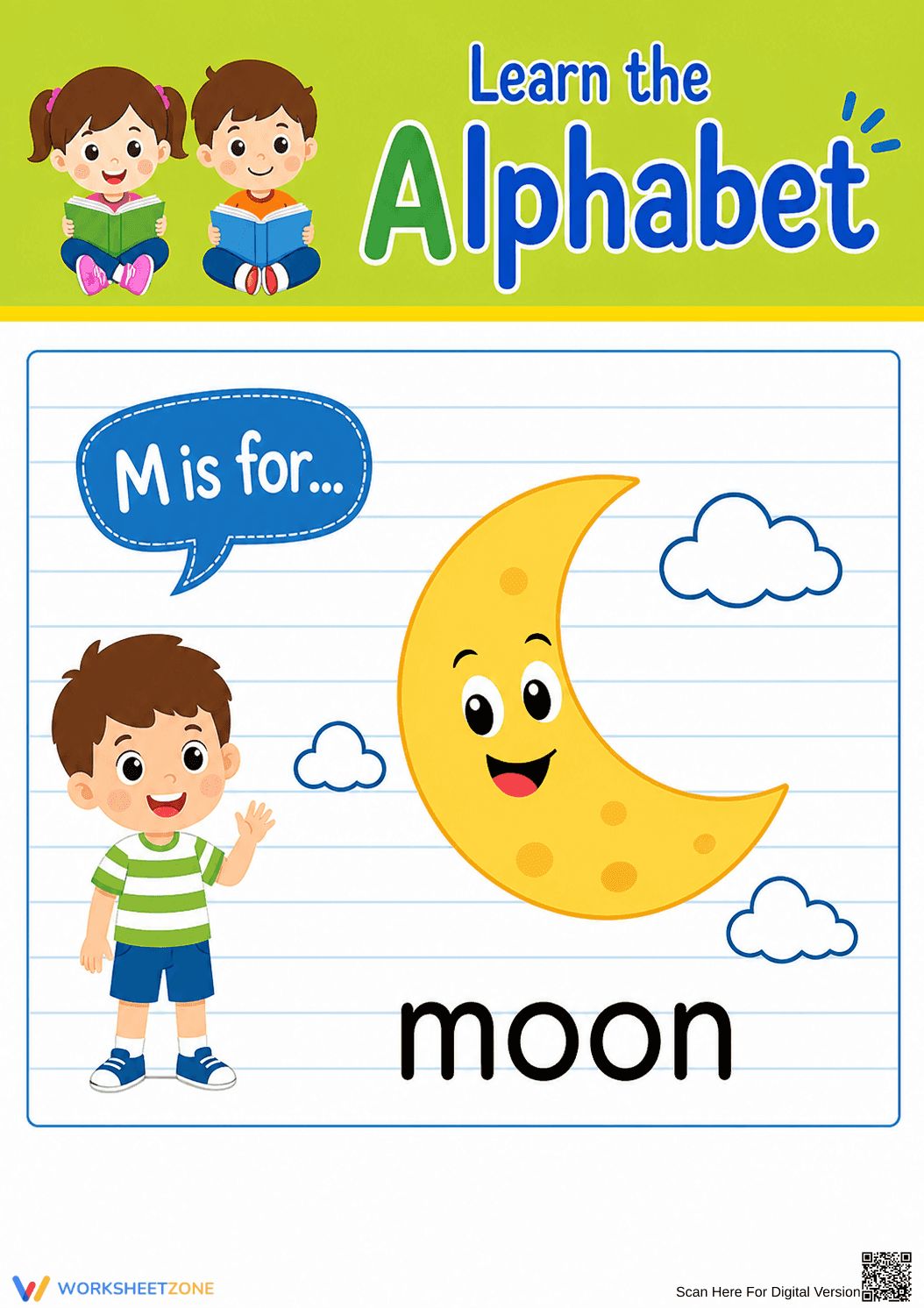
This Letter M beginning sound worksheet helps early learners identify the initial phoneme in common words like "moon." By connecting the visual representation of the letter with a familiar object, students build the foundational phonemic awareness necessary for reading fluency. It provides a clear, high-contrast visual aid for classroom instruction.
At a Glance
- Grade: Kindergarten · Subject: ELA Phonics
- Standard:
CCSS.ELA-LITERACY.RF.K.3.A— Demonstrate basic knowledge of one-to-one letter-sound correspondences for consonants- Skill Focus: Letter M Beginning Sound
- Format: 1 page · 1 task · Visual Aid · PDF
- Best For: Initial phoneme introduction and classroom display
- Time: 5–10 minutes
Inside this resource, you will find a single-page instructional sheet designed for high visibility. It features the uppercase and lowercase letter M, a vibrant illustration of a moon, and the corresponding word printed in a clear, sans-serif font. This structure supports letter-sound association without overwhelming young students with complex instructions or multiple tasks.
Skill Progression
- Guided practice: Students engage in whole-group repetition of the letter name and the /m/ sound as modeled by the teacher using the visual anchor.
- Supported practice: Students identify the "moon" image and vocalize the initial sound, connecting the phoneme to the grapheme in a shared setting.
- Independent practice: Students move to identifying other objects in their immediate environment that begin with the same sound, reinforcing the 1-to-1 correspondence.
This resource follows a gradual-release model to ensure students move from recognition to independent production of the target sound.
Standards Alignment
This worksheet is aligned with `CCSS.ELA-LITERACY.RF.K.3.A`, which requires students to demonstrate basic knowledge of one-to-one letter-sound correspondences for consonants. It also supports RF.K.1.D by helping students recognize and name all upper- and lowercase letters of the alphabet. Both standard codes can be copied directly into lesson plans, IEP goals, or district curriculum mapping tools.
How to Use It
Use this worksheet during the "Introduction to New Material" phase of a phonics lesson. It serves as an excellent anchor chart for a "Letter of the Week" bulletin board or a digital slide for direct instruction. For formative assessment, observe if students can independently produce the /m/ sound when pointing to the moon. Expected completion time for the primary activity is approximately 5 to 10 minutes.
Who It's For
This resource is ideal for Kindergarten students, English Language Learners (ELLs), and students receiving Tier 2 intervention for phonological awareness. It pairs naturally with a letter M tracing sheet or a physical "alphabet bag" containing objects like magnets, maps, and marbles to reinforce the concept through tactile learning and direct instruction.
Research from RAND AIRS 2024 emphasizes that explicit phonics instruction, particularly focusing on letter-sound correspondence, is a critical predictor of later reading success. By isolating the /m/ sound through visual and auditory cues, this worksheet adheres to evidence-based practices for early literacy development. The use of high-frequency imagery like the "moon" reduces cognitive load, allowing students to focus entirely on the phonemic target. According to Fisher & Frey (2014), providing clear visual anchors during the initial stages of phoneme acquisition helps bridge the gap between abstract symbols and spoken language. This worksheet provides that essential anchor, ensuring that the CCSS.ELA-LITERACY.RF.K.3.A standard is met through direct, focused engagement. Educators can confidently integrate this tool into a comprehensive literacy framework to support foundational decoding skills and phonemic proficiency in early childhood settings.


