




























Views
Downloads
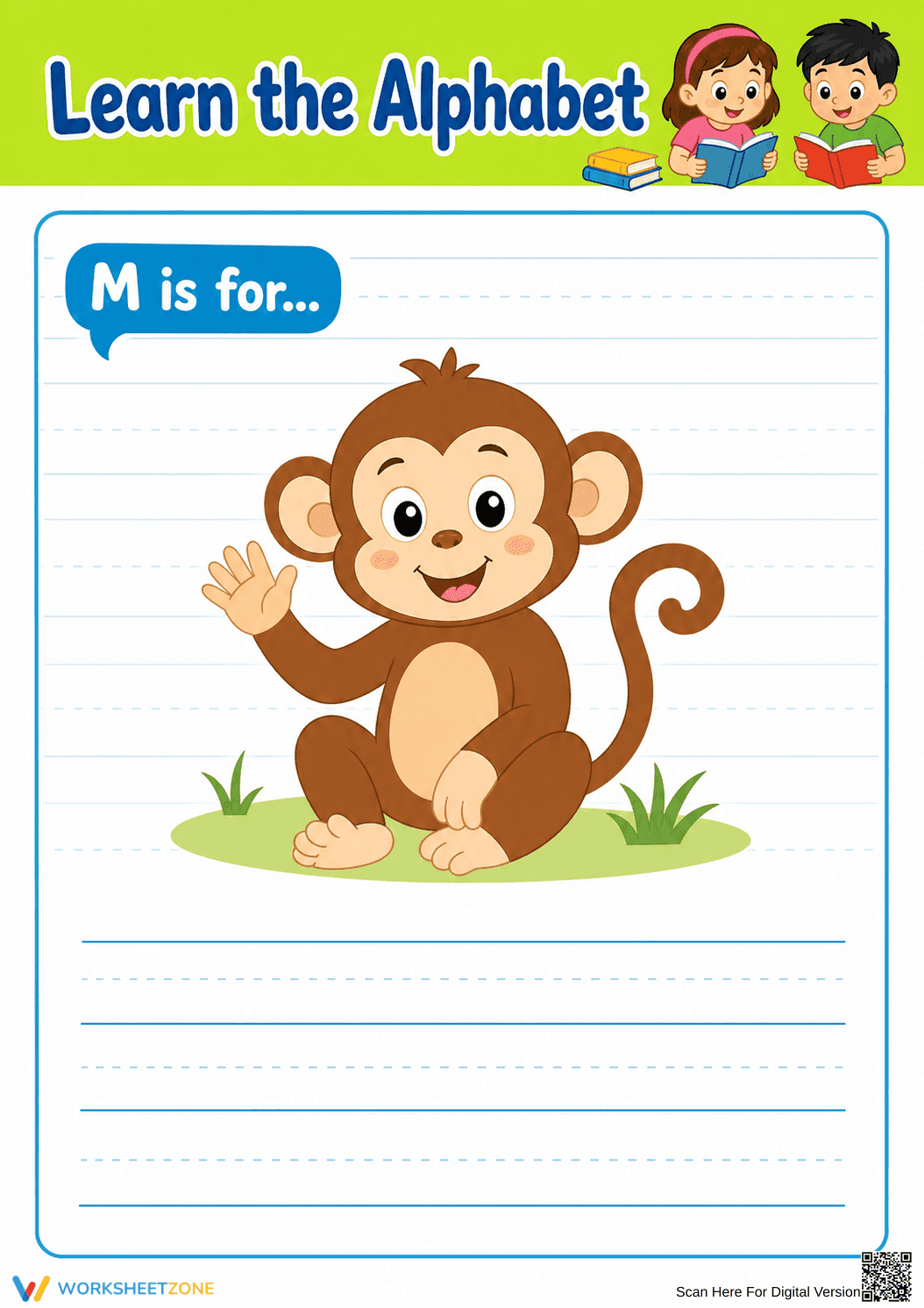

Essential Letter M Beginning Sound Worksheet | Grade K-2

Paste this activity's link or code into your existing LMS (Google Classroom, Canvas, Teams, Schoology, Moodle, etc.).
Students can open and work on the activity right away, with no student login required.
You'll still be able to track student progress and results from your teacher account.
This Grade K-2 phonics worksheet helps early learners master the letter M beginning sound through visual association and handwriting practice. By connecting the letter M to a familiar monkey image, students build phonemic awareness and fine motor skills simultaneously. It provides a clear, structured environment for initial sound recognition and letter formation.
At a Glance
- Grade: K-2 · Subject: ELA Phonics
- Standard:
CCSS.ELA-LITERACY.RF.K.3.A— Demonstrate basic knowledge of one-to-one letter-sound correspondences by producing the primary sound- Skill Focus: Letter M Beginning Sound
- Format: 1 page · 1 task · Writing lines included · PDF
- Best For: Initial phonics instruction and handwriting practice
- Time: 10–15 minutes
Inside this resource, you will find a single-page layout featuring a large, engaging monkey illustration to reinforce the /m/ sound. The page includes five sets of primary dashed writing lines, allowing students ample space to practice writing the letter M or the word monkey. The clean design minimizes distractions for young learners while providing the necessary structure for early writing development.
The worksheet follows a gradual release of responsibility. First, students engage in guided identification by looking at the monkey and saying the /m/ sound. Next, they move to supported practice by tracing or copying the letter on the provided lines. Finally, independent practice is achieved as students fill the remaining lines with their own letter formations or related words. This progression ensures that students move from simple recognition to active production.
This resource aligns with `CCSS.ELA-LITERACY.RF.K.3.A`, which requires students to demonstrate basic knowledge of one-to-one letter-sound correspondences. It also supports RF.K.1.D regarding letter recognition and formation. Both standard codes can be copied directly into lesson plans, IEP goals, or district curriculum mapping tools to ensure instructional compliance and tracking.
Use this worksheet during your phonics block after introducing the letter M. It works well as a formative assessment to observe pencil grip and sound-symbol association. Expect students to complete the page in 10 to 15 minutes. It is also an excellent choice for a quiet morning work activity, a literacy center station, or as a quick homework assignment to reinforce the day's lesson.
This is designed for Kindergarten and Grade 1 students who are beginning their literacy journey. It is particularly helpful for English Language Learners (ELLs) who benefit from the clear visual cue of the monkey to anchor the new sound. Pair this with a letter M anchor chart or a read-aloud book featuring M words for a complete, multi-sensory instructional experience.
Research from Fisher & Frey (2014) emphasizes the importance of visual scaffolding in early literacy, noting that combining pictorial cues with writing tasks accelerates phonemic acquisition. This worksheet applies these principles by linking the /m/ phoneme to a high-frequency visual representation. By practicing the CCSS.ELA-LITERACY.RF.K.3.A standard through repetitive writing on primary lines, students solidify the connection between the grapheme and its corresponding sound. Studies in the RAND AIRS 2024 report suggest that consistent, focused practice on individual letter sounds is a predictor of future reading fluency. This printable provides the necessary repetition for mastery while maintaining student engagement through age-appropriate illustrations. Educators can use this tool to bridge the gap between oral language and written expression in early childhood classrooms.


