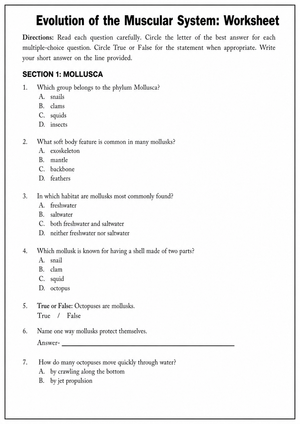
When students first meet the claim that all life shares common ancestry, they tend to treat it as something to believe or reject rather than something to reason about. A good set of evidence of evolution worksheets flips that dynamic. Instead of asking students to accept a conclusion, these activities hand them fossils, bone diagrams, embryo images, and DNA percentages and ask them to build the case themselves. That shift toward evidence-based reasoning is exactly what middle school life science and high school biology standards expect.
Why Evidence of Evolution Worksheets Belong in Your Biology Unit
Evolution is one of the few topics in the K-12 science sequence where the goal is not memorizing a single mechanism but weighing independent sources of data that all point the same direction. NGSS standard HS-LS4-1 asks students to communicate scientific information showing that common ancestry and biological evolution are supported by multiple lines of empirical evidence. Notice the plural. The standard is built around the idea that no single fossil or gene proves anything on its own; the strength comes from convergence across fossils, anatomy, embryology, molecules, and geography.
Worksheets are well suited to this because they let students slow down and annotate. A student can label homologous bones, circle a vestigial structure, or calculate a similarity percentage and then write a sentence explaining what that observation supports. The written explanation is where the standard actually lives, and it is the part students most often skip when a lesson stays verbal.
The Five Lines of Evidence to Build Into Your Worksheets
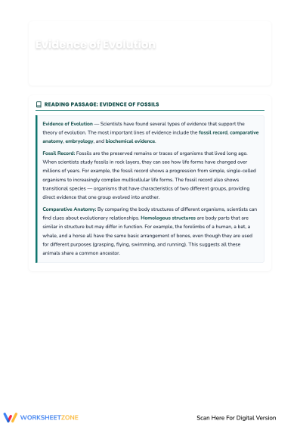
Most classroom-ready worksheet sets organize around five categories, and covering all five keeps your unit aligned with how evolution evidence is presented in resources like NGSS Life Science and Biology LibreTexts:
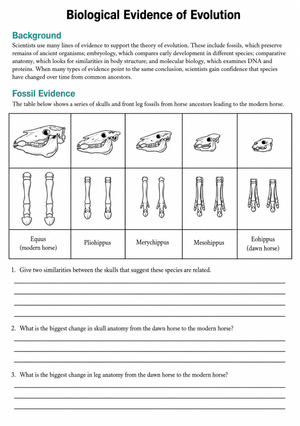
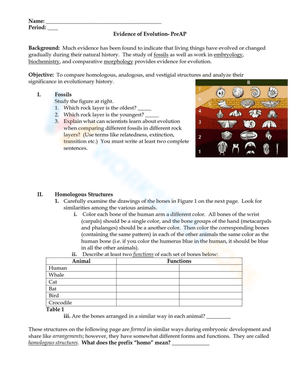
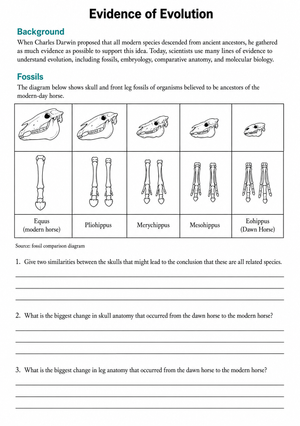
- Fossil evidence — the sequence of forms in the rock record, including transitional species that show intermediate traits.
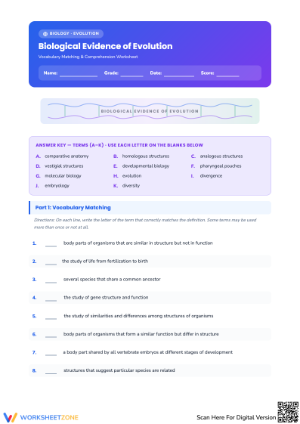
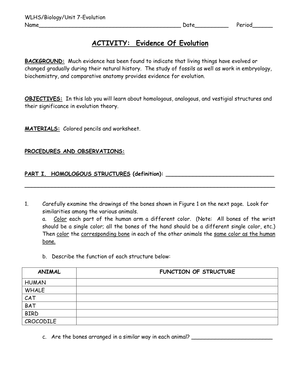
- Comparative anatomy — homologous structures that share a common plan and vestigial structures that persist without a current function.
- Embryological evidence — shared developmental features such as pharyngeal pouches and tails in vertebrate embryos.
- Molecular evidence — similarities in DNA and protein sequences that track relatedness across species.
- Biogeography — the distribution of species across continents and islands and what it reveals about descent with modification.
Designing at least one task per category prevents the common problem of a unit that leans entirely on fossils while students walk away thinking that gaps in the fossil record undercut the whole idea.
Homologous and Analogous Structures Side by Side
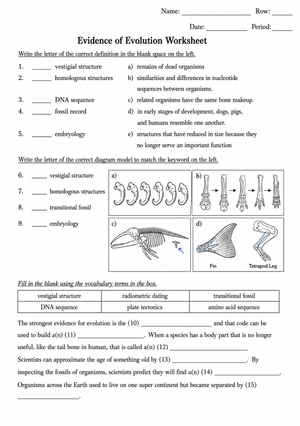
The distinction between homologous and analogous structures is where a lot of student reasoning breaks down, so it deserves a dedicated worksheet page. Homologous structures share an underlying pattern inherited from a common ancestor, even when their functions differ. The classic example is the same bone arrangement in a human arm, a bat wing, and a whale flipper. Analogous structures, by contrast, look or work alike but evolved independently, like a bird wing and an insect wing.
According to Khan Academy's overview of the lines of evidence for evolution, human and chimpanzee DNA sequences are roughly 98-99% identical, a level of molecular similarity that points to a recent shared ancestor. Worksheets that place this figure next to a bone-homology diagram let students see anatomical and molecular evidence agreeing, which is the convergence the standard asks them to communicate.
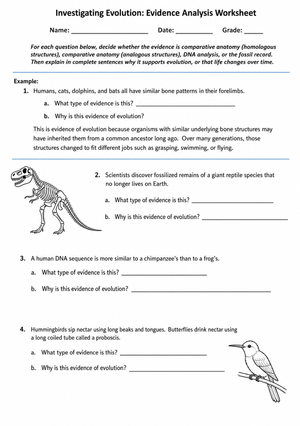
A simple worksheet move: give students four labeled limbs and ask them to color-code matching bones, then answer whether the similarity is best explained by common ancestry or by independent adaptation to the same task.
Molecular Evidence and DNA Similarity Data
Molecular data is the newest line of evidence and often the most convincing to students, because percentages feel objective. Beyond the human-chimpanzee comparison, worksheets can have students compare a short gene or protein sequence across several species and tally the number of matching bases or amino acids. Students then rank the species by similarity and propose which share the most recent common ancestor.
Conserved developmental genes add another layer. The same Hox genes regulate body-plan development across strikingly different animals, and embryos of different vertebrates share features like tails and pharyngeal pouches early in development. A worksheet that pairs embryo images with a note about shared genetic control helps students connect molecular and embryological evidence rather than treating them as separate facts.
Using These Worksheets In Real Classes
To turn these worksheets into a coherent unit rather than a stack of pages, sequence them so evidence accumulates. Start with fossils and anatomy, which are visual and intuitive, then move to embryology and molecules once students trust the pattern.
- Open with a sorting task. Have students sort images into the five evidence categories before any direct instruction to surface prior ideas.
- Use worksheets as formative checks. The written explanations reveal misconceptions, like the idea that a fossil 'gap' disproves evolution, while they are still correctable.
- Close each page with a claim-evidence-reasoning sentence. This mirrors the communication demand in HS-LS4-1.
Frequently Asked Questions
1. What are the main types of evidence for evolution that worksheets should cover?
Strong worksheet sets cover five lines: fossil evidence, comparative anatomy (homologous and vestigial structures), embryological evidence, molecular or DNA evidence, and biogeography. Covering all five shows students that common ancestry is supported by independent data that converge on the same conclusion.
2. How does the NGSS HS-LS4-1 standard apply to these worksheets?
HS-LS4-1 asks students to communicate that common ancestry and biological evolution are supported by multiple lines of empirical evidence. Worksheets meet this by having students analyze data from more than one evidence category and write explanations, not just recall definitions.
3. What grade levels typically teach evidence of evolution?
Evidence of evolution appears in middle school life science and again, in greater depth, in high school biology. Middle school work stays mostly qualitative, while high school adds quantitative tasks like DNA similarity comparisons and relatedness diagrams.
4. How can fossil evidence worksheets address student misconceptions?
Fossil worksheets counter the missing-link misconception by having students examine transitional forms such as Archaeopteryx and Tiktaalik and identify their mix of older and newer traits. This shows that intermediates exist and that the fossil record documents change over time.
5. What is a simple classroom example of homologous structures?
The clearest example is the shared bone pattern in a human arm, a bat wing, and a whale flipper. Despite different functions, the same bones appear in the same arrangement, which points to inheritance from a common ancestor rather than independent design.