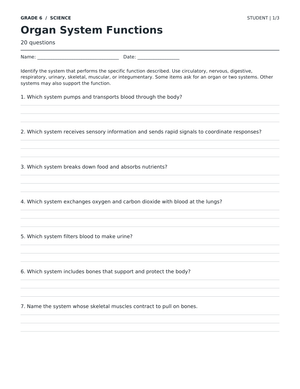
These organ system pdf worksheets give life science teachers a print-ready collection covering all 11 major human systems — skeletal through integumentary — with activities that move students from naming organs to reasoning about how those systems sustain life together. Each worksheet focuses on one specific task: labeling a blank body diagram, sorting organs into their correct systems, or writing a constructed-response explanation of how two systems depend on each other. That specificity makes each worksheet easy to drop into any instructional slot — a five-minute warm-up, a lab station, or a period-ending exit ticket — without adjusting anything else in the lesson.
What Students Actually Do in Each Worksheet
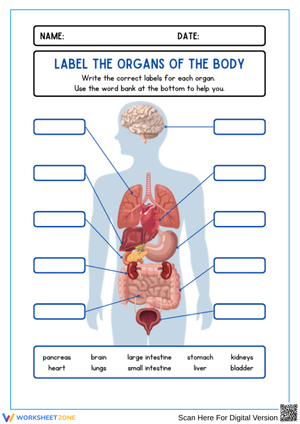
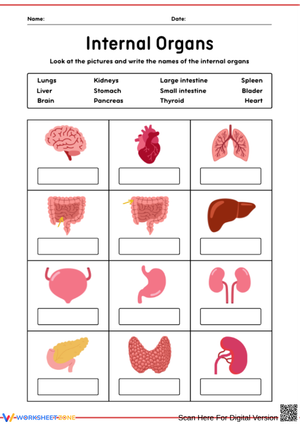
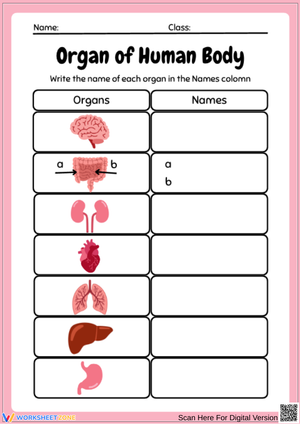
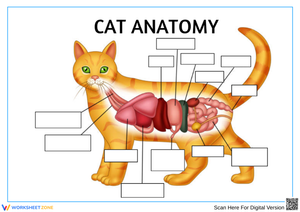
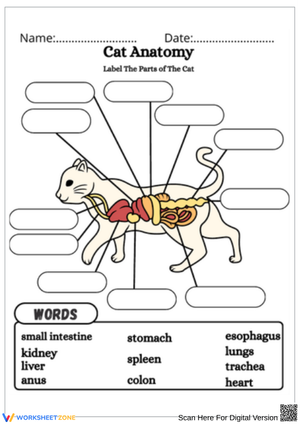
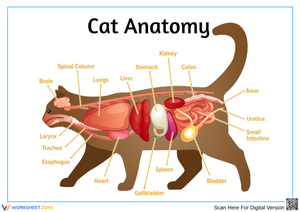
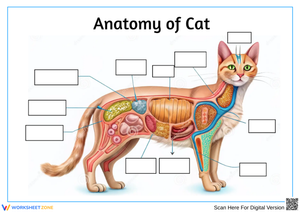
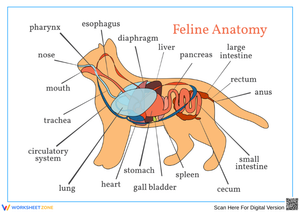
Labeling worksheets ask students to place organs spatially — marking kidney location, tracing the path of the large intestine, situating the thyroid against a body outline. That spatial work exposes a gap that lecture rarely catches: students who can recite "the kidneys filter blood" often still sketch them floating somewhere in the chest. A blank diagram makes the error visible within thirty seconds of pencil hitting paper.
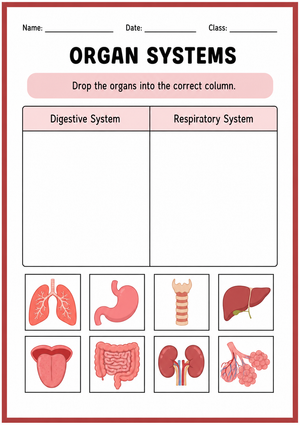
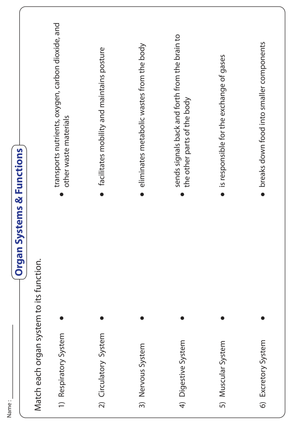
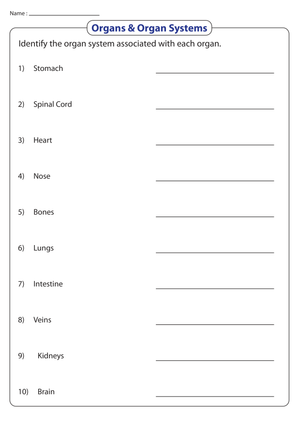
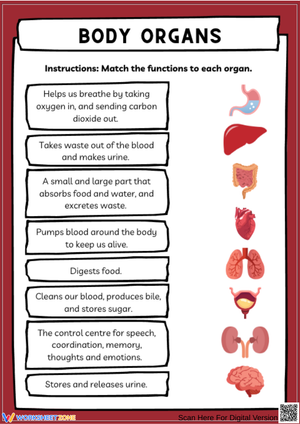
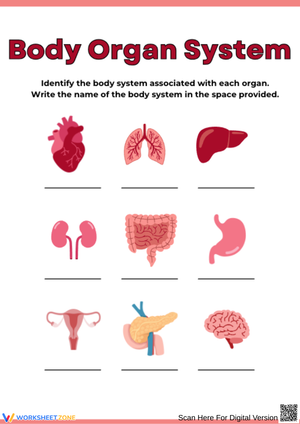
Sorting and matching worksheets present a list of organs and ask students to place each one under its correct system heading. The exercise sounds routine until a student reaches the pancreas and must decide between digestive and endocrine — the answer is both, and that moment of productive confusion is worth engineering deliberately. Compare-and-contrast charts, especially the pairing of the nervous and endocrine systems, push students to articulate the difference between electrical signaling and chemical signaling rather than treating both as interchangeable "body regulators."
Constructed-response prompts round out the activity formats. A question like "If the respiratory system failed to supply adequate oxygen during sustained exercise, what would happen to the muscular system? Cite at least two system interactions in your answer" requires the multi-system reasoning that separates a student who understands the body from one who has memorized a vocabulary list.
Predictable Student Errors These Worksheets Help You Catch
The most persistent misconception in this unit is system isolation — the belief that each organ system operates independently. Students confidently label the heart as circulatory but cannot explain that the respiratory system must re-oxygenate the blood before the heart can distribute it usefully. When a short-answer worksheet asks them to connect the two, that conceptual gap surfaces within the first sentence they write, before the unit assessment makes it costly to address.
A second pattern involves multi-function organs. Students consistently assign the pancreas to the digestive system exclusively because that is where it appears in most textbook diagrams. A sorting worksheet that lists the pancreas without flagging its endocrine role catches that assumption early. Students also regularly conflate the lymphatic and circulatory systems — both involve fluid moving through vessel-like structures — and without an explicit compare-and-contrast task, many treat them as the same system under two names. Exit-ticket data from grades 6 through 8 confirms this confusion appears reliably, even in classrooms where the distinction was addressed in direct instruction.
Smart Ways to Fit These Worksheets Into Your Lesson Plans
The strongest use of organ system pdf worksheets in a weekly rotation is pairing each one with a retrieval attempt rather than treating the worksheet as a post-lecture comprehension check. The day after introducing a new system, open class with a blank-diagram worksheet and give students six minutes to reconstruct what they remember before notes are visible. Spaced retrieval research is clear on this: the retrieval attempt — even when students get things wrong — primes the correction that follows far more effectively than re-reading notes does.
Station rotations suit this set well because the different activity formats map cleanly onto different stations: labeling at one, sorting at another, constructed-response at a third. Rotating every eight to ten minutes keeps energy up and guarantees students encounter multiple question types in a single period. After students complete a compare-and-contrast chart, a brief peer-teaching moment — each pair shares one finding with another pair before the rotation ends — deepens the explainer's understanding more than an additional solo review would, without requiring any extra materials.
For exit tickets, a single constructed-response worksheet gives a formative snapshot at the end of the period. Group the responses by the specific error students made — not by who made it — so reteaching the following day is targeted. Because the PDFs are already formatted for printing, that preparation takes under two minutes.
Standard Alignment
These organ system pdf worksheets align primarily with NGSS standard MS-LS1-3, which asks middle school students to construct an argument supported by evidence for how the body's systems interact to support essential life functions. That standard marks a specific instructional pivot: students must stop treating systems as a list and start treating them as a network. Worksheets that offer only recall tasks — name this organ, define this term — do not reach that bar. The constructed-response and compare-and-contrast formats in this set are what make the coverage substantive for MS-LS1-3 rather than adjacent to it.
Adjusting Each Worksheet for a Range of Readiness Levels
The same PDF supports differentiated instruction with modifications that require no reprinting. For students whose working memory is taxed by unfamiliar terminology, a printed word bank on a labeling worksheet shifts cognitive effort toward correct organ placement — the actual target skill — rather than spelling recall. Removing the word bank for students who have already demonstrated system fluency keeps the task appropriately demanding without creating a separate document.
- Students who freeze on constructed-response prompts: A sentence starter — "The circulatory system depends on the respiratory system because…" — removes the blank-page barrier while still requiring the student to complete the reasoning independently.
- English learners: Bold or italicize target vocabulary the first time it appears on each worksheet so students can locate terms quickly during matching tasks without scanning dense surrounding text.
- Students ready for extension: Ask them to add a second organ to each system on a sorting worksheet and write one function for each addition — a demand that deepens engagement without requiring a separate worksheet entirely.
- Pre-assessment review: Allow students to use a completed worksheet from earlier in the unit as a reference during a new compare-and-contrast task. It provides a concrete anchor without handing over the answers to the new activity.
Frequently Asked Questions
Does this set cover all 11 major organ systems?
Yes. Each worksheet addresses one or more of the following: skeletal, muscular, circulatory, respiratory, digestive, nervous, endocrine, lymphatic/immune, urinary, reproductive, and integumentary. Covering every system matters because students who study only the high-profile systems tend to build a fragmented mental model that makes the homeostasis unit significantly harder to teach later in the year.
What grade level is this set designed for?
Grades 6 through 8 are the primary target, consistent with the NGSS middle school life science progression. The body systems unit most often appears in 7th grade in state scope-and-sequence documents, but the labeling and sorting worksheets work well as preview or review material at the 6th or 8th grade level without modification.
Can individual worksheets be used for independent or take-home practice?
Each worksheet is self-contained — diagrams include all reference information students need, sorting charts include all categories, and constructed-response prompts provide enough context for students to work without live teacher support. Answer keys allow students or parents to check work without waiting for in-class feedback, which makes these practical for absent students and evening homework alike.
How do these worksheets address the NGSS move away from pure memorization?
The organ system pdf worksheets in this set include at least one constructed-response prompt per system cluster that asks for a cause-and-effect relationship rather than a definition. That design is deliberate: MS-LS1-3 calls for argumentation and evidence, and a worksheet that only asks students to match the kidney to the urinary system does not build the performance skill the standard actually requires.