































Essential Evidence of Evolution Worksheet for Grades 8‑12

Paste this activity's link or code into your existing LMS (Google Classroom, Canvas, Teams, Schoology, Moodle, etc.).
Students can open and work on the activity right away, with no student login required.
You'll still be able to track student progress and results from your teacher account.
This 4‑page worksheet guides students through essential evolution‑evidence vocabulary while they analyze real anatomical examples. Through 29 carefully sequenced tasks, learners define terms, label structures, and confront common misconceptions using fossil and skeletal data.
At a Glance
- Grade: Grades 8–12 · Subject: Science
- Standard: Analyze anatomical and fossil evidence to explain evolutionary relationships
- Skill Focus: Evidence of evolution vocabulary and structural classification
- Format: 4 pages · 29 problems · Answer key included · PDF
- Best For: Unit introduction and conceptual review
- Time: 40–50 minutes
What’s Inside
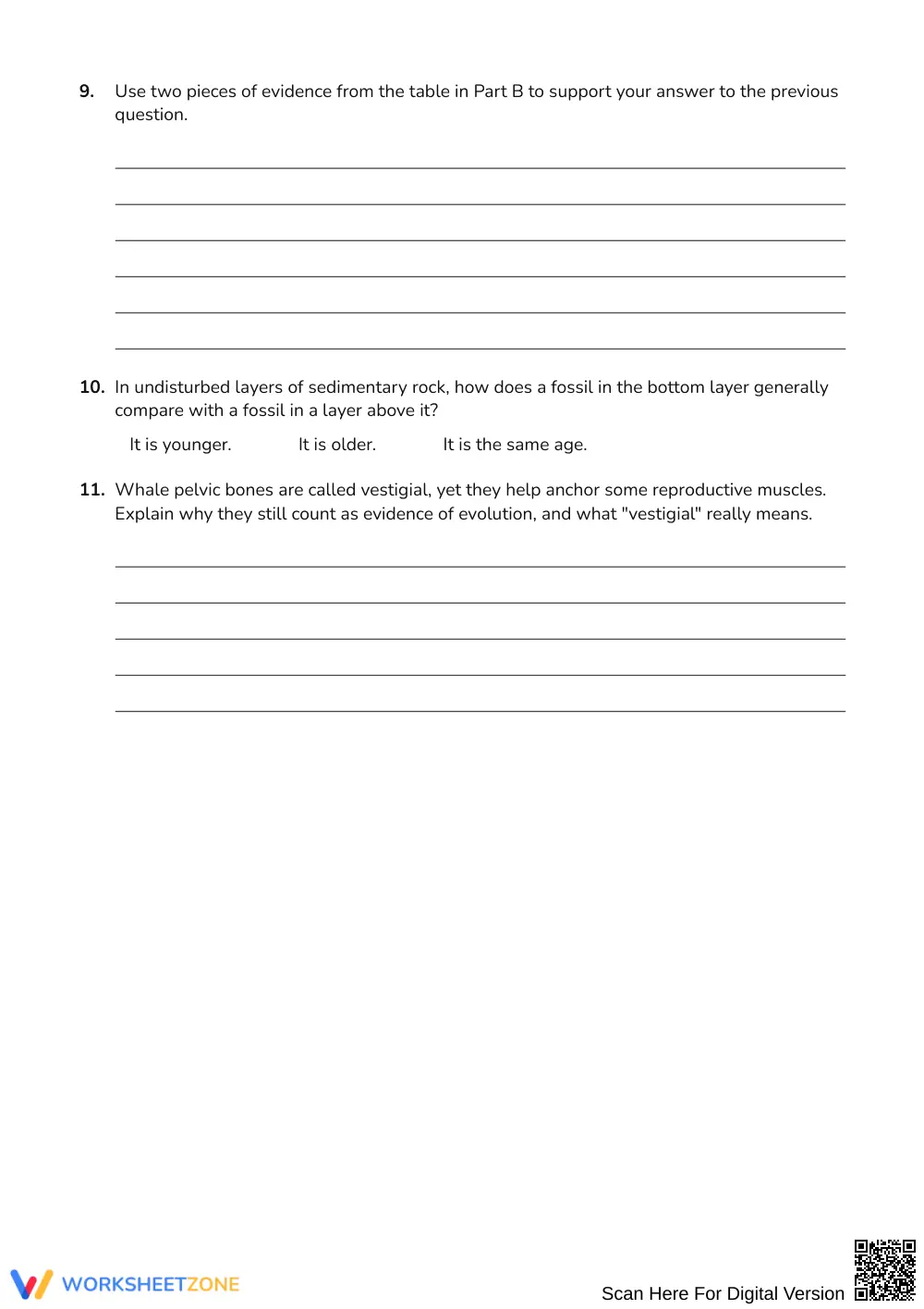
Students begin with a word‑bank activity that defines key terms such as adaptation, homologous, analogous, and vestigial. They then label a bat‑wing skeletal diagram and compare forelimb data across four vertebrate species. The final section asks learners to classify novel structures, interpret fossil‑age charts, and correct a targeted misconception about flight evolution.
Skill Progression
- Guided Practice (Part A, 9 tasks): Define foundational terms and match each to authentic biological examples.
- Supported Practice (Part B, 8 tasks): Label the bat wing model and use a comparative data table to identify patterns of similarity.
- Independent Practice (Part C, 12 tasks): Classify new anatomical features, evaluate stratigraphic ages, and resolve the misconception check.
The sequence follows an I‑Do, We‑Do, You‑Do release, moving students from recall to higher‑order comparative reasoning.
Standards Alignment
The resource aligns with typical middle‑ and high‑school life‑science expectations that require analysis of anatomical structures and fossil distribution to infer shared ancestry. Teachers can copy the alignment statement directly into lesson plans or curriculum maps.
How to Use It
Deploy the worksheet after a short lecture on evolutionary evidence. It works as a paired activity or an individual checkpoint. Monitor Part C to ensure students do not confuse functional similarity with common ancestry. The entire set fits within a 40‑ to 50‑minute class period.
Who It’s For
Designed for secondary biology students, the activity supports visual learners with labeled diagrams and English‑language learners with a scaffolded word bank. Pair it with a slide deck on homologies or with physical vertebrate bone specimens for maximum impact.
Research shows that explicit vocabulary instruction combined with concrete visual models accelerates conceptual understanding in science classrooms. Fisher & Frey (2014) report that students who receive scaffolded definitions followed by immediate application achieve higher mastery of complex terms. This worksheet embodies that approach across 29 tasks, ensuring learners not only memorize words like homologous, analogous, and vestigial but also apply them to real data sets and fossil‑age charts. By confronting persistent misconceptions directly, the resource deepens scientific literacy and prepares students for later work on evolutionary genetics and phylogenetic trees in high‑school biology.


