


























Views
Downloads
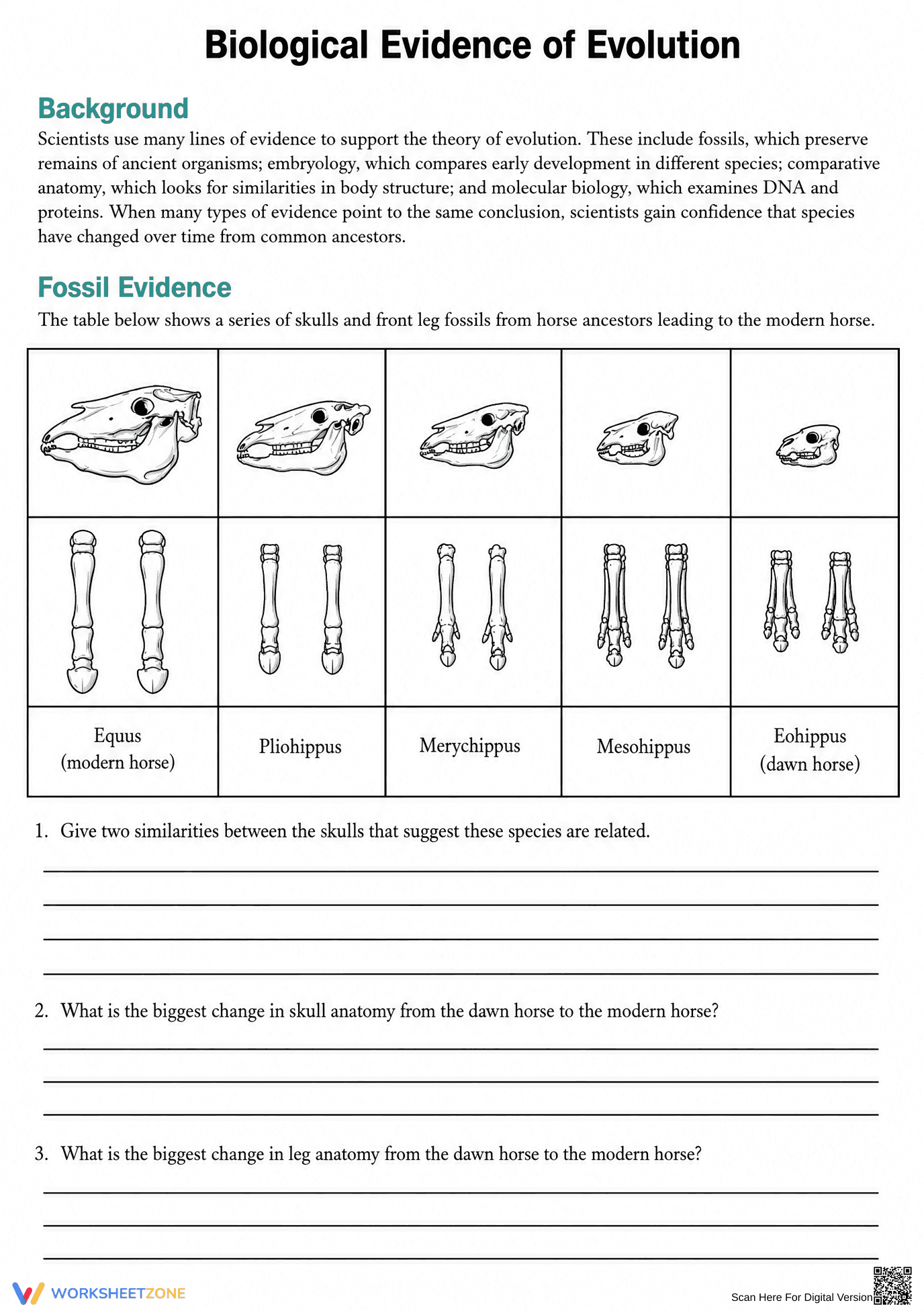

Grade 8 Fossil Evidence — Printable No-Prep Worksheet
Paste this activity's link or code into your existing LMS (Google Classroom, Canvas, Teams, Schoology, Moodle, etc.).
Students can open and work on the activity right away, with no student login required.
You'll still be able to track student progress and results from your teacher account.
This Grade 8 science worksheet introduces students to the biological evidence of evolution by analyzing anatomical changes in the fossil record. By examining the skull and leg structures of horse ancestors, students will draw evidence-based conclusions about how species adapt and change over millions of years.
At a Glance
- Grade: 8 · Subject: Science
- Standard:
MS-LS4-2— Infer evolutionary relationships from anatomical similarities and differences- Skill Focus: Analyzing fossil evidence and anatomical changes
- Format: 1 page · 3 problems · Answer key included · PDF
- Best For: Independent practice or sub plans
- Time: 15–20 minutes
This single-page resource features a concise background reading on Darwin's theory and multiple lines of evolutionary evidence. The core activity centers on a detailed visual table displaying the skulls and front leg fossils of five horse ancestors, from the dawn horse (Eohippus) to the modern horse (Equus). Students respond to three short-answer questions requiring them to identify structural similarities and track specific anatomical shifts over time. A complete answer key is provided for easy grading.
Zero-Prep Workflow
- Print (1 minute): Simply print the single-page PDF. No special materials or prior setup are required.
- Distribute (1 minute): Hand out the worksheet as a standalone assignment. The included background text ensures students have the context they need to begin immediately.
- Review (3 minutes): Use the provided answer key to quickly check student responses or facilitate a brief class discussion on their findings.
With a total teacher prep time of under two minutes, this resource is highly effective for emergency sub plans or quick formative assessments.
Standards Alignment
This activity is directly aligned to MS-LS4-2: Apply scientific ideas to construct an explanation for the anatomical similarities and differences among modern organisms and between modern and fossil organisms to infer evolutionary relationships. It also supports high school standard HS-LS4-1 by introducing multiple lines of empirical evidence for biological evolution. Both standard codes can be copied directly into lesson plans, IEP goals, or district curriculum mapping tools.
How to Use It
This worksheet serves as an excellent independent practice activity following direct instruction on the fossil record. Alternatively, it functions perfectly as a "Do Now" or bell-ringer to activate prior knowledge before moving into comparative anatomy. As students work, observe their responses to the second and third questions; this provides a quick formative assessment of their ability to translate visual data into written scientific observations. Expected completion time is 15 to 20 minutes.
Who It's For
This resource is designed primarily for middle school life science and introductory high school biology students. For learners who need additional scaffolding, teachers can pre-highlight key terms in the background text or provide sentence starters for the short-answer questions. It pairs naturally with interactive timeline activities or physical fossil modeling labs to reinforce the concept of gradual evolutionary change.
Effectively teaching students to infer evolutionary relationships from anatomical similarities and differences requires clear, visual data representations. According to a ScienceDirect TpT Analysis, integrating structured visual models with targeted analytical questions significantly improves student comprehension of abstract biological processes like evolution. This resource addresses MS-LS4-2 by providing a concrete, step-by-step visual progression of horse ancestry, allowing learners to directly observe and document structural adaptations over time. By grounding theoretical concepts in observable fossil evidence, educators can foster stronger scientific reasoning and data interpretation skills. The combination of concise background reading and focused visual analysis ensures that students are not merely memorizing facts, but actively engaging in the scientific practice of evidence-based deduction, a critical competency for advanced STEM coursework.


