




























Views
Downloads
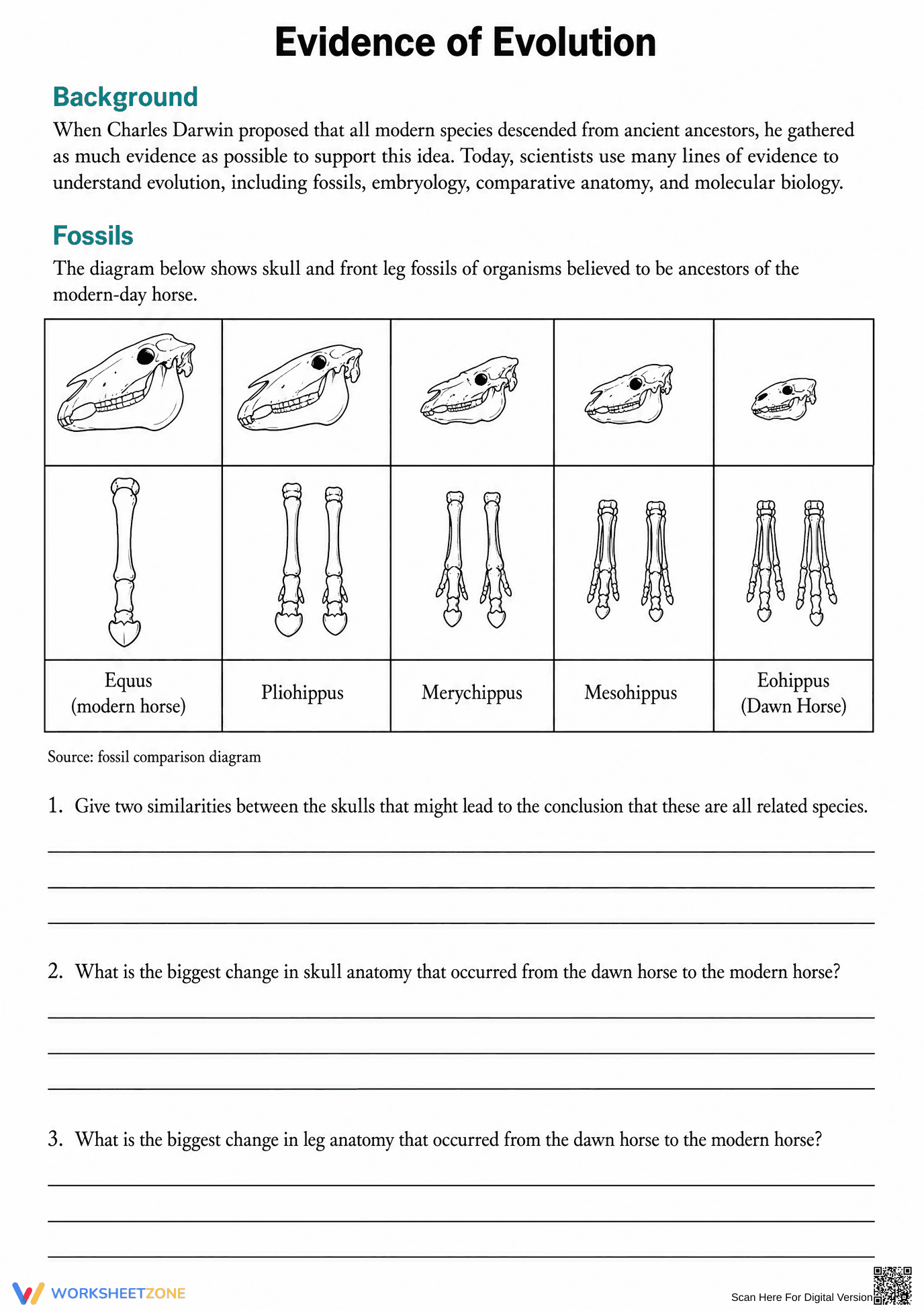

Grade 8 Evidence of Evolution — Printable No-Prep Worksheet

Paste this activity's link or code into your existing LMS (Google Classroom, Canvas, Teams, Schoology, Moodle, etc.).
Students can open and work on the activity right away, with no student login required.
You'll still be able to track student progress and results from your teacher account.
This evidence of evolution worksheet provides middle school students with a clear introduction to comparative anatomy. By analyzing structural changes in horse ancestors, learners observe how anatomical similarities support biological evolution.
At a Glance
- Grade: 8 · Subject: Science
- Standard:
MS-LS4-2— Infer evolutionary relationships using anatomical similarities and differences.- Skill Focus: Analyzing fossil evidence
- Format: 1 page · 3 problems · Answer key included · PDF
- Best For: Independent practice or sub plans
- Time: 15–20 minutes
Inside this resource is a single-page activity centered on a diagram of horse evolution, tracing skulls and front legs from Eohippus to Equus. Students respond to three short-answer questions identifying anatomical changes and explaining shared lineages. A complete answer key is provided.
Designed for immediate implementation with a zero-prep workflow:
- Print (1 min): Download the PDF and print. Diagrams reproduce perfectly.
- Distribute (1 min): Hand out the activity. Embedded text provides necessary context.
- Review (3 mins): Use the answer key to check responses.
With under two minutes of teacher prep time, this is ideal for biology units or sub plans.
Aligned to MS-LS4-2: Apply scientific ideas to construct an explanation for the anatomical similarities and differences among modern organisms and between modern and fossil organisms to infer evolutionary relationships. Both standard codes can be copied directly into lesson plans, IEP goals, or district curriculum mapping tools.
Deploy this worksheet during an evolution unit, following a lecture on natural selection. It serves as excellent independent practice for comparative anatomy. Use it as a formative assessment; observing how students articulate anatomical changes helps gauge their ability to interpret scientific diagrams. Expected completion time is 15 to 20 minutes.
Designed for 7th to 9th-grade science students exploring biology. The clear visual scaffolds make it accessible for diverse learners who benefit from visual aids. It pairs perfectly with direct instruction on the fossil record.
Effectively teaching biological concepts requires resources that connect abstract theories to observable data. This worksheet aligns with MS-LS4-2, helping students infer evolutionary relationships using anatomical similarities and differences. According to a ScienceDirect TpT Analysis, integrating visual models like fossil diagrams significantly enhances middle school students' comprehension of long-term evolutionary changes. By requiring learners to actively compare the structural traits of the Eohippus and the modern Equus, this activity moves beyond rote memorization, fostering critical thinking and data interpretation skills. The structured progression from reading background context to analyzing visual evidence ensures that students build a robust, evidence-based understanding of natural selection. Providing clear, concise, and visually supported materials is essential for developing scientific literacy and preparing students for more advanced biological studies in high school and beyond.


