




























Views
Downloads

Evidence for Evolution Worksheet | Essential Grade 9-12

Paste this activity's link or code into your existing LMS (Google Classroom, Canvas, Teams, Schoology, Moodle, etc.).
Students can open and work on the activity right away, with no student login required.
You'll still be able to track student progress and results from your teacher account.
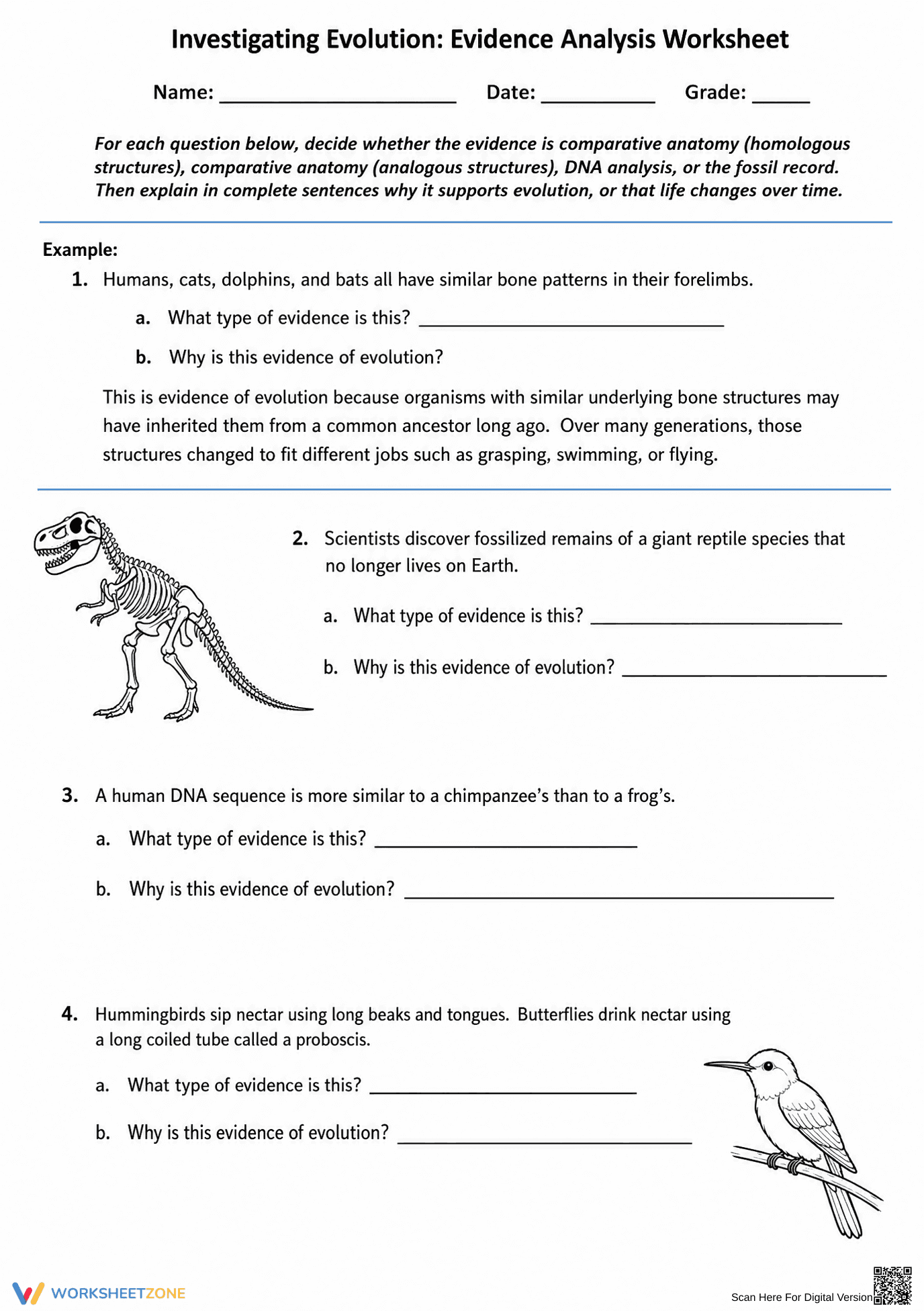
This high school biology worksheet guides students through the critical analysis of evolutionary evidence. By examining real-world scenarios involving comparative anatomy, molecular biology, and the fossil record, learners develop the ability to explain how diverse data points converge to support the theory of common ancestry and biological change over time.
At a Glance
- Grade: 9-12 · Subject: Biology
- Standard:
HS-LS4-1— Communicate scientific information that common ancestry is supported by multiple lines of empirical evidence- Skill Focus: Evidence Analysis (Anatomy, DNA, Fossils)
- Format: 2 pages · 6 tasks · Answer key included · PDF
- Best For: Reinforcing evolutionary theory and evidence types
- Time: 30–45 minutes
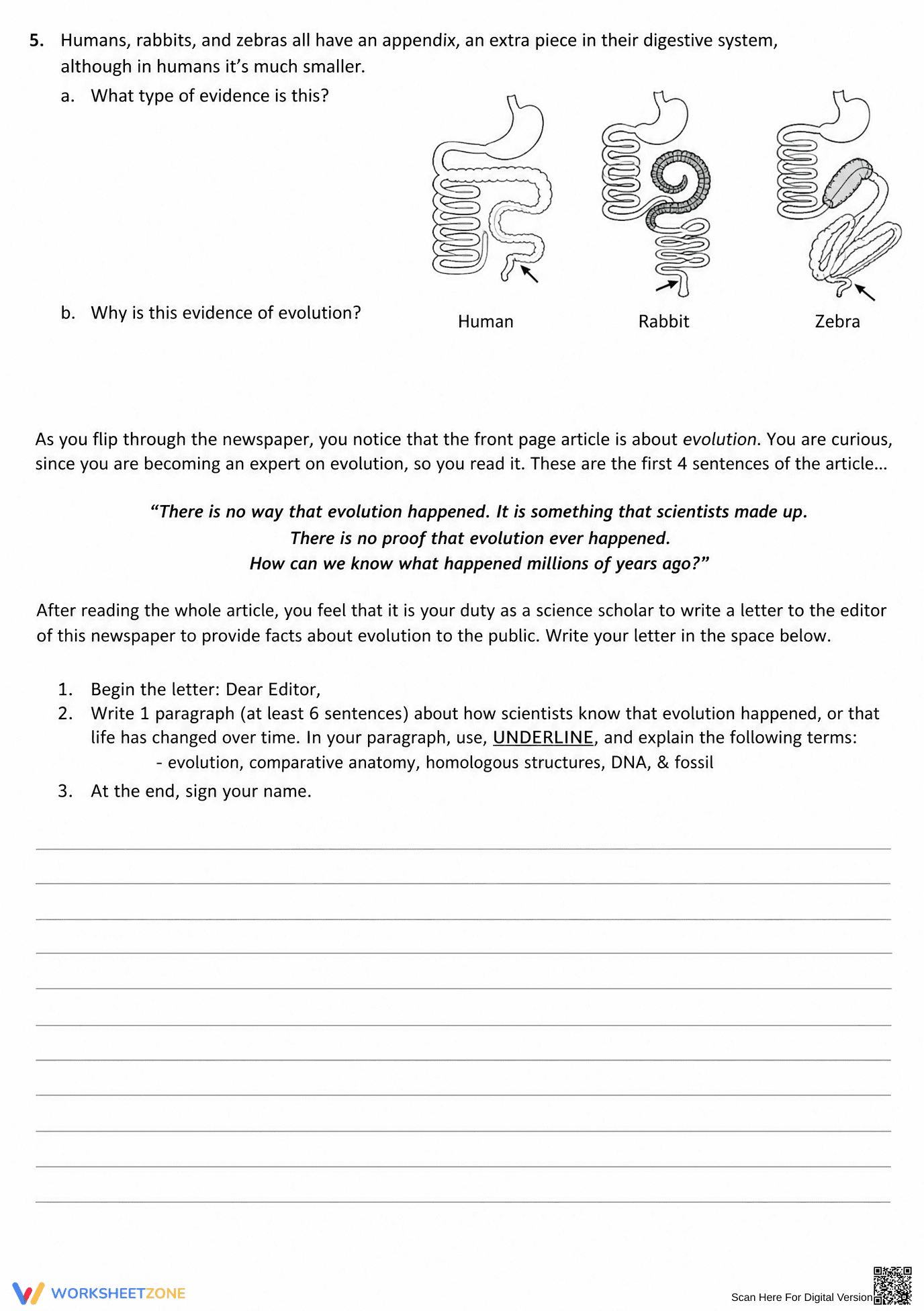
The resource consists of a two-page PDF featuring five structured analysis scenarios and one extended writing prompt. Students encounter specific examples such as mammalian forelimb structures, vestigial organs like the appendix, and DNA sequence comparisons. Each task requires identifying the evidence type and providing a written justification. A clear worked example is included to model high-quality scientific explanations.
Zero-Prep Workflow
- Print: Select the double-sided print option for the 2-page document (30 seconds).
- Distribute: Hand out to students as a follow-up to direct instruction on Darwinian theory (1 minute).
- Review: Use the provided answer key or the built-in example to facilitate a whole-class check or peer-review session (10 minutes).
Total teacher preparation time is under two minutes, making this an ideal sub plan or ready-to-use lab supplement.
Standards Alignment
This worksheet is directly aligned with HS-LS4-1: "Communicate scientific information that common ancestry and biological evolution are supported by multiple lines of empirical evidence." It specifically addresses the NGSS requirement for students to integrate patterns in the fossil record, anatomical similarities, and molecular similarities. This standard code can be copied directly into lesson plans, IEP goals, or district curriculum mapping tools.
How to Use It
Assign this worksheet during the "Explain" or "Elaborate" phase of a 5E instructional cycle. It serves as an excellent formative assessment to gauge if students can distinguish between homologous and analogous structures. Expect students to spend approximately 35 minutes completing the analysis and the "Letter to the Editor" synthesis task.
Who It's For
Designed for high school biology students, this resource is particularly effective for learners who need practice articulating scientific reasoning. It pairs naturally with a comparative anatomy lab or a virtual fossil record exploration. The writing component provides a valuable literacy connection for integrated ELA/Science classrooms.
According to the RAND AIRS 2024 report on science literacy, structured evidence-analysis tasks are vital for moving students from rote memorization to conceptual mastery of evolutionary biology. This worksheet addresses the HS-LS4-1 standard by requiring students to synthesize information from the fossil record, DNA analysis, and comparative anatomy. By engaging with 6 distinct tasks, including a persuasive writing prompt, students demonstrate their ability to communicate complex scientific information. Research from Fisher & Frey (2014) suggests that providing worked examples, like the one included here, significantly improves the quality of student-generated scientific explanations. This resource provides a rigorous yet accessible framework for high school learners to explore the empirical foundations of biological evolution, ensuring they meet national benchmarks for college and career readiness in the sciences.


