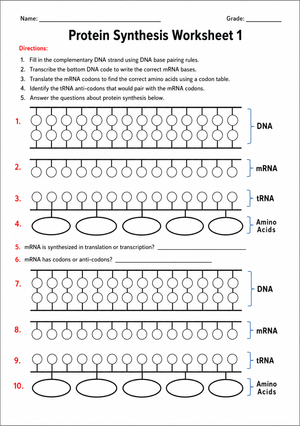
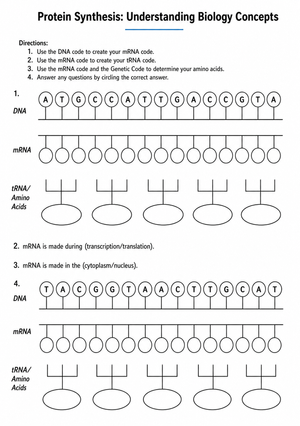
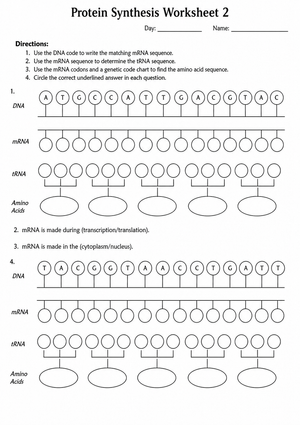
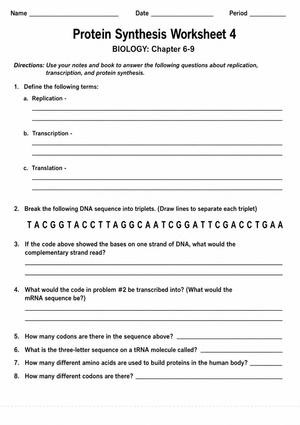
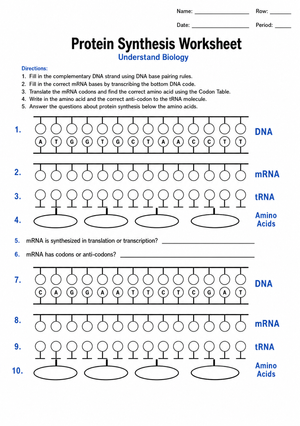
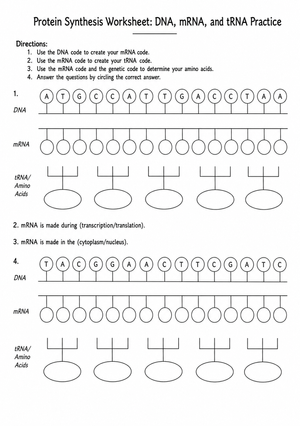
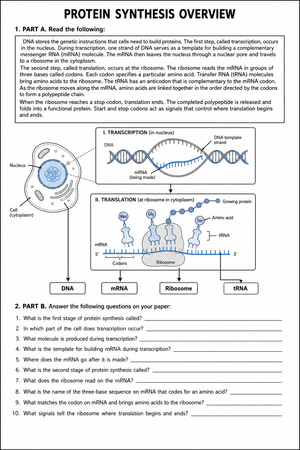
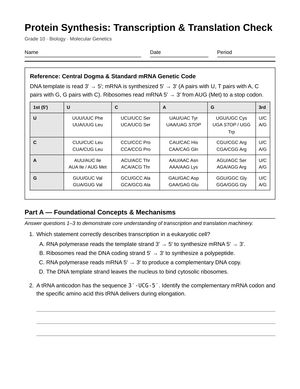
Transcription and translation are two of the densest concepts in a biology course, and students often lose the thread between DNA structure and the protein it eventually builds. Protein synthesis worksheets give teachers a structured way to slow that process down. Instead of asking students to hold the whole DNA to mRNA to amino acid chain in their heads at once, a well-designed worksheet breaks it into discrete steps students can check as they go, which matters most during the first pass through new content and again right before a unit test.
These worksheets are especially useful in classrooms that mix visual and kinesthetic learners, since a printed codon chart and a blank strand of bases give every student the same starting point regardless of reading level. For teachers building or refreshing a genetics unit, worksheets also double as a quick way to see, at a glance, which students are transcribing correctly but translating incorrectly, or vice versa.
Aligning These Worksheets to MS-LS3-1 and HS-LS1-1
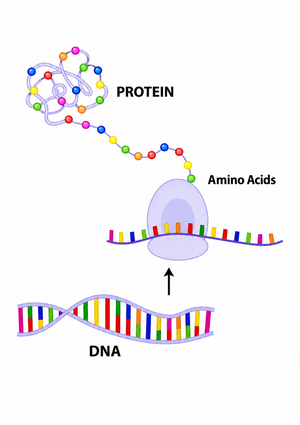
Grade band matters a lot when choosing or building a protein synthesis worksheet. Middle school life science standard MS-LS3-1 introduces how DNA and RNA relate to gene expression at a conceptual level, so worksheets for this age group should focus on the basic flow: DNA carries the code, RNA copies it, and that copy becomes a protein. Diagrams and simplified base-pairing tasks work well here.
High school biology standard HS-LS1-1 asks students to construct an explanation for how DNA structure determines protein structure, which in turn carries out the specialized functions of cells. That is a deeper analytical task than the middle school version, so high school worksheets should push students to explain, not just execute, each step. A strong high school worksheet asks students to justify why a particular codon change would or would not alter the resulting amino acid, not just to fill in a chart.
The practical difference between the two standards is depth of explanation, not topic coverage. Both MS-LS3-1 and HS-LS1-1 touch DNA, RNA, and gene expression, but a middle schooler is expected to describe the general relationship while a high schooler is expected to construct a causal explanation linking DNA sequence to protein function. Worksheets pitched at the wrong depth for the grade band either bore high schoolers with rote fill-in tasks or overwhelm middle schoolers with explanatory writing they are not yet ready for.
Building Transcription Fluency Before Translation
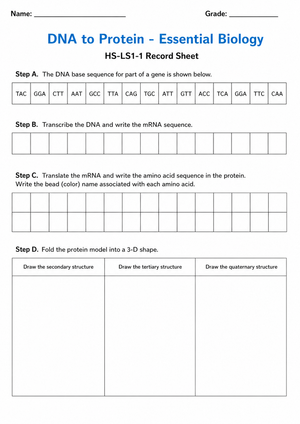
Most protein synthesis worksheets ask students to transcribe a given DNA strand into mRNA before translating that mRNA into an amino acid sequence. It helps to treat these as two separate skills rather than one combined task, at least during initial instruction. A worksheet that isolates transcription first, with several short DNA strands and immediate answer checking, lets students master base-pairing rules (including the DNA to RNA swap of thymine for uracil) before codons enter the picture.
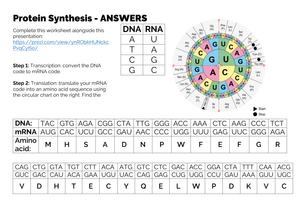
Once transcription is solid, translation practice worksheets that pair mRNA codons with a codon chart become far more productive, since students are not simultaneously fighting confusion about which strand they are even reading. This sequencing also makes grading faster, because errors traceable to transcription versus translation show up in different worksheet sections rather than being tangled together in one long strand-to-protein task.
Using Codon Chart Practice to Build Independence
Reading a codon chart is its own skill, separate from understanding what transcription and translation represent biologically. Worksheets that give students repeated, low-stakes codon chart lookups build the kind of fluency that pays off during timed assessments, when students cannot afford to search the chart slowly for every codon. Short, frequent codon chart worksheets, even just five or six codons at a time, tend to build more lasting fluency than one long worksheet completed under time pressure.
For students who still struggle with reading the chart correctly, color-coding worksheets by row or highlighting stop codons in a different color from other codons can reduce careless errors, which is especially useful for students with reading or attention accommodations.
Classroom Implementation
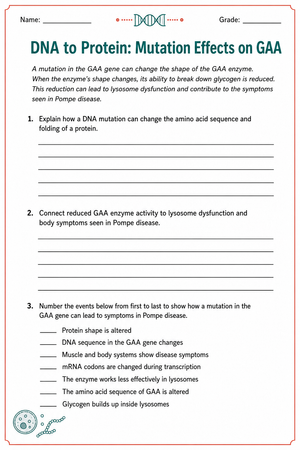
When building a protein synthesis unit around worksheets, sequence matters. Start with DNA structure and base-pairing rules, move to transcription-only practice, then introduce the codon chart and translation, and finish with combined worksheets that require the full DNA to protein sequence independently. Save any worksheet that asks students to explain, in writing, why a specific DNA mutation would or would not change the resulting protein for the high school HS-LS1-1 level, since that explanatory task is where the standard's depth actually lives.
For review before an assessment, mix formats: one worksheet focused purely on codon chart accuracy, one combined transcription-translation worksheet under light time pressure, and one that asks students to identify a planted error in a sample strand. This variety surfaces different kinds of misunderstanding than a single worksheet type would.
Frequently Asked Questions
1. What grade level typically covers protein synthesis worksheets?
Protein synthesis worksheets show up in both middle school and high school biology, but the expected depth differs. Middle school worksheets introduce the basic DNA to RNA to protein relationship, while high school worksheets require students to explain how DNA structure determines protein structure and function.
2. What NGSS standards do protein synthesis worksheets align to?
Middle school worksheets commonly align to MS-LS3-1, which covers how DNA and RNA relate to gene expression. High school worksheets commonly align to HS-LS1-1, which asks students to construct an explanation linking DNA structure to protein structure and cell function.
3. How can teachers use these worksheets for review versus new instruction?
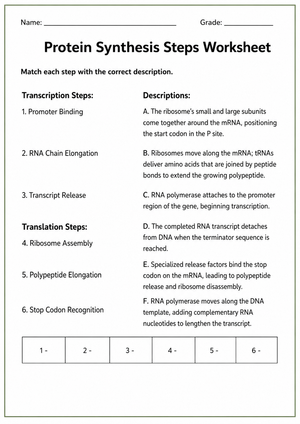
During new instruction, worksheets work best broken into separate transcription-only and translation-only practice so students build each skill before combining them. For review, mixed-format worksheets that combine both steps, or that include a planted error to identify, help surface lingering misconceptions before a test.
4. What should a protein synthesis worksheet include to cover both transcription and translation?
A complete worksheet should give students a DNA strand to transcribe into mRNA, a codon chart to translate that mRNA into an amino acid sequence, and space to record each intermediate step so teachers can trace exactly where an error occurred.
5. How do these worksheets support struggling students in molecular genetics?
Breaking the DNA to protein process into discrete, checkable steps helps struggling students avoid the confusion of tracking the entire pathway at once. Color-coded codon charts, shorter practice sets, and pairing worksheets with hands-on foldables or team activities can further reduce errors for students who need more scaffolding.