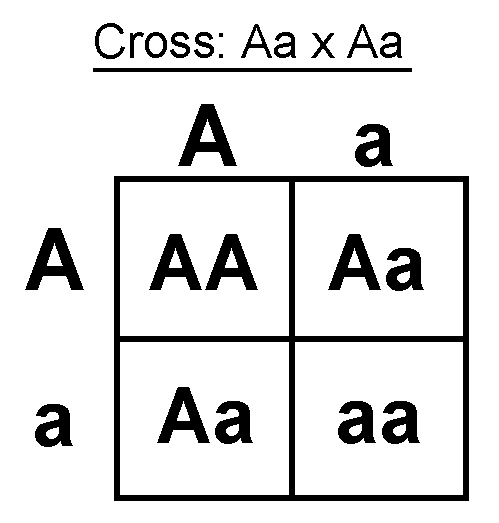
Students rarely fail Punnett square problems because they cannot draw a grid. They fail because they cannot hold onto what allele, genotype, and phenotype actually mean while also tracking probability. Genetics vocabulary worksheets exist to solve that specific bottleneck. Before a heredity unit asks students to reason about inheritance, they need automatic recall of the terms that describe it. In classrooms working through MS-LS3 (Heredity: Inheritance and Variation of Traits), students are expected to model why asexual reproduction produces identical offspring while sexual reproduction produces variation, and that explanation is impossible to construct without secure vocabulary for allele, genotype, and phenotype already in place.
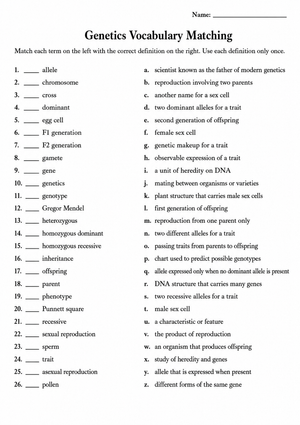
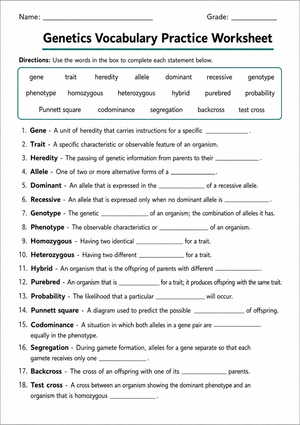
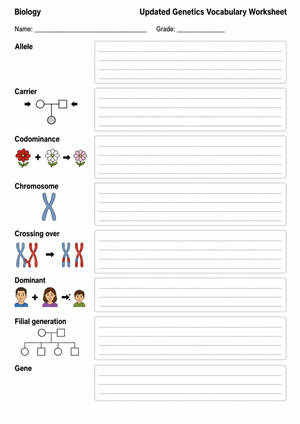
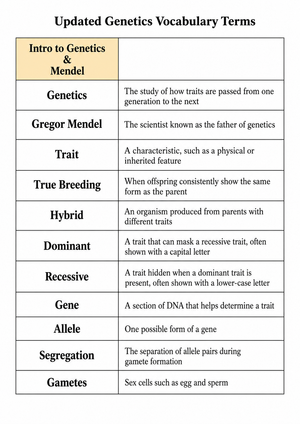
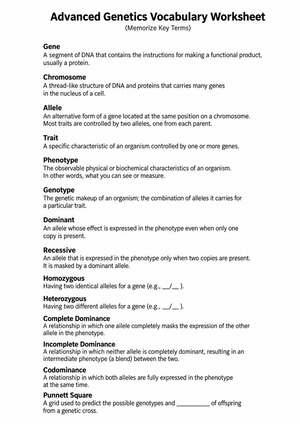
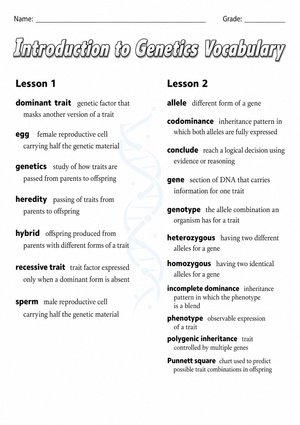
A well-built worksheet for this unit is not a random word list. It should reflect the terms students will actually need in the sequence that follows: gene, allele, dominant, recessive, genotype, phenotype, homozygous, heterozygous, trait, heredity, and Punnett square. Middle school worksheets can stop there. High school worksheets often extend into molecular vocabulary, since HS-LS3-1 asks students to clarify the relationship between DNA, chromosomes, and coded instructions for inherited traits before they move into probability-based reasoning.
Sequencing Vocabulary Before Punnett Square Practice
Teachers get the most out of these worksheets when they treat vocabulary as step one in a three-step sequence rather than an isolated activity. A practical order looks like this:
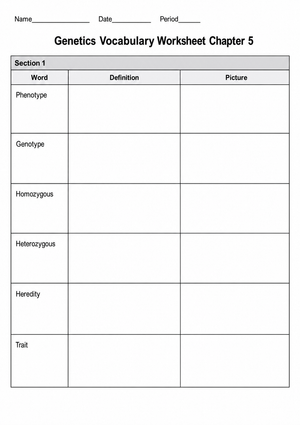
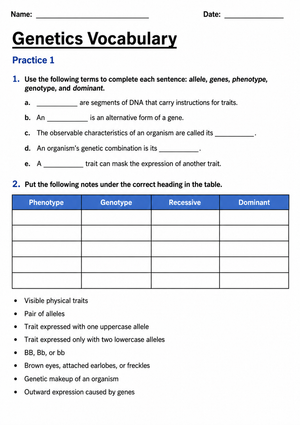
- Vocabulary worksheet: definitions, matching, or fill-in-the-blank with the core term list
- Genotype and phenotype matching or sorting practice using simple trait examples
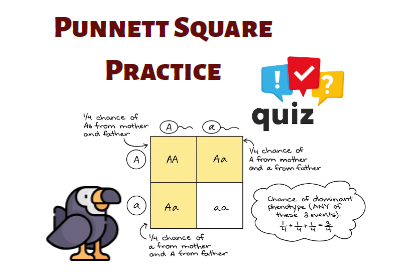
- Punnett square practice, once terminology is automatic rather than something students are still decoding
Skipping straight to Punnett squares without this scaffold tends to produce students who can fill in a grid mechanically but cannot explain what the letters in the boxes represent, which shows up later as confusion on inheritance problems that ask for phenotype ratios rather than genotype ratios.
The Genotype and Phenotype Mix-Up
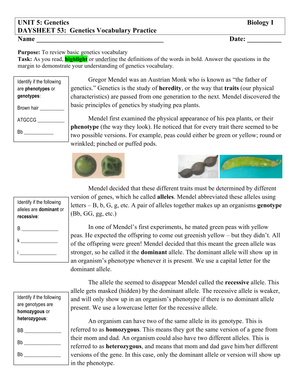
This is the single most common vocabulary error in a heredity unit. Genotype is the underlying allele combination, such as Bb. Phenotype is the observable trait that results, such as brown eyes. Students often use the terms interchangeably because both describe something about an organism, and worksheets that force a direct compare-and-contrast (not just separate definitions) are more effective at breaking the habit than definitions alone. A quick diagnostic works well: give students a genotype and ask for the phenotype, then reverse it and ask them to identify a possible genotype for a given phenotype, since more than one genotype can produce the same observable trait.
Homozygous vs Heterozygous: A Second Common Trap
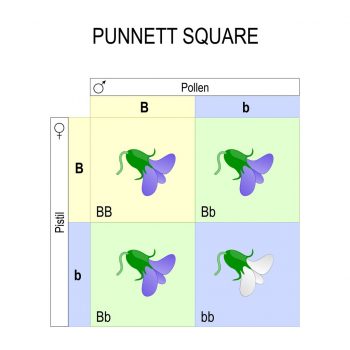
The second recurring confusion pairs homozygous and heterozygous with dominant and recessive, as if they are the same axis of meaning. Homozygous and heterozygous describe whether the two alleles at a location match (BB or bb) or differ (Bb). Dominant and recessive describe how an allele behaves when paired with a different one. A student can be homozygous recessive, homozygous dominant, or heterozygous, and worksheets that include all three combinations in practice items, rather than only the two most obvious pairings, surface this gap before it derails a full Punnett square lesson.
Teacher Tips
A few adjustments make genetics vocabulary worksheets more effective in a real classroom rotation:
- Pair each term with a non-example, not just a definition, since students often recognize a correct definition but still misapply the term in context
- Use the same term set across the vocabulary worksheet, the genotype and phenotype practice, and the Punnett square worksheet so students see consistent language rather than shifting phrasing
- Reserve five minutes at the start of Punnett square lessons for a quick vocabulary recall check, since terms fade fast without repeated retrieval
- For students entering the unit with weak recall, assign the vocabulary worksheet as independent or small-group review a day ahead rather than during the Punnett square lesson itself
Frequently Asked Questions
1. What genetics vocabulary terms should students know before starting Punnett squares?
Students should be able to define and correctly apply gene, allele, dominant, recessive, genotype, phenotype, homozygous, heterozygous, trait, and heredity before starting Punnett square practice. High school classes typically add DNA, chromosome, and meiosis, since HS-LS3-1 connects these terms to inherited traits ahead of probability-based tasks in HS-LS3-3.
2. How can teachers use vocabulary worksheets to check readiness for a heredity unit?
A short matching or fill-in-the-blank vocabulary worksheet given at the start of the unit works as a quick formative check. Students who complete it accurately and quickly are ready for genotype and phenotype practice, while students who struggle benefit from a targeted small-group review before moving into Punnett square work.
3. What is the difference between genotype and phenotype, and why do students confuse them?
Genotype is the underlying allele combination, such as Bb, while phenotype is the observable trait that results, such as a specific eye color. Students confuse the two because both describe something about an organism. Worksheets that ask students to move directly between a given genotype and its possible phenotype, and back again, help separate the concepts more effectively than definitions alone.
4. How do genetics vocabulary needs differ between middle school and high school biology?
Middle school students working under MS-LS3 need the foundational term set covering how traits are inherited and why sexual reproduction produces variation. High school students build on that base with molecular vocabulary tied to HS-LS3-1 and apply probability reasoning to inheritance patterns under HS-LS3-3, which requires a deeper and more precise vocabulary foundation than the middle school unit.