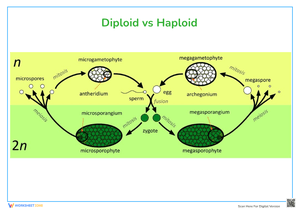
Diploid cells, written as 2n, contain two complete sets of chromosomes, one inherited from each parent. Haploid cells, written as n, contain a single set. In humans, diploid body cells carry 46 chromosomes arranged as 23 homologous pairs, while haploid gametes, the sperm and egg, carry 23 chromosomes each. Once students see this pairing structure clearly, the arithmetic of dividing or doubling a chromosome count becomes far less mysterious.
A useful classroom framing is to ask students what would happen if two diploid cells fused during fertilization without any reduction division first. The chromosome number would double every generation, which is obviously not what happens in nature. This question sets up the purpose of meiosis before any formulas appear on a worksheet.
The Core Calculation Method Students Need
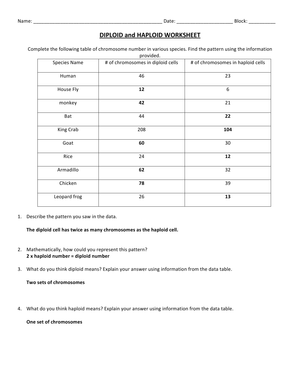
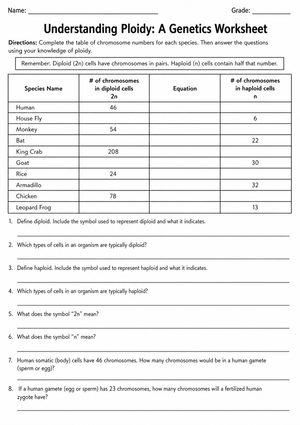
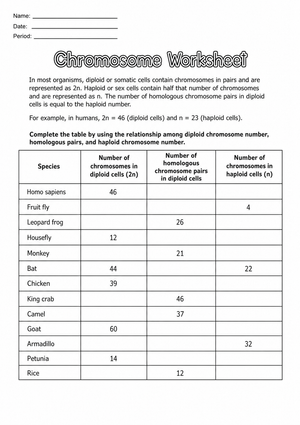
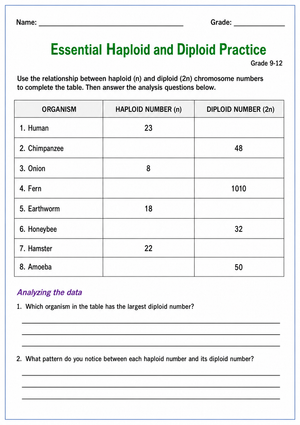
Most calculating haploid and diploid numbers worksheets rely on one relationship: 2n is always twice n. If a worksheet gives students the diploid number, they divide by two to find n. If it gives the haploid number, they multiply by two to find 2n. The challenge is not the division or multiplication itself, it is knowing which number the problem has already given them.
A pattern shows up across biology classrooms when students first attempt these problems: many will default to dividing regardless of which number is stated, because the word haploid gets associated with division in their notes. Explicitly labeling each given number as either n or 2n before any arithmetic happens, rather than relying on students to infer it from context, resolves a large share of these errors and is worth building into the worksheet format itself.
Using Organism-Specific Data to Build Practice Sets
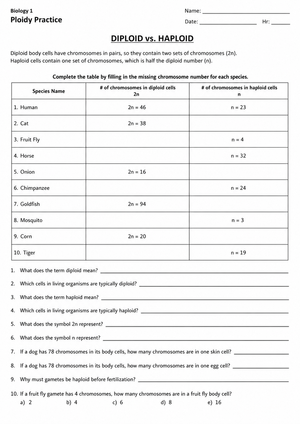
Comparing chromosome numbers across species makes the concept concrete and prevents students from assuming that 46 is a universal diploid number. Fruit flies have a diploid number of 8, corn has a diploid number of 20, and humans have a diploid number of 46. A worksheet that mixes organisms forces students to apply the n and 2n relationship as a rule rather than memorizing a single answer.
- Give the diploid number and ask for the haploid number for several organisms in one table.
- Give the haploid number for a gamete and ask students to predict the diploid number of the resulting zygote.
- Ask students to identify which stage of meiosis a given cell must be in based on its chromosome count.
Sequencing These Worksheets Within a Meiosis Unit
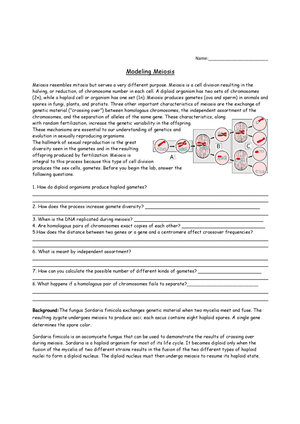
Haploid and diploid calculation practice works best when placed right after students learn the stages of meiosis but before they tackle genetics vocabulary like alleles and zygosity. Meiosis I is the reductional division that halves the chromosome number from 2n to n, while meiosis II separates sister chromatids without any further reduction, similar in mechanism to mitosis. Meiosis begins with one diploid cell and ends with four haploid gametes, and a worksheet that has students track chromosome number at each stage reinforces this sequence far better than a diagram alone.
Teachers who introduce chromosome counting problems immediately after the meiosis stages lesson report that students retain the reductional division concept longer, because the arithmetic gives them a concrete checkpoint at each phase rather than an abstract description to memorize.
Classroom Implementation
Start each haploid and diploid unit with a single, well-labeled human example before introducing other organisms. Once students can confidently state that human body cells are 2n = 46 and human gametes are n = 23, layer in fruit fly and corn data to build flexibility. Pair every calculation worksheet with a brief verbal check, asking a few students to explain their reasoning aloud, since this catches the label-confusion error pattern before it appears on a graded assessment. For classes moving quickly, combine chromosome counting with a short meiosis stage-identification task on the same page so students practice both skills together rather than in isolation.
Keep an answer key visible for self-checking during independent practice, but require students to show their division or multiplication step rather than just circle a final number. This makes reteaching far more targeted, since a wrong final answer with correct work shown points to a labeling error rather than a conceptual gap.
Connecting the Math to Genetic Variation
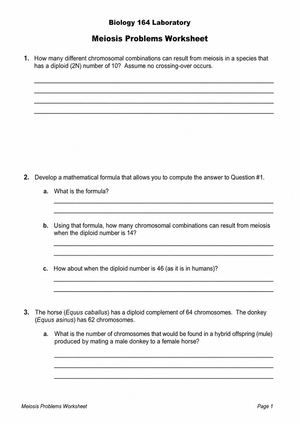
Once students are comfortable with the arithmetic, tie the concept back to why sexual reproduction produces genetic variation. Because meiosis reduces the chromosome number by half and independent assortment shuffles which homologous chromosome ends up in each gamete, offspring inherit a unique combination of chromosomes from each parent. Framing the haploid and diploid calculation as a stepping stone toward this bigger idea gives the worksheet practice a clearer purpose than arithmetic drilling alone.
Frequently Asked Questions
1. What grade level typically covers haploid and diploid number calculations?
This content most commonly appears in middle school life science and high school biology courses, usually within a cell division or genetics unit that follows an introduction to mitosis.
2. What is the difference between calculating chromosome number in mitosis versus meiosis?
In mitosis, the chromosome number stays constant from parent cell to daughter cells. In meiosis, the number is halved during meiosis I, going from 2n to n, and stays at n through meiosis II as sister chromatids separate.
3. How can teachers help students avoid mixing up n and 2n on worksheets?
Have students label every given number as either n or 2n before doing any arithmetic, and require them to show the division or multiplication step rather than writing only a final answer.
4. What are good example organisms to use for haploid/diploid practice problems?
Humans with a diploid number of 46, fruit flies with a diploid number of 8, and corn with a diploid number of 20 are commonly used because their chromosome counts are well documented and provide useful contrast to the human example.
5. How do these worksheets support standards-aligned instruction on meiosis?
By pairing chromosome counting practice with explicit reference to meiosis I as the reductional division and meiosis II as the equational division, these worksheets reinforce the mechanism described in standard meiosis coverage, such as the process outlined in the OpenStax Biology 2e chapter on meiosis.