Cellular respiration is one of the hardest processes for middle and high school students to picture, because it happens at a molecular scale they can't see and layers three connected stages on top of each other. Worksheets give students a place to slow the process down, label each step, and track where energy actually comes from. This guide breaks down how to choose and sequence cellular respiration worksheets for a US biology or life science unit, which NGSS standards they support, and how to use them to catch misconceptions before a test.
When to Use Cellular Respiration Worksheets
Most US schools introduce cellular respiration in a life science course around grades 6-8 and revisit it in high school biology around grades 9-10. Middle school framing stays at the input-output level: food and oxygen go in, carbon dioxide, water, and usable energy come out. High school pushes into the three stages and the chemistry of bond breaking and bond forming. A good worksheet set matches that grade band instead of dropping full electron-transport detail on a sixth grader.
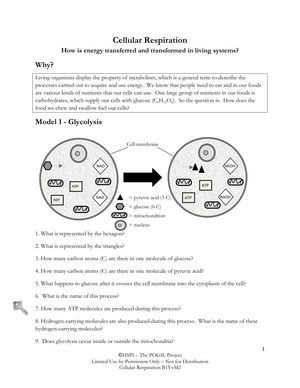
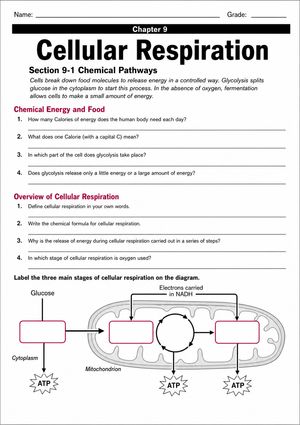
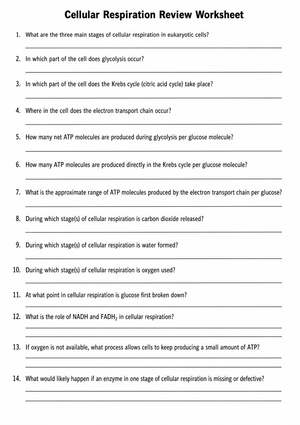
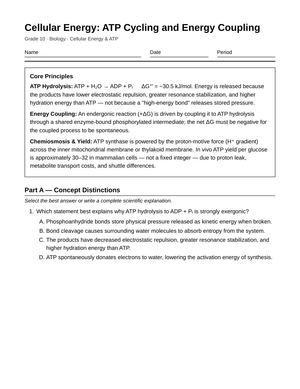
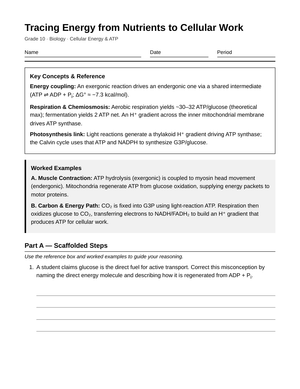
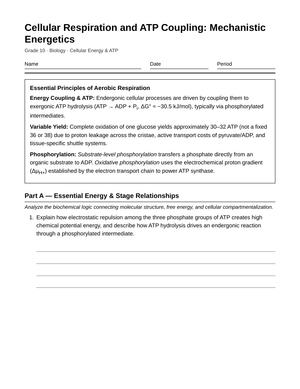
Worksheets fit several points in a unit. Use a diagram-labeling page during direct instruction to give students something to annotate. Assign a fill-in-the-blank or comparison sheet as guided practice the next day. Then use a short-answer worksheet as formative assessment before the unit test, so you can see which stages students still confuse.
Aligning to NGSS MS-LS1-7 and HS-LS1-7
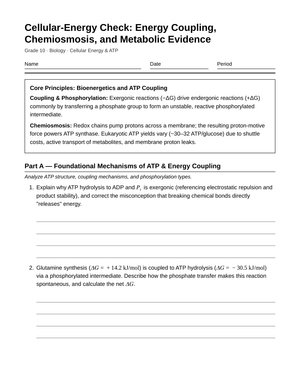
Two NGSS performance expectations anchor this topic. MS-LS1-7 asks middle schoolers to develop a model that describes how food is rearranged through chemical reactions to release energy or support growth. HS-LS1-7 raises the bar: students use a model of cellular respiration to show that food and oxygen bonds break while new bonds form, transferring energy in the process.
According to NGSS HS-LS1-7, published by the California Department of Education, students must use a model to illustrate that cellular respiration is a chemical process in which the bonds of food molecules and oxygen molecules break, new compounds form, and roughly 36 to 38 ATP can result from a single glucose molecule.
MS-LS1-7 also sits inside a larger matter-and-energy story, so worksheets work best when they connect back to a phenomenon students have already met, such as why an athlete breathes harder during a sprint or how a seed grows in the dark. Anchoring the worksheet to a real event gives the modeling task a purpose beyond filling in blanks.
The word model in both standards is the key. Worksheets that ask students only to memorize a definition miss the standard entirely. Pick pages that ask students to draw, label, or complete a diagram, then explain in their own words how matter and energy move through it.
Breaking Down the Three Stages
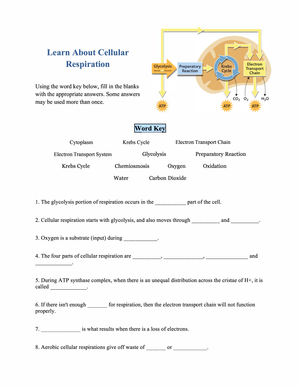
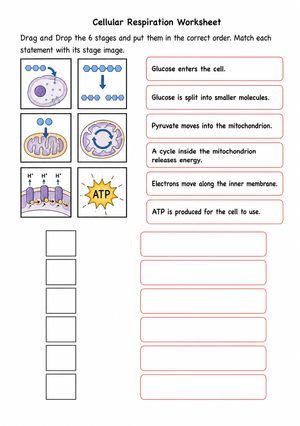
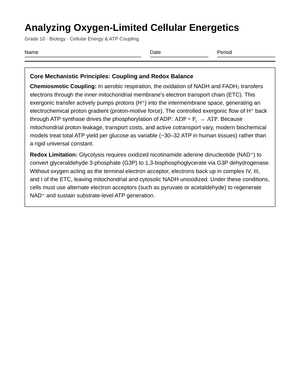
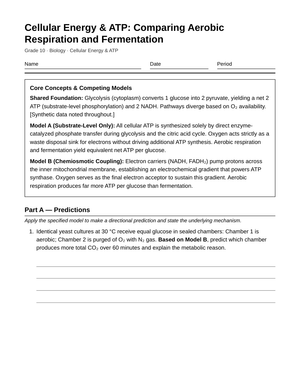
High school worksheets should separate glycolysis, the citric acid cycle, and the electron transport chain so students see each stage's job. Glycolysis splits glucose in the cytoplasm. The citric acid cycle runs in the mitochondrial matrix and releases carbon dioxide. The electron transport chain, along the inner mitochondrial membrane, is where most ATP is made. Diagram-labeling worksheets that show location alongside product help students connect structure to function.
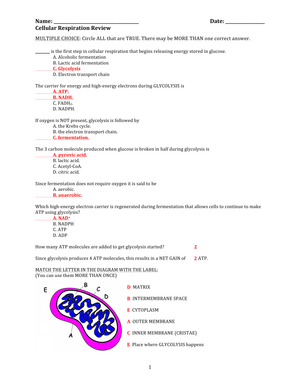
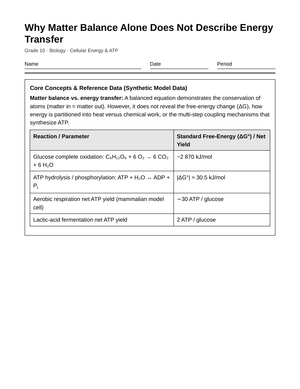
The most valuable worksheet question isolates ATP yield by stage, because that is where reasoning breaks down. Students routinely assume glycolysis produces the most ATP since it comes first, but glycolysis nets only about 2 ATP, the citric acid cycle adds roughly 2 more, and the electron transport chain generates the large majority, on the order of 32 to 34. A worksheet that forces students to tally each stage separately exposes this gap far better than one that reports a single total of 36 to 38.
Pairing Photosynthesis and Cellular Respiration
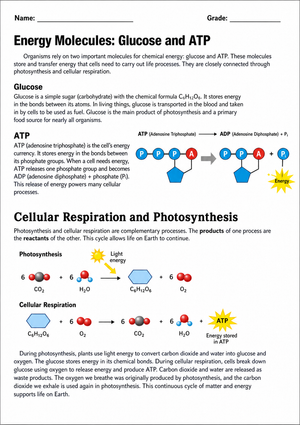
Cellular respiration makes the most sense when students see it beside photosynthesis. A side-by-side comparison table, built as parallel worksheet columns, lets students line up inputs and outputs: the products of photosynthesis are the reactants of respiration, and vice versa. This pairing reinforces matter and energy flow, which is the conceptual core of the LS1 standards.
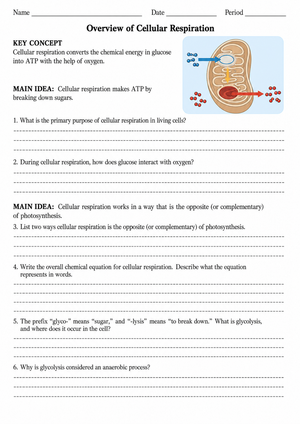
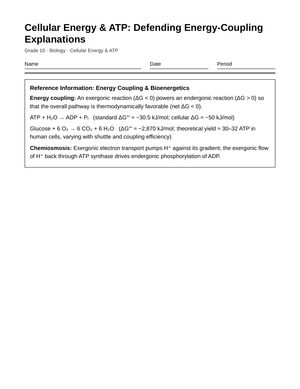
A comparison worksheet also gives you a quick check on balance. Ask students to write the overall equation for each process and notice that they are near mirror images. Photosynthesis uses carbon dioxide and water to build glucose and release oxygen; respiration uses glucose and oxygen to release carbon dioxide, water, and energy. Seeing the equations stacked makes the cycle of matter concrete instead of abstract.
Worksheets that ask students to trace a carbon atom or an oxygen molecule across both processes push beyond memorization. When a student can explain that the oxygen a plant releases is the same oxygen its cells use to respire, the two topics stop feeling like separate units.
Targeting Common Misconceptions
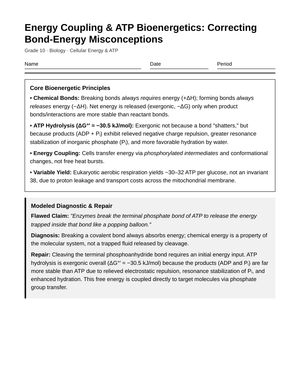
Two misconceptions show up in nearly every class. The first is that only animals perform cellular respiration while plants only photosynthesize. Plants do both, around the clock. The second is confusing breathing with cellular respiration, treating a whole-organism behavior as if it were the chemical reaction inside a cell.
A third, quieter misconception is that respiration and photosynthesis are opposites that cancel out, so a plant that photosynthesizes never needs to respire. Worksheets can correct this by asking students to account for energy at night, when photosynthesis stops but the plant's cells still need ATP to stay alive. That single question does more work than a paragraph of explanation.
Sequencing helps. Teaching respiration in plants first, before connecting it to animal breathing, reduces the breathing-versus-chemistry confusion. Choose worksheets that explicitly ask whether a plant respires at night, or that separate the word respiration from breathing in a labeling task. The Science Teacher's respiration resources offer question sets built around exactly these sticking points.
Classroom Implementation
Start with a plant-first diagram-labeling worksheet during instruction, so the model is on paper before students hear the word breathing. On day two, move to a fill-in-the-blank page that names each stage and its ATP output, and have students work in pairs so they can argue over the numbers. Use a photosynthesis-respiration comparison sheet as homework to lock in the input-output relationship.
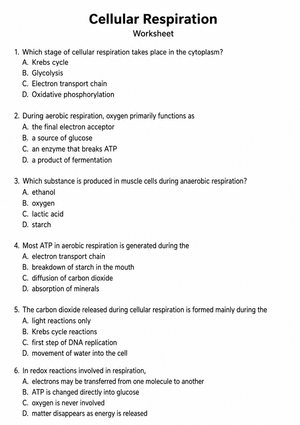
Reserve a short-answer worksheet for formative assessment. Two or three questions that isolate ATP yield by stage and ask students to defend which process a plant runs at midnight will tell you more than a 20-item recall quiz. Grade it fast, sort responses into stacks, and reteach only the stage most students missed. That turns a worksheet into a diagnostic instead of a grade in the book.
Frequently Asked Questions
1. What grade level is cellular respiration taught at in US schools?
Most students first meet cellular respiration in middle school life science, around grades 6-8, then study it in more depth in high school biology, usually grades 9-10. The middle school version stays at inputs and outputs, while high school adds the three stages and bond-level chemistry.
2. Which NGSS standards do cellular respiration worksheets align with?
The two anchor standards are MS-LS1-7 for middle school and HS-LS1-7 for high school. Both are modeling standards, so choose worksheets that ask students to build, label, or complete a model rather than only recall a definition.
3. What misconceptions should these worksheets target?
The big three are believing only animals respire, confusing breathing with the cellular chemical reaction, and assuming glycolysis produces the most ATP. Worksheets that isolate ATP yield by stage and ask about plant respiration address all three.
4. How can teachers pair these worksheets with photosynthesis?
Use a side-by-side comparison worksheet so students line up the inputs and outputs of each process. Asking students to trace a single carbon or oxygen atom across both reactions reinforces matter and energy flow and prevents the two topics from feeling disconnected.
5. What worksheet formats work best for the stages of cellular respiration?
Mix diagram labeling, fill-in-the-blank, and comparison tables. Labeling ties each stage to its location in the cell, fill-in-the-blank drills vocabulary and ATP output, and comparison tables connect respiration to photosynthesis. Rotating formats keeps practice from becoming rote.