




























Views
Downloads


Printable Anatomy Word Search | Grades 7–8 Science

Paste this activity's link or code into your existing LMS (Google Classroom, Canvas, Teams, Schoology, Moodle, etc.).
Students can open and work on the activity right away, with no student login required.
You'll still be able to track student progress and results from your teacher account.
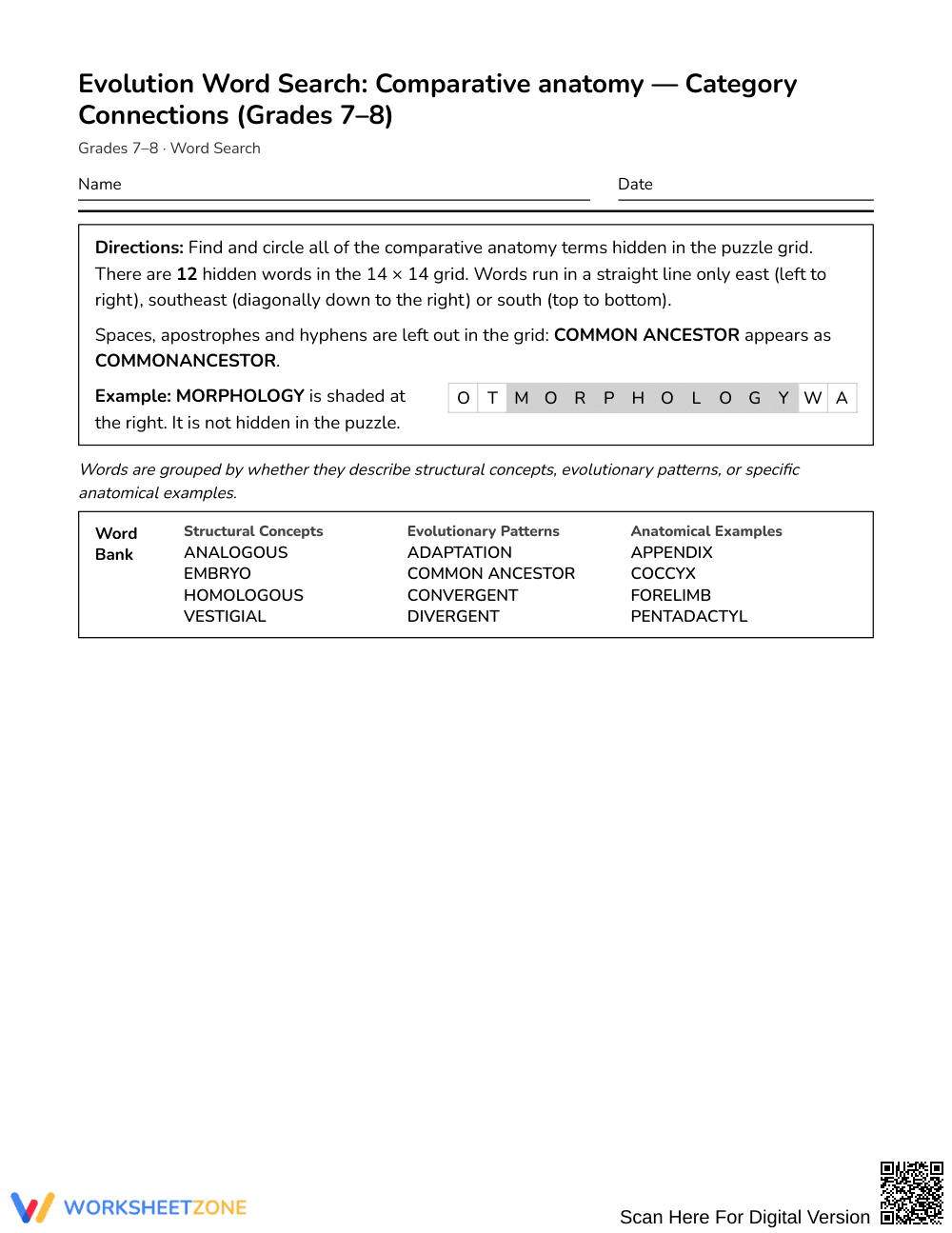
This comparative anatomy word search reinforces core evolutionary biology terminology for middle school science learners. Students find twelve key terms covering structural concepts and evolutionary patterns, strengthening academic vocabulary through active pattern recognition across a clean two-page activity.
At a Glance
- Grade: Grades 7–8 · Subject: Science
- Standard: Not standards-assessed — vocabulary enrichment targeting evolutionary terminology and structural concepts
- Skill Focus: Comparative anatomy and evolutionary structures
- Format: 2 student pages · 12 hidden words · 3-page full answer key included · Printable PDF
- Best For: Unit vocabulary review, warm-ups, and early finisher tasks
- Time: 15–25 minutes
What's Inside
This printable resource features a two-page activity built around a 14 by 14 grid holding 12 comparative anatomy words. The word bank groups terms into structural concepts, evolutionary patterns, and anatomical examples. Accompanying clues define each term to build scientific literacy, while a 3-page answer key provides complete solutions.
How the Puzzle Works
Students find twelve specialized terms placed inside a 14 by 14 letter matrix. Words run in three directions: horizontally to the right (East), diagonally downwards to the right (Southeast), and vertically downwards (South). Because words never run backward, learners scan without visual frustration while reviewing categorized terms like homologous, vestigial, and pentadactyl.
Standards Alignment
This comparative anatomy word search serves as vocabulary enrichment and is not aligned to a specific standard. Rather than assessing formal performance benchmarks, it strengthens the specialized scientific language students need when investigating evidence of evolution and anatomical structures in core science units.
How to Use It
Use this puzzle after direct instruction on evolutionary patterns or as a warm-up review before an exam. During independent work, observe whether students connect vocabulary clues to anatomical structures like the appendix or coccyx. Most students finish the search in 15 to 25 minutes.
Who It's For
This activity is designed for Grades 7–8 science students studying evolutionary biology. Grouped categories support English learners and developing readers by chunking related ideas. Pair this puzzle with vertebrate limb comparative diagrams to deepen structural comprehension.
Integrating structured vocabulary acquisition into middle school life science reinforces comparative anatomy concepts by connecting morphological terms with their evolutionary definitions. As highlighted by Fisher & Frey (2014), intentional exposure to disciplinary vocabulary through multiple modalities—including categorized word banks, descriptive clues, and visual search tasks—anchors domain-specific knowledge in long-term memory. When Grades 7–8 students locate terms like homologous, vestigial, and convergent in structured puzzle grids, they engage in deliberate orthographic mapping and semantic categorization. This cognitive processing bridges the gap between passive memorization and active comprehension of evolutionary patterns. The two-page format and 12 curated terms allow science teachers to deliver focused terminology practice without cognitive overload, supporting academic literacy across diverse classroom settings. By combining contextual definitions with targeted letter scanning across a 14 by 14 matrix, students consolidate critical anatomical terminology essential for subsequent biological inquiry.


