What Cell Organelles Worksheets Teach in a Middle School Life Science Unit
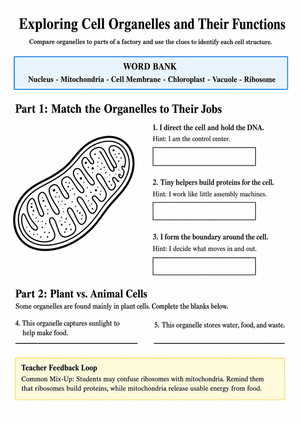
When students first meet the cell, the challenge isn't memorizing a diagram, it's connecting each part to a job the cell has to do. Cell organelles worksheets give middle school life science teachers a structured way to move students from naming the nucleus, mitochondria, and cell membrane to explaining what those parts actually accomplish. Most sets built for grades 6-8 focus on identification, structure-to-function matching, and plant versus animal comparison, which lines up with how cell content is sequenced in nearly every state's science standards. Because organelle instruction shows up in almost every US middle school curriculum, a strong worksheet set does double duty: it works as core instruction for a cells unit and as review before a state assessment.
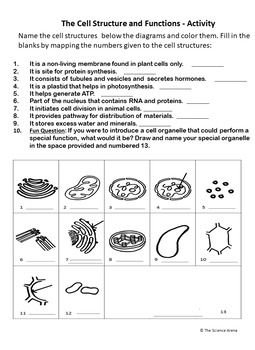
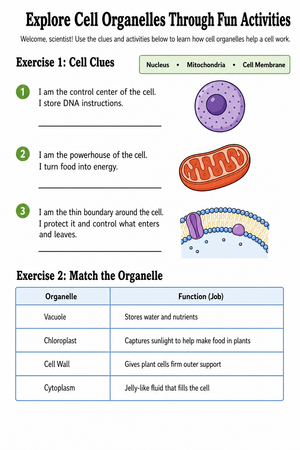
The organelles that anchor most middle school sets are the nucleus, mitochondria, cell membrane, cell wall, chloroplast, cytoplasm, and vacuole. Worksheets usually introduce them in that rough order, moving from the parts every cell shares to the parts that separate plant and animal cells. Keeping that progression in mind helps you choose sheets that build on each other instead of repeating the same identification task three times.
Aligning Organelle Worksheets to NGSS MS-LS1-2
If your district uses NGSS, the anchor standard for this unit is MS-LS1-2, which asks students to develop and use a model that describes the function of a cell as a whole and how its parts contribute to that function. That single sentence shapes what your worksheets should do. Pure labeling isn't enough on its own; students need repeated practice explaining why a part matters to the whole cell.
According to NGSS performance expectation MS-LS1-2, students must develop a model of a cell that names five parts: the nucleus, chloroplasts, mitochondria, cell membrane, and cell wall. Assessment of structure-and-function reasoning is bounded to just two of them, the cell wall and cell membrane.
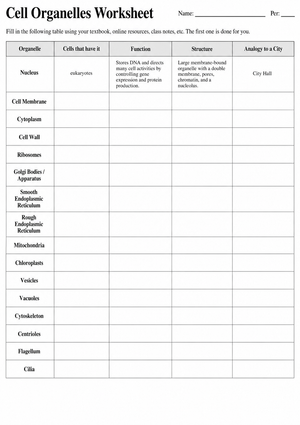
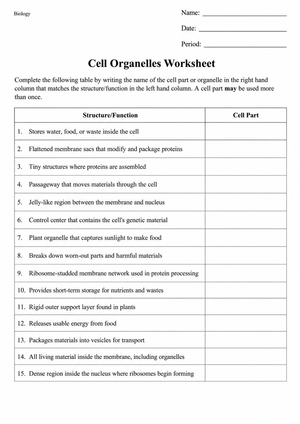
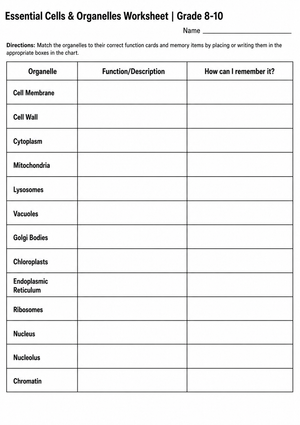
That boundary is useful for planning. It tells you where to spend the most instructional time: students should be able to reason in detail about how the cell wall and cell membrane relate to their structure, while the other three organelles can be modeled mainly for their contribution to the whole cell. A worksheet that pushes every organelle to the same depth may over-invest where the standard doesn't ask for it. Practically, that means building or choosing worksheets with an explanation column, not just a labeling blank. Every organelle line should ask students to write, in a sentence, what the part does for the cell. That small design choice is what turns a naming exercise into evidence of the modeling MS-LS1-2 expects.
Using Plant vs. Animal Cell Comparison Worksheets
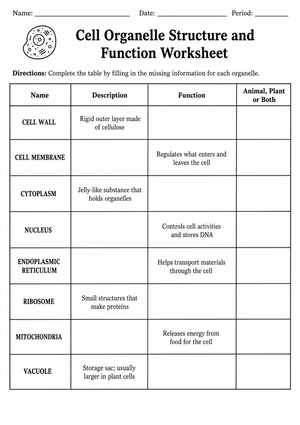
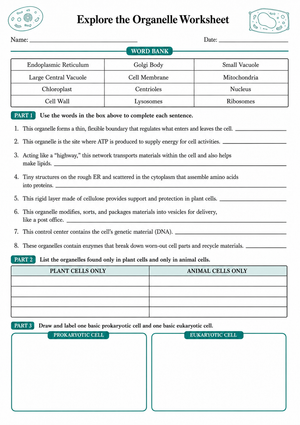
Comparison worksheets are one of the clearest ways to reinforce the two organelles students confuse most: the chloroplast and the cell wall. Both appear in plant cells but not animal cells, and both are named directly in MS-LS1-2. A side-by-side Venn or two-column organizer asks students to sort organelles into 'both,' 'plant only,' and 'animal only,' which forces the structure-to-function thinking the standard wants. When a student writes that chloroplasts capture light energy for food and therefore appear only in plant cells, they're modeling function, not just recalling a label. Follow the sort with a short prompt: 'A cell has a cell wall and chloroplasts. Is it plant or animal, and how do you know?'
Comparison sheets also give you a natural spot for error analysis. Show a mislabeled diagram where an animal cell has been drawn with a cell wall, and ask students to find and correct the mistake. Catching the error requires them to reason from function rather than guess, and it surfaces misconceptions before a summative assessment does.
Scaffolding Vocabulary with Guided Notes First
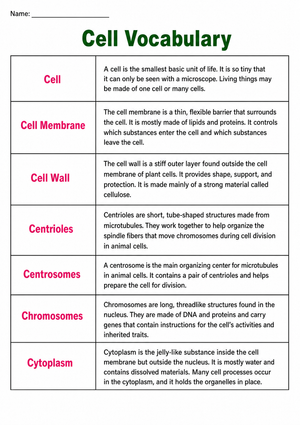
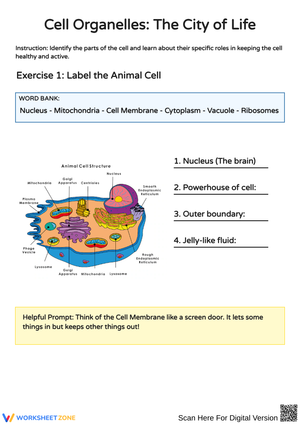
Organelle units are vocabulary-heavy, and students who stall on the words never reach the reasoning. Guided notes and graphic organizers give you a low-stakes entry point before independent labeling or matching. Start with a partially completed organizer where the organelle name and a picture are provided, and students fill in the function in their own words. This keeps the cognitive load on meaning rather than spelling. Once students can restate each function without prompting, move them to blank diagram labeling and matching tasks. The sequence matters: guided notes, then supported practice, then independent identification, then application in a model or analogy.
Word walls help here too. Post each organelle with a one-line function students helped write, and refer back to it during labeling practice. A visible reference reduces the number of students who freeze on a blank diagram simply because they can't recall a term.
Pairing Short Reading with Organelle Practice
Content-area literacy is part of the job in a science classroom, and organelle worksheets pair naturally with a short informational-text passage. A one-page reading on how organelles work together, followed by function-explanation writing, builds science reading stamina while reinforcing the same vocabulary. Ask students to underline each organelle in the passage, then answer a text-dependent question such as 'Which two organelles are most involved in releasing energy, and what in the text tells you so?' This keeps reading and content knowledge on the same page instead of treating literacy as a separate task.
For classes that need more support, read the passage aloud once, then have students reread with a highlighter before they write. The second pass is where comprehension usually happens, and it keeps slower readers from falling behind during the writing step.
Classroom Implementation
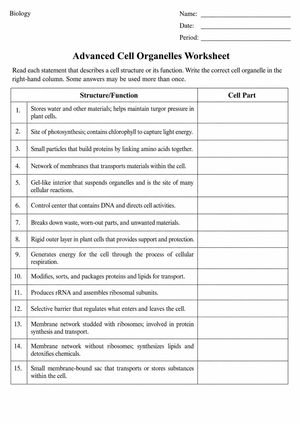
In a mixed-readiness class, one worksheet rarely fits everyone. Offer the same organelle content in a few formats: a color-by-answer or cut-and-paste version for students who need a lower reading load, a standard labeling sheet for the middle, and an extension that asks students to design a cell analogy for a fast-finishing group. Because the content is identical, you can grade against the same objective while meeting students where they read.
Here's the move experienced teachers make: use organelle worksheets as a formative gate, not a grade. Give a quick five-organelle labeling and function check the day before the cell model or analogy project. If more than about a third of the class misses the cell wall or cell membrane function, that's your signal to reteach those two specifically, because those are the exact organelles MS-LS1-2 holds students accountable for at the structure-and-function level. The worksheet becomes a diagnostic that tells you whether the class is ready to model, not just a task to complete.
Frequently Asked Questions
1. What grade level covers cell organelles in US science?
Cell organelles are typically taught in middle school life science, most often across grades 6-8. Because nearly every state standard includes cell structure and function, the topic appears somewhere in the middle grades regardless of which framework your district follows.
2. Which organelles are required under NGSS MS-LS1-2?
MS-LS1-2 names five: the nucleus, chloroplasts, mitochondria, cell membrane, and cell wall. Detailed structure-and-function reasoning is assessed only for the cell wall and cell membrane, while the other three are modeled for their contribution to the whole cell.
3. How can teachers differentiate organelle worksheets for struggling readers?
Offer the same content in lower-load formats such as color-by-answer, cut-and-paste, or picture-supported guided notes, and let students explain functions in their own words. Keep the objective identical so every version still targets structure and function.
4. What's the difference between plant and animal cell organelle worksheets?
Plant-focused sheets add the chloroplast and cell wall, which animal cells lack. Comparison worksheets that sort organelles into plant-only, animal-only, and both are the most efficient way to make that difference stick.
5. How do organelle worksheets fit into a full cells unit?
They work best as the bridge between vocabulary and modeling: use guided notes to introduce terms, labeling and matching to build fluency, and a final formative check before students build a cell model or analogy for MS-LS1-2.