































Proven Evidence of Evolution Worksheet | Grade 8-12 Science

Paste this activity's link or code into your existing LMS (Google Classroom, Canvas, Teams, Schoology, Moodle, etc.).
Students can open and work on the activity right away, with no student login required.
You'll still be able to track student progress and results from your teacher account.
This 4-page evolutionary biology assessment delivers 26 focused tasks to evaluate student mastery of anatomical, fossil, and molecular evidence for common ancestry. Secondary science students examine comparative forelimb diagrams, analyze chronological fossil strata, rank cytochrome c sequences, and critique evolutionary mechanisms using authentic models.
At a Glance
- Grade: 8–12 · Subject: Science
- Standard: Empirical Evidence — Analyze anatomical, fossil, and molecular data supporting common ancestry
- Skill Focus: Evidence of Evolution
- Format: 4 pages · 26 problems · Answer key included · PDF
- Best For: Cumulative unit assessment
- Time: 45–60 minutes
What's Inside
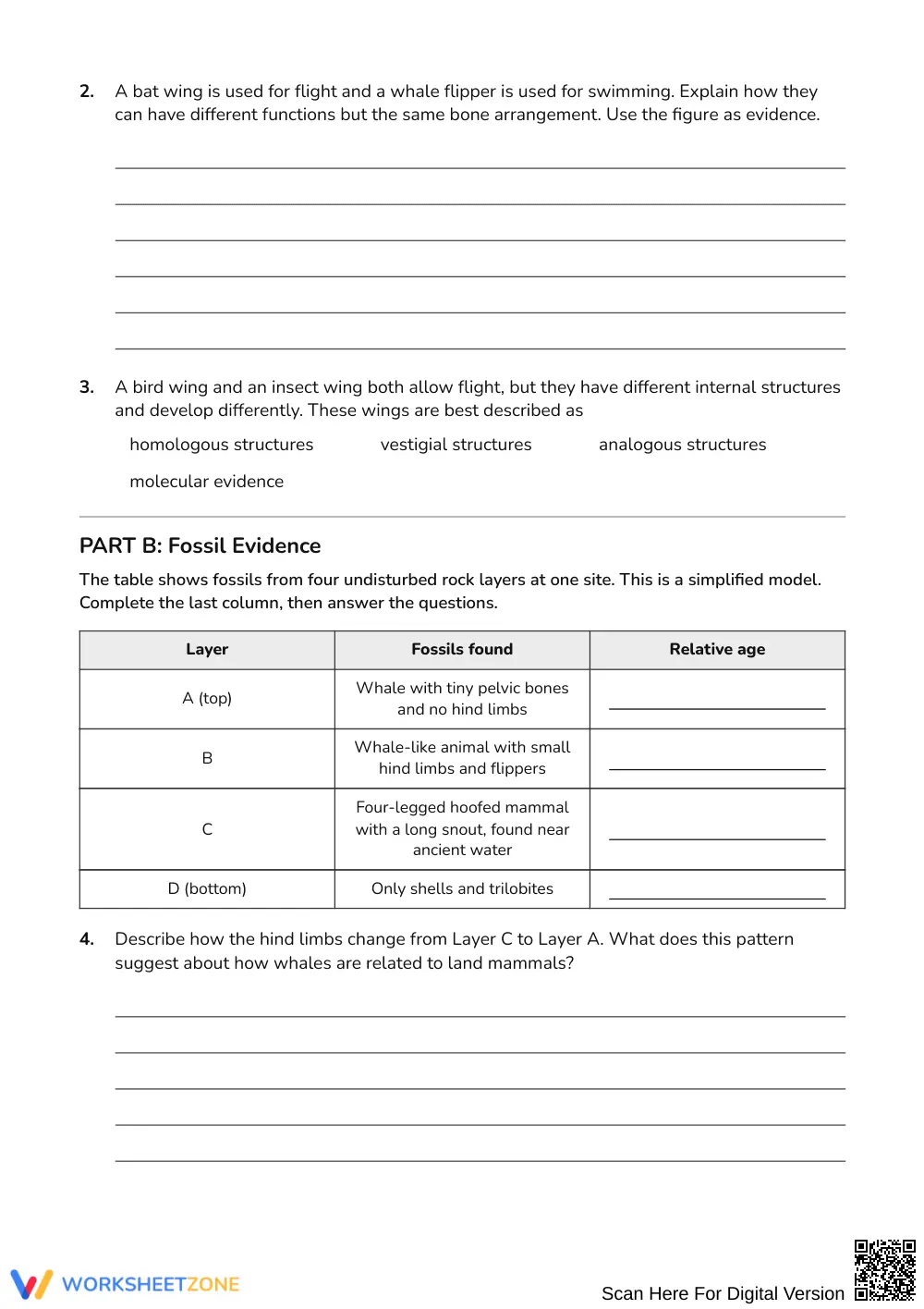
The worksheet contains 26 tasks across 4 printable pages. Structural supports include anatomical forelimb diagrams (human, cat, whale, bat), rock stratum tables, and cytochrome c comparisons. Task formats include diagram labeling, multiple-choice questions, data ranking, and short-answer prompts, supported by a complete 4-page answer key.
Skill Progression
- Guided practice (Part A, 4 tasks): Students identify homologous bone structures using labeled anatomical figures, distinguishing homologous from analogous traits with visual support.
- Supported practice (Parts B & C, 11 tasks): Learners evaluate fossil strata sequences and rank amino-acid disparities using structured data tables.
- Independent practice (Part D, 11 tasks): Students evaluate vestigial structures, apply natural selection principles, and correct common evolutionary misconceptions without scaffolds.
This gradual-release sequence guides students from foundational anatomical identification to independent scientific reasoning.
Standards Alignment
This assessment supports life science standards requiring students to analyze empirical evidence of biological evolution. Learners synthesize anatomical homologies, chronological fossil records, and biochemical data to validate common descent. These standard details can be copied directly into lesson plans, IEP goals, or district curriculum mapping tools.
How to Use It
Administer this resource as a summative unit exam or divide the four sections across separate instructional days for formative checkpoints. During administration, monitor student explanations of homologous versus analogous structures in Part A to catch common misconceptions about shared functions. Expected completion time is 45 to 60 minutes.
Who It's For
Designed for Grades 8–12 biology students, this worksheet suits general education classes, honors biology, and targeted intervention. Educators can scaffold the text for developing readers or assign Part D as an extension for advanced learners. Pair this packet with a fossil analysis lab or cladogram modeling activity.
According to educational research by Fisher & Frey (2014), structured science assessments that integrate visual models, data interpretation, and analytical synthesis substantially improve conceptual understanding. This 26-task cumulative biology worksheet operationalizes evidence-based instructional scaffolding by challenging students to examine homologous structures, interpret fossil rock strata, rank cytochrome c amino-acid differences, and refute persistent Lamarckian misconceptions using natural selection. When high school and middle school science students evaluate empirical data through multiple complementary lines of evidence rather than memorizing isolated facts, their analytical reasoning and long-term retention increase significantly. The included four-page answer key equips educators with clear criteria for scoring both objective data questions and complex written scientific explanations. Ultimately, this comprehensive assessment functions as a reliable evaluation tool that documents student mastery of biological evolution while developing essential argumentation skills across diverse learning environments.


