




























Views
Downloads
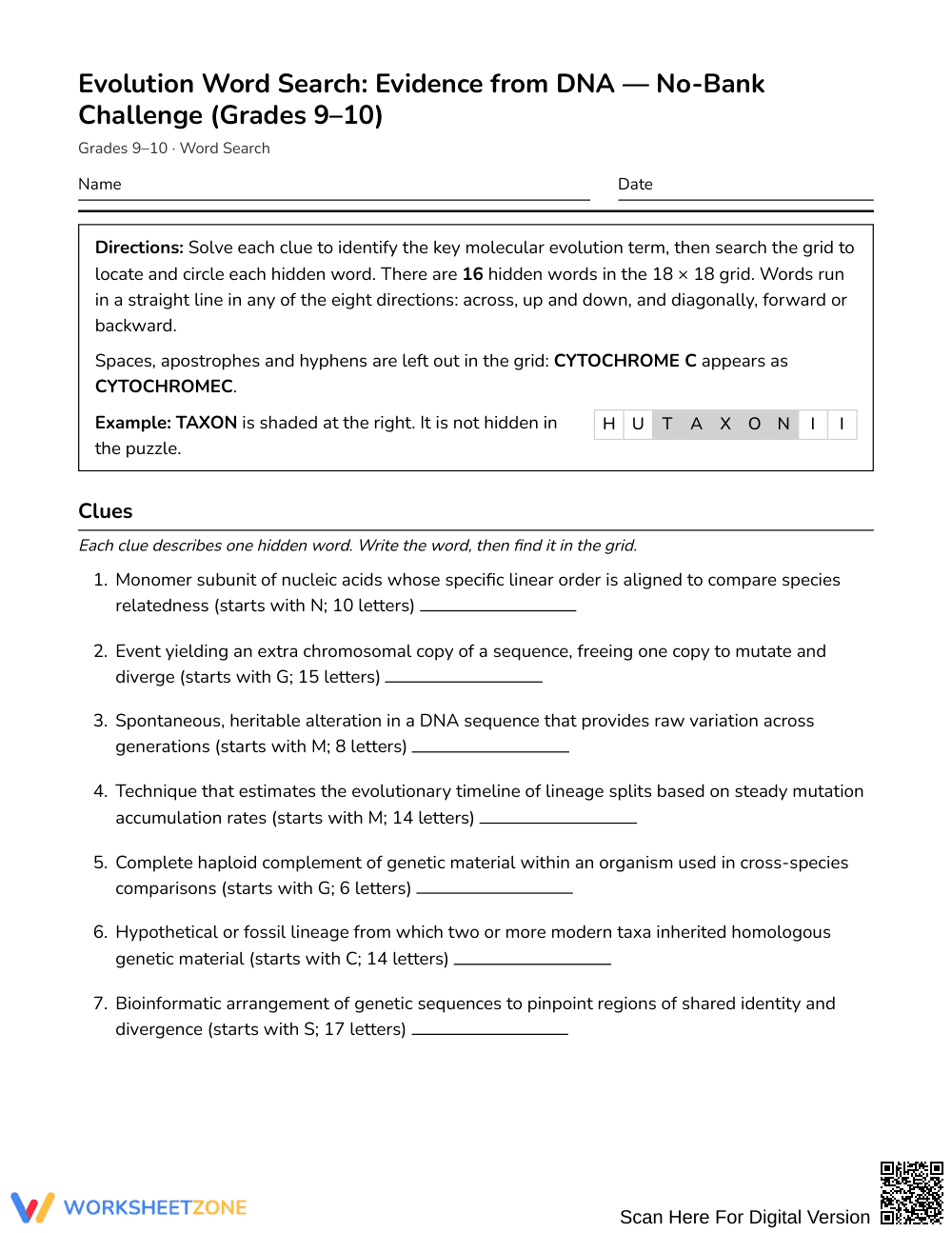
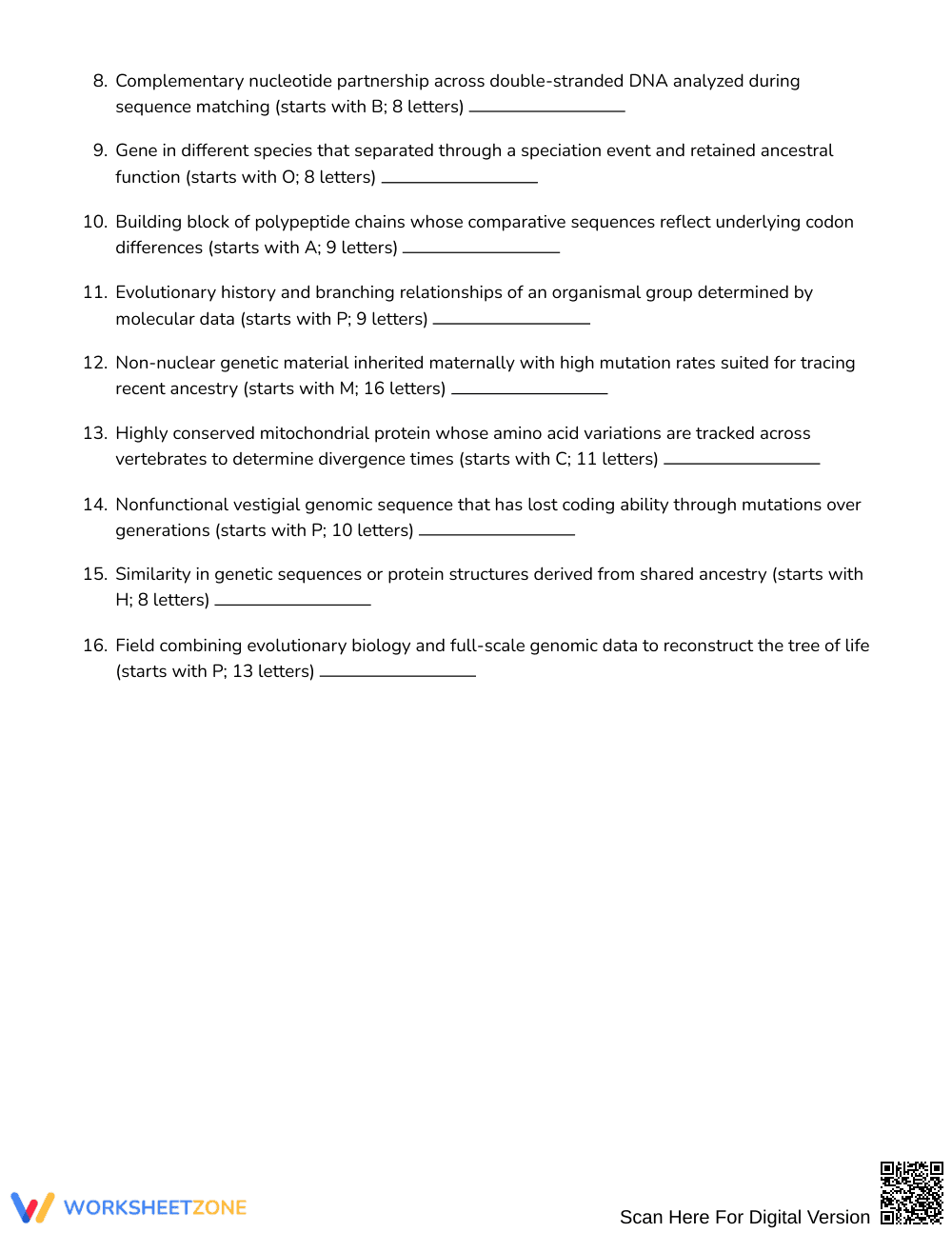


Essential DNA Evidence Word Search | Grades 9–10 Science

Paste this activity's link or code into your existing LMS (Google Classroom, Canvas, Teams, Schoology, Moodle, etc.).
Students can open and work on the activity right away, with no student login required.
You'll still be able to track student progress and results from your teacher account.
This molecular biology word search reinforces high school students' understanding of evidence from DNA through rigorous vocabulary retrieval. Students analyze descriptive clues to identify 16 core molecular evolution terms and locate them in an 18-by-18 grid. This active recall exercise strengthens retention of complex biochemical and evolutionary terminology without relying on passive word lists.
At a Glance
- Grade: Grades 9–10 · Subject: Science
- Standard: Not standards-assessed — vocabulary enrichment
- Skill Focus: Evidence from DNA
- Format: 3 pages · 16 words · Answer key included · PDF
- Best For: Vocabulary review and biology concept reinforcement
- Time: 25–35 minutes
What's Inside
The 3-page activity features a no-bank challenge structured around 16 detailed biological clues rather than an open term list. Students read definitional prompts covering molecular phylogenetics, mutations, and comparative genomics to deduce each target term before searching the grid. The resource includes a full 4-page answer key showing completed word locations and corresponding clue solutions for straightforward verification.
Puzzle Mechanics
This activity challenges learners with an 18 x 18 grid where hidden vocabulary terms run in all eight possible compass directions: north, northeast, east, southeast, south, southwest, west, and northwest. Because the worksheet provides no word bank, students must actively process each scientific definition to generate the correct term, preventing mindless letter scanning and demanding genuine comprehension of evolutionary genetics.
Standards Alignment
This science resource functions as targeted vocabulary enrichment and is not aligned to a formal assessed performance expectation. Instead, it provides supplemental lexical reinforcement supporting high school biology units on genetics and evolutionary history. Teachers can integrate this activity alongside broader coursework on natural selection and common descent to build essential domain-specific academic vocabulary.
How to Use It
Deploy this word search during an evolutionary biology unit immediately after direct instruction on molecular homology and sequence alignment. For a collaborative review, have pairs work together to solve the clues before hunting for the terms within the puzzle. Formatively observe whether students correctly identify concepts like pseudogenes or orthologs from the clue descriptions without consulting external references. The activity takes approximately 25 to 35 minutes to complete.
Who It's For
Designed for Grades 9–10 biology, life science, and pre-AP biology classrooms, this puzzle offers an engaging, rigorous vocabulary review. For emerging readers or students needing language support, educators can provide the first letter of each identified term as a scaffold. Pair this activity with a phylogenetic tree construction lesson or cladogram analysis task to connect molecular terminology with graphical models of shared ancestry.
Mastering evidence from DNA requires high school students to integrate complex biochemical terms into their broader understanding of evolutionary relationships. According to Fisher & Frey (2014), domain-specific vocabulary acquisition accelerates when instructional tasks require intentional retrieval and contextual application rather than rote memorization. This word search activity operationalizes that principle by eliminating the traditional word bank and requiring learners to deduce 16 precise biological terms—including molecular clock, sequence alignment, and cytochrome c—from rigorous functional clues before scanning an 18 x 18 grid. By shifting the cognitive demand from visual matching to semantic recall across eight search directions, the activity solidifies foundational terminology necessary for analyzing phylogenetic trees and biochemical homologies. High school biology educators can implement this print-and-go 3-page enrichment puzzle to gauge conceptual familiarity and reinforce critical science vocabulary during molecular genetics and evolution units.


