Where Mutation Worksheets Fit in a Genetics Unit
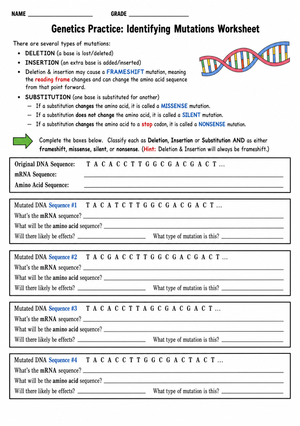
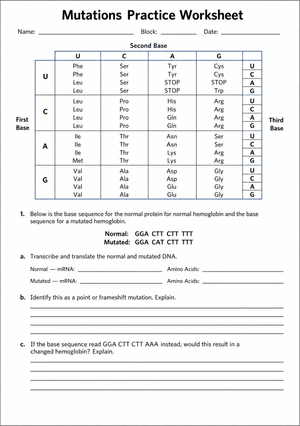
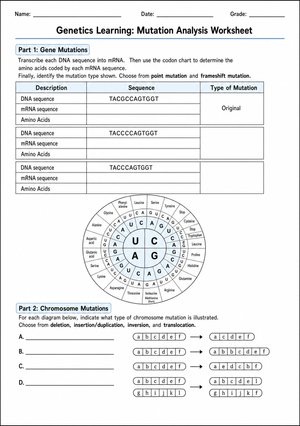
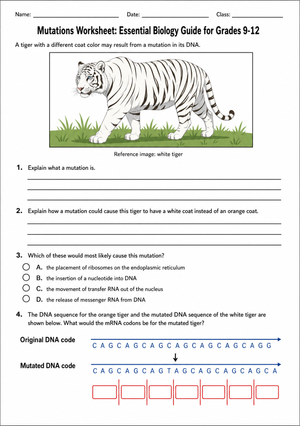
Mutation worksheets sit at a specific point in the biology sequence: after students understand DNA structure and protein synthesis, but before they analyze heredity and variation across a population. That placement matters. When you hand out a mutation worksheet, you are asking students to connect a change in a nucleotide sequence to a change in an amino acid, and then to a possible change in a trait. Worksheets built for US classrooms usually give students short DNA or mRNA strands, ask them to transcribe and translate, and then compare a mutated strand against the original so the effect is visible rather than abstract.
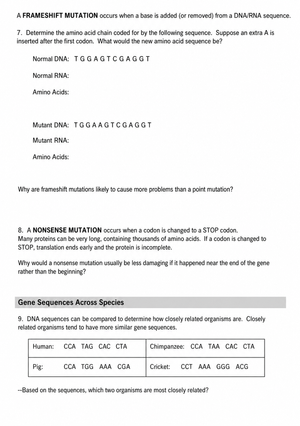
For middle school life science, the tasks stay at the level of spotting a change and predicting whether a protein is affected. For high school biology, the same worksheet format extends into frameshift analysis, reading-frame shifts, and probability questions about how often a variation appears in a group. A single worksheet set that scales across both grade bands saves planning time and keeps your vocabulary consistent from grade 7 through grade 10.
The Three Gene Mutation Types Students Practice
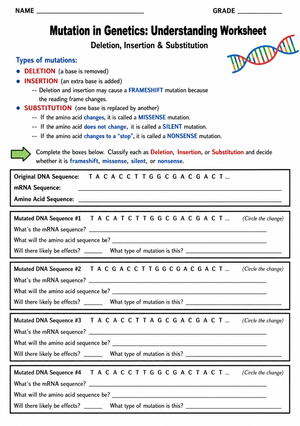
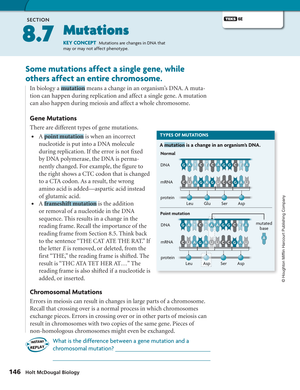
Nearly every mutation worksheet centers on three small-scale changes: substitution, insertion, and deletion. In a substitution, one base is swapped for another, which may change a single amino acid or none at all. In an insertion, an extra base is added; in a deletion, a base is removed. Both insertions and deletions can shift the entire reading frame downstream, which is why students often see dramatic changes in the resulting protein when only one letter moves.
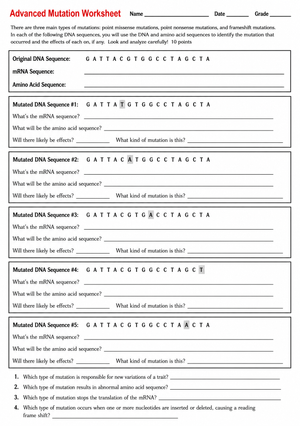
Strong worksheets do not stop at definitions. They give students a reference strand and several mutated versions, then ask them to label each mutation type and translate the outcome. This pushes the reader to see that a substitution near the end of a gene can be harmless, while a single deletion near the start can rewrite everything after it. Khan Academy's mutation lessons use this same original-versus-mutated comparison, which makes structured worksheet practice a natural follow-up to that reading.
Aligning Mutation Worksheets to NGSS
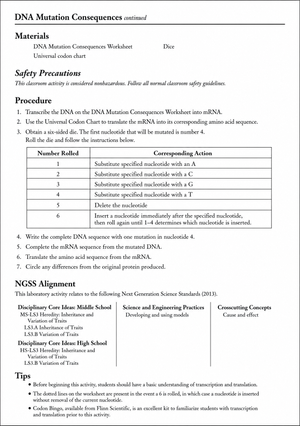
Standards alignment is what lets you defend a worksheet in a lesson plan or a walkthrough. At the middle school level, MS-LS3-1 asks students to develop and use a model describing why structural changes to genes may affect proteins and may result in harmful, beneficial, or neutral effects. A worksheet that has students classify outcomes maps directly onto that expectation with almost no reframing.
At the high school level, HS-LS3-1 covers how DNA and chromosome structure code for inherited traits, and HS-LS3-2 asks students to make and defend a claim that genetic variation comes from new combinations through meiosis, replication errors, and environmental mutations. HS-LS3-3 then brings in statistics and probability to explain how traits are distributed in a population. Mutation worksheets that include frequency or probability questions give you an on-ramp to that third expectation without ever leaving the same topic.
Classifying Mutation Effects: Harmful, Beneficial, or Neutral
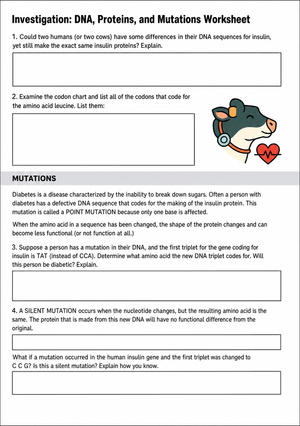
The classification task is where the biggest learning happens. Students tend to arrive believing every mutation is bad, so a worksheet that deliberately mixes harmful, beneficial, and neutral examples does real conceptual work. Sickle cell anemia is the standard harmful point-mutation example, while mutations linked to reduced disease risk serve as beneficial cases. Neutral mutations, often silent substitutions, round out the set and keep students from over-generalizing.
According to NGSS performance expectation MS-LS3-1, students must develop a model showing how structural changes to genes may result in harmful, beneficial, or neutral effects on the resulting protein. Worksheets that ask learners to classify all 3 mutation outcomes give teachers direct evidence toward this single middle-school standard.
Classroom Implementation
These worksheets flex to fit whatever slot your lesson needs. As a bell-ringer, a five-minute strand comparison reactivates yesterday's protein-synthesis work. As a station rotation, you can spread substitution, insertion, and deletion examples across three desks and have small groups classify each before switching. As an exit ticket, a single mutated strand with the prompt "harmful, beneficial, or neutral—and why" gives you a quick read on who can reason from sequence to effect.
- Bell-ringer: one strand, transcribe and label the mutation type.
- Small-group stations: sort mixed examples by both type and effect.
- Exit ticket: classify one outcome and justify the reasoning in a sentence.
- Homework: extend high school sets with a frameshift and a probability question.
Because the format stays constant, you can differentiate by swapping the strand length and the question depth rather than rebuilding the activity. Middle school groups classify; high school groups translate the full downstream sequence and defend a claim about severity.
Frequently Asked Questions
1. What grade level are mutation worksheets appropriate for?
They fit middle school grades 6-8 and high school grades 9-10 biology. Middle school versions focus on identifying a change and predicting protein effects, while high school versions add frameshift translation and probability, so the same topic scales with the grade band.
2. How do mutation worksheets align with NGSS standards?
Classification tasks map to MS-LS3-1 at middle school. At high school they support HS-LS3-1 on DNA coding for traits, HS-LS3-2 on the sources of genetic variation, and HS-LS3-3 when the worksheet includes frequency or probability questions.
3. What are the three main types of gene mutations covered?
Substitution, insertion, and deletion. Substitution swaps one base and may change a single amino acid or none; insertion and deletion add or remove a base and can shift the reading frame, changing every codon downstream of the mutation.
4. How can teachers use these worksheets for formative assessment?
Use a single strand as an exit ticket asking students to classify the effect as harmful, beneficial, or neutral and justify it. For homework, assign longer sets with frameshift and probability questions so practice reaches the reasoning depth high school standards expect.