


























Views
Downloads
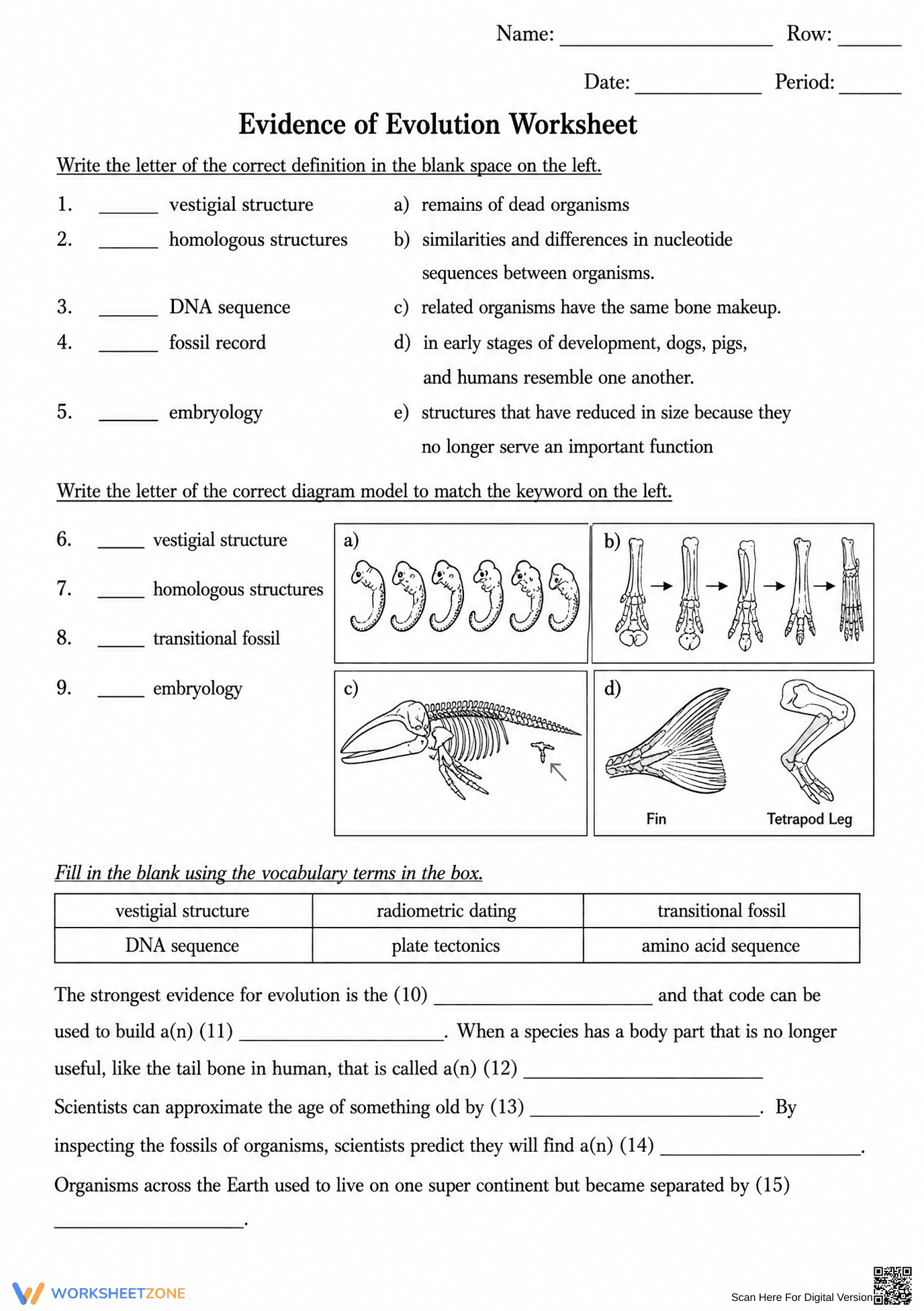

Essential Evidence of Evolution Worksheet | Grade 9-12
Paste this activity's link or code into your existing LMS (Google Classroom, Canvas, Teams, Schoology, Moodle, etc.).
Students can open and work on the activity right away, with no student login required.
You'll still be able to track student progress and results from your teacher account.
This high school biology worksheet provides a comprehensive review of the empirical evidence supporting biological evolution. Students analyze anatomical structures, embryological development, and molecular data to reinforce their understanding of common ancestry. By connecting vocabulary to visual models, learners build a concrete foundation for complex evolutionary theory and scientific argumentation.
At a Glance
- Grade: 9-12 · Subject: Biology
- Standard:
HS-LS4-1— Communicate scientific information that common ancestry and biological evolution are supported by evidence- Skill Focus: Evolutionary Evidence Analysis
- Format: 1 page · 15 problems · Answer key included · PDF
- Best For: Quick review or formative assessment
- Time: 20–30 minutes
This single-page PDF contains three distinct assessment modules designed to evaluate student comprehension of evolutionary biology. It includes a 5-item definition matching set, a 4-item visual identification section featuring comparative anatomy and embryology diagrams, and a 6-item contextual fill-in-the-blank paragraph. The layout is clean and professional, featuring clear illustrations of homologous structures and vestigial organs to support visual learners.
Zero-Prep Workflow
- Print: Select the single-page PDF and print enough copies for your class in less than 60 seconds.
- Distribute: Hand out the worksheets as a bell-ringer or independent practice activity with zero additional setup required.
- Review: Use the provided answer key to conduct a 5-minute whole-class check or grade the 15 items quickly for immediate feedback.
Standards Alignment
This resource is aligned to `HS-LS4-1`, which requires students to communicate scientific information that common ancestry and biological evolution are supported by multiple lines of empirical evidence, including similarities in DNA sequences and anatomical structures. It also supports the development of scientific literacy by requiring precise use of academic vocabulary. This standard code can be copied directly into lesson plans, IEP goals, or district curriculum mapping tools.
How to Use It
Assign this worksheet during the "Explain" or "Elaborate" phase of a 5E lesson cycle to solidify student understanding of evolutionary patterns. It serves as an excellent formative assessment tool; teachers should observe if students can correctly distinguish between homologous and vestigial structures in the diagram section. Expected completion time is 20 to 30 minutes depending on prior knowledge.
Who It's For
This resource is tailored for high school biology students, including those in Honors or AP tracks requiring a quick refresher. It is particularly effective for students who benefit from visual scaffolding and structured vocabulary practice. Pair this worksheet with a short video on the fossil record or a direct instruction lecture on comparative genomics for a complete lesson.
The Evidence of Evolution worksheet is a targeted instructional tool designed to meet the rigorous demands of the HS-LS4-1 standard. By requiring students to synthesize information across anatomical, embryological, and molecular domains, the resource facilitates the "multiple lines of evidence" approach essential for modern biology education. Research from EdReports (2024) emphasizes that high-quality science materials must move beyond rote memorization toward the application of evidence-based reasoning. This worksheet achieves that by forcing students to map abstract concepts like DNA sequences and radiometric dating onto concrete biological scenarios. According to the NAEP science framework, the ability to identify patterns in natural data is a key indicator of scientific proficiency. By integrating 15 distinct tasks that range from simple identification to contextual application, this printable resource ensures that students can articulate the mechanisms of common ancestry with precision and clarity, making it a reliable asset for any secondary science curriculum.


