































Complete Evolution Evidence Worksheet | Grades 8–12 Science

Paste this activity's link or code into your existing LMS (Google Classroom, Canvas, Teams, Schoology, Moodle, etc.).
Students can open and work on the activity right away, with no student login required.
You'll still be able to track student progress and results from your teacher account.
This comprehensive science worksheet guides secondary biology students through interpreting multiple independent lines of evolutionary evidence. Across four sequential sections, learners examine comparative anatomy, rock strata fossil distributions, cytochrome c amino acid sequences, and vestigial pelvic structures in whales to explain patterns of common ancestry and evolutionary change.
At a Glance
- Grade: Grades 8–12 · Subject: Science
- Standard: Life Science — Analyze anatomical, fossil, and genetic data to infer evolutionary relationships
- Skill Focus: Evidence of evolution data interpretation
- Format: 4 pages · 24 problems · Answer key included · PDF
- Best For: High school biology review and practice
- Time: 45–60 minutes
What's Inside
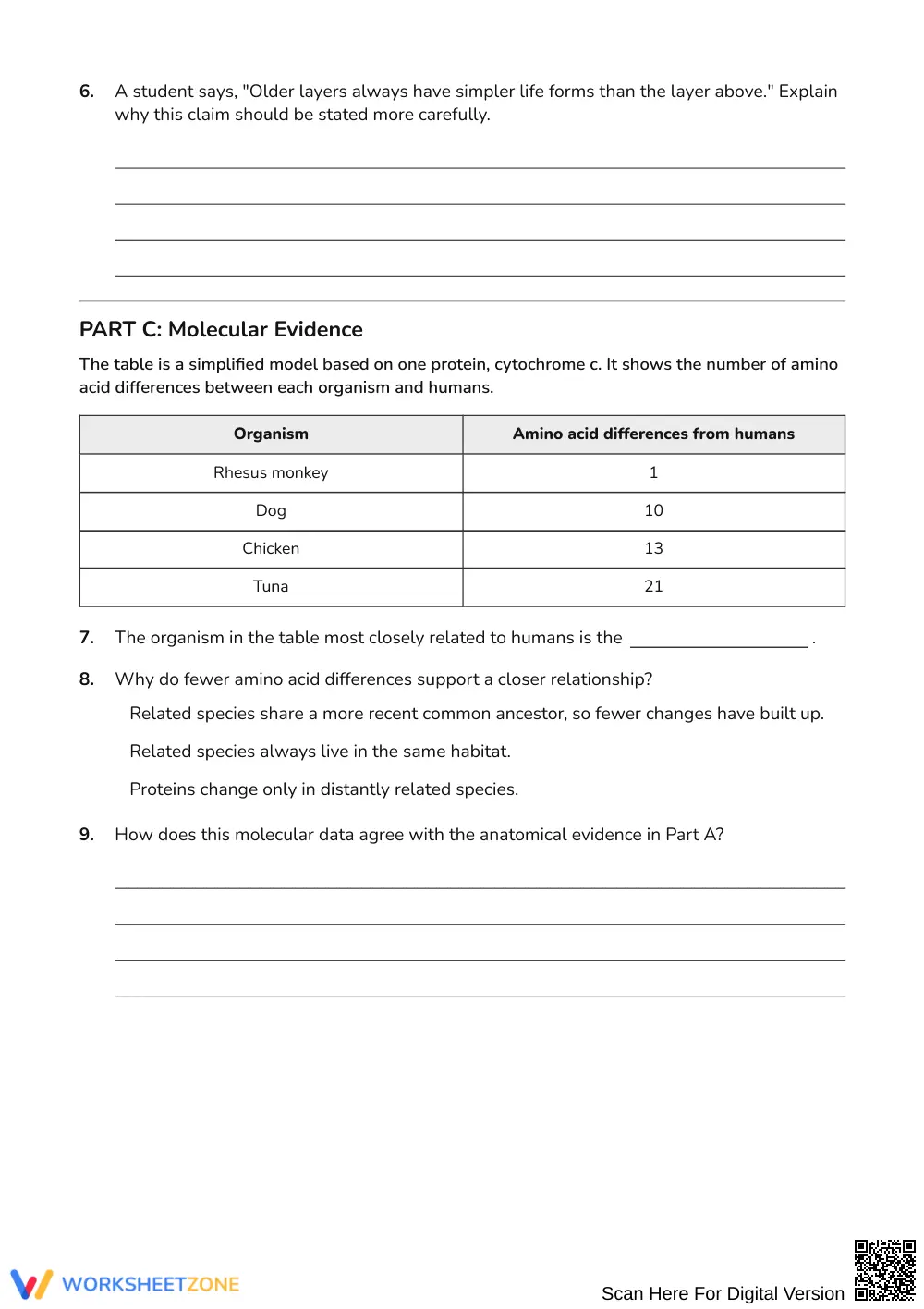
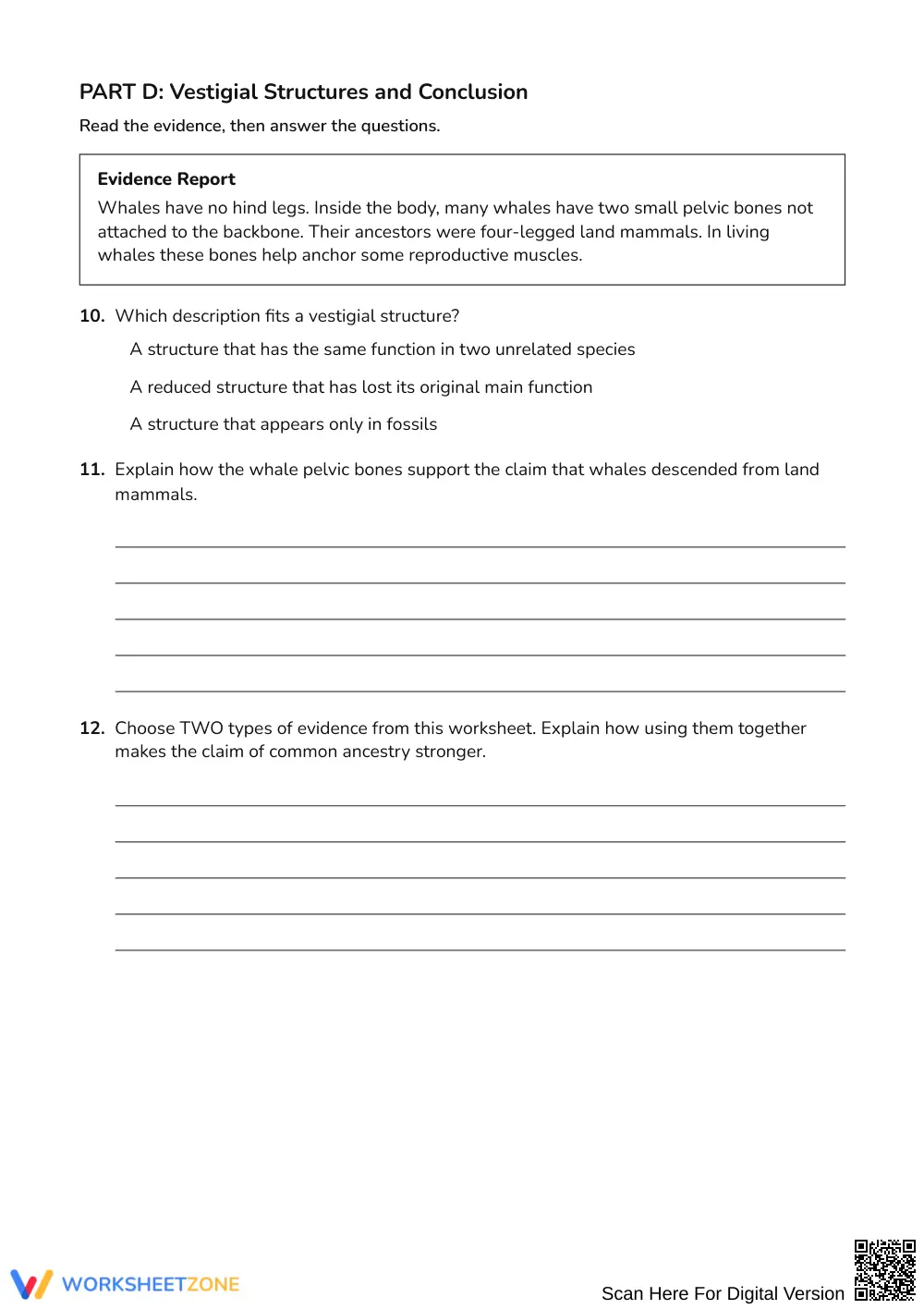
This 4-page student packet delivers 24 targeted prompts combining anatomical diagram labeling, comparative data analysis, and short written explanations. Students analyze a bat wing bone diagram supported by a word bank, evaluate undisturbed rock layer tables using the law of superposition, inspect a cytochrome c amino acid comparison chart, and evaluate a whale case study. A full 4-page teacher answer key provides sample explanations and complete solutions.
Skill Progression
- Guided Practice (Part A, 7 tasks): Students use a provided bone bank and structured table to label forelimb bones, define homologous versus analogous structures, and establish baseline anatomical connections.
- Supported Practice (Parts B & C, 10 tasks): Learners read tabular fossil depths and protein sequence differences, using provided data to trace transitional sequences and justify relatedness claims.
- Independent Practice (Part D, 7 tasks): Students evaluate vestigial whale structures and write a multi-evidence synthesis explaining how combining distinct biological data sets verifies common descent.
This deliberate sequence mirrors the gradual-release framework, moving learners smoothly from structured identification toward autonomous, multi-source scientific argumentation.
Standards Alignment
This resource aligns with secondary life science standards requiring students to analyze and interpret scientific data showing that organisms share common anatomical, developmental, and molecular traits. The exercises emphasize constructing scientific explanations based on valid empirical evidence gathered across multiple disciplines. Both standard codes can be copied directly into lesson plans, IEP goals, or district curriculum mapping tools.
How to Use It
Deploy this packet after direct instruction on the mechanisms of macroevolution as an in-class synthesis station or structured partner activity. For formative assessment, inspect student responses to the Part B rock layer misconception prompt and the Part D multi-evidence synthesis question to evaluate whether students distinguish between general stratigraphic trends and rigid rules. Typical completion requires 45 to 60 minutes of focused classroom work.
Who It's For
This worksheet serves general biology, honors life science, and introductory AP Biology students in grades 8 through 12. Built-in word banks and data tables provide accessible scaffolding for developing readers without diluting scientific rigor. For optimal results, pair this assignment with an interactive cladogram exploration or an introductory comparative anatomy slide deck.
According to Fisher & Frey (2014), structured instructional progressions that guide students from concrete visual models to abstract data analysis significantly improve conceptual retention in secondary science domains. This 24-task biology packet applies these findings to evolutionary theory, requiring learners to evaluate empirical data across comparative anatomy, stratigraphy, and molecular biochemistry. Rather than viewing evolution through isolated textbook definitions, students directly interrogate 4 pages of authentic data tables, rock strata sequences, and cytochrome c comparisons. By requiring written justifications alongside objective data interpretation, the resource fosters rigorous scientific reasoning and evidence-based argumentation, ensuring high school students build enduring mastery of common ancestry principles.


