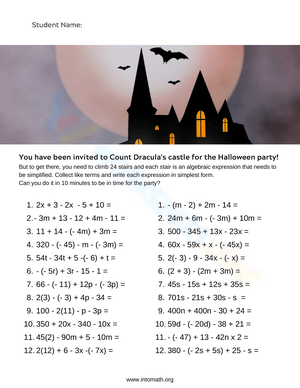
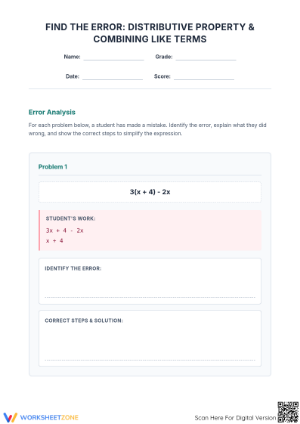
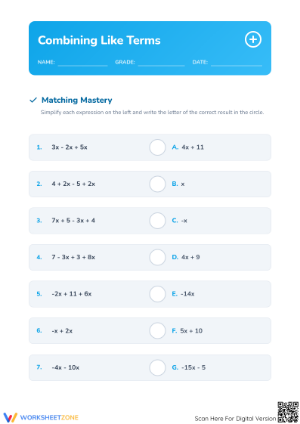
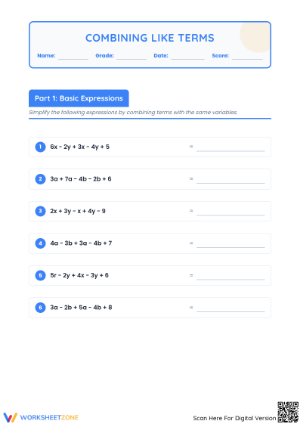
If your students can simplify 5x + 3x but freeze on 5x + 4, combining like terms worksheets give you the focused repetitions that turn a shaky rule into automatic fluency. This skill sits right at the hinge between arithmetic and algebra, and getting it solid in grades 6-8 pays off through every equation and inequality your students meet later. The worksheet sets here are built for that transition, with practice you can drop into whole-class review, stations, or targeted intervention. Every set here comes with an answer key so practice stays independent and you can spend class time reteaching, not grading.
What These Combining Like Terms Worksheets Practice
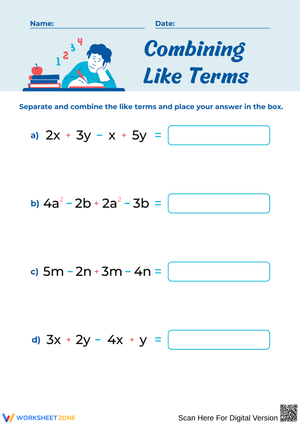
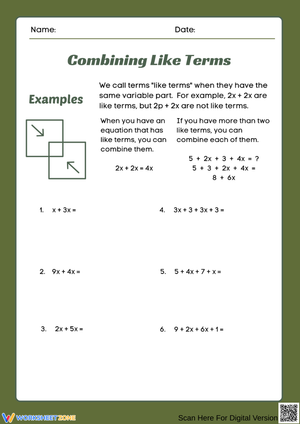
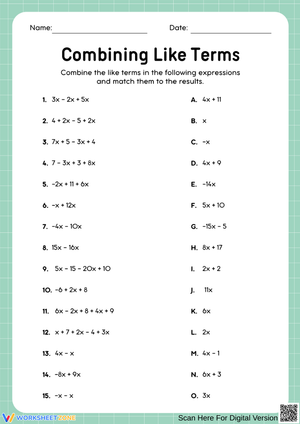
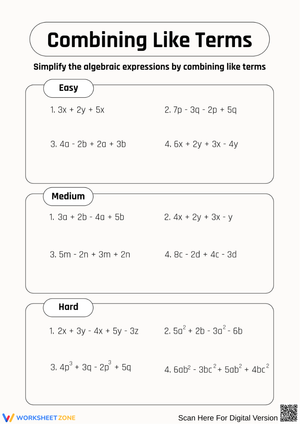
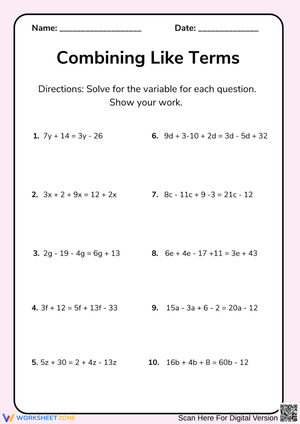
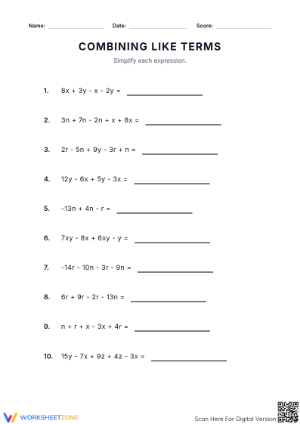
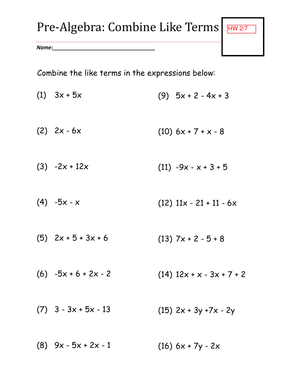
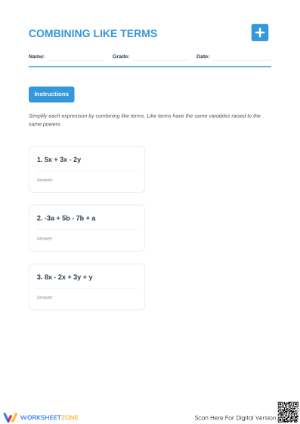
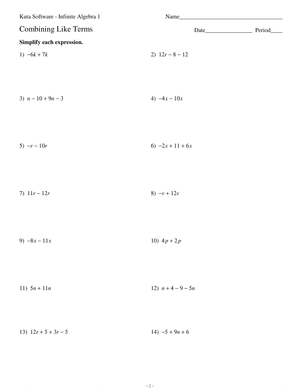
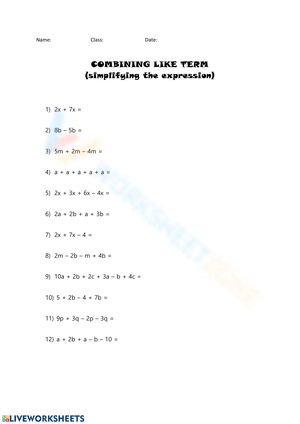
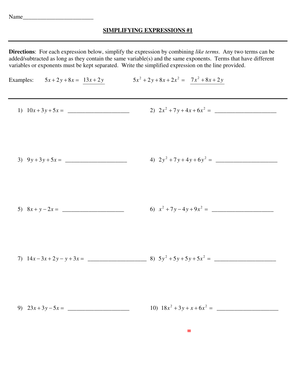
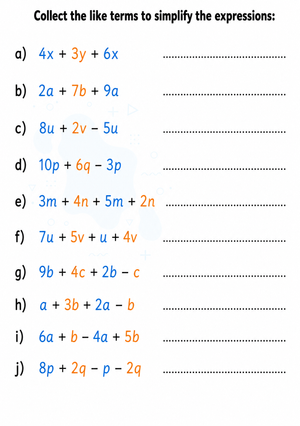
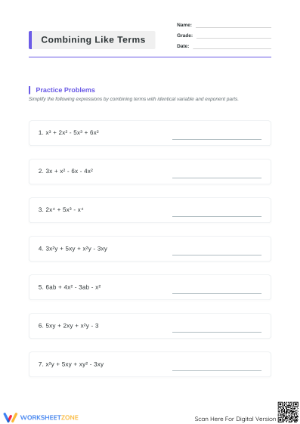
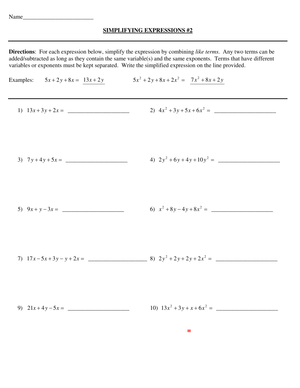
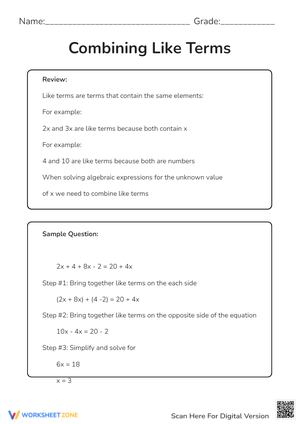
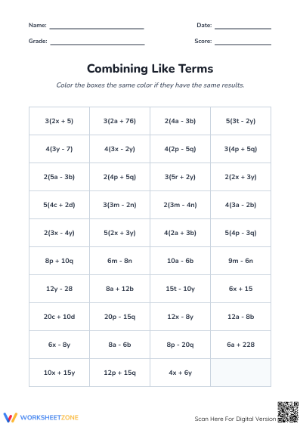
Combining like terms means adding or subtracting terms that share the same variable raised to the same exponent. On these worksheets students identify like terms, group them, and simplify expressions such as 7a + 2 - 3a into 4a + 2. The problem sets move from two-term expressions with whole-number coefficients toward longer strings that mix positive and negative rational coefficients. Because the rule depends on matching both the variable and its exponent, worksheets deliberately mix in unlike pairs, so students learn that 5x and 2y stay separate. That sorting step, done repeatedly on paper, is what makes the concept stick before students apply it inside equations. Good worksheet sets also vary how expressions are written — some with terms already grouped, others scattered — so students don't rely on position as a shortcut for meaning.
Where Combining Like Terms Fits in Your Standards
Combining like terms is formalized in CCSS.Math.Content.7.EE.A.1, which asks seventh graders to apply properties of operations to add, subtract, factor, and expand linear expressions with rational coefficients. The groundwork starts a year earlier: grade 6 standards on equivalent expressions (6.EE.A.3-4) introduce the idea that two expressions can name the same value, which is exactly what students confirm when they combine terms. Sequencing worksheets along that progression, from generating equivalent expressions to simplifying with rational coefficients, keeps practice aligned to where your students actually are.
According to Curriculum Associates' work on algebra readiness, combining like terms is one of the key prerequisite skills students must master before Algebra 1. When it isn't solidified by grade 8 — a gap researchers still document in high school — those simplification errors follow students straight into multi-step equation solving.
The Misconceptions Your Worksheets Should Target
The single most common error is treating 5x + 4 as 9x, or collapsing 5x + 2y into 7xy — both come from adding coefficients without checking that the variable parts match. This isn't only a middle-school slip. A study of Grade 9 learners using algebra tiles found that many students still struggle to combine like terms and rearrange expressions for simplification, meaning the misconception routinely survives into high school when it isn't corrected early. Worksheets that force students to label each term before simplifying interrupt the reflex to add everything in sight.
Watch for a second pattern: students who drop the sign in front of a term, turning 8 - 3x into a subtraction they apply to the wrong piece. Building a few sign-focused rows into each worksheet catches this before it contaminates equation solving. Highlighting or boxing like terms in different colors on the first few rows gives students a visible routine they can carry to problems that no longer have the scaffold.
Sequencing Worksheet Difficulty
Pick worksheet sets in an order that scaffolds toward algebra readiness rather than jumping straight to hard problems:
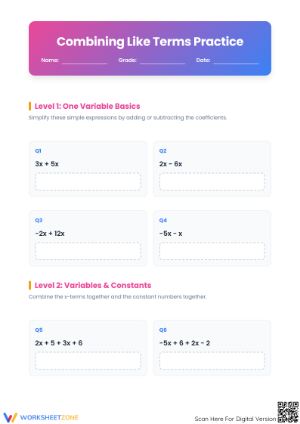
- Level 1: two-term, single-variable expressions with whole-number coefficients, such as 6n + 2n.
- Level 2: three or four terms with a mix of positive and negative coefficients, such as 4y - 7 + 2y.
- Level 3: rational coefficients and multiple variables, such as 1.5a + 3b - 0.5a.
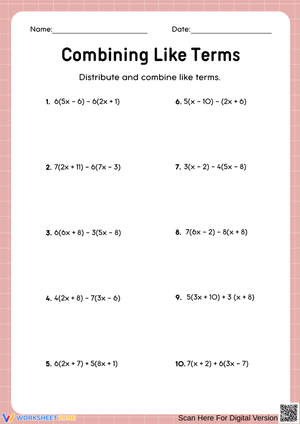
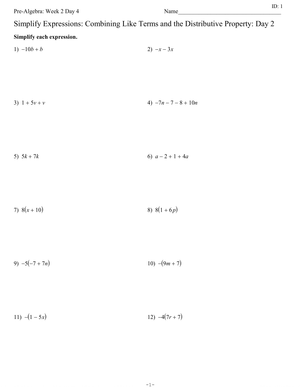
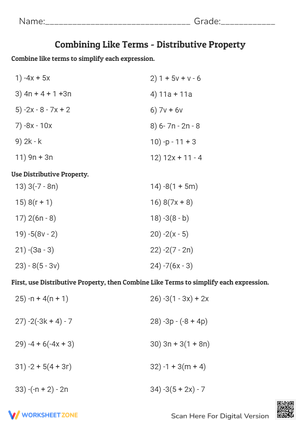
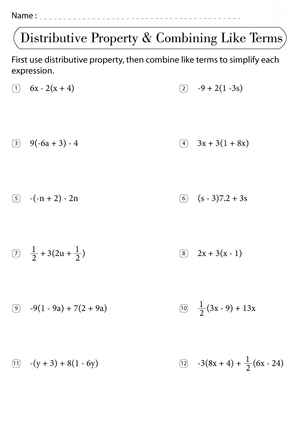
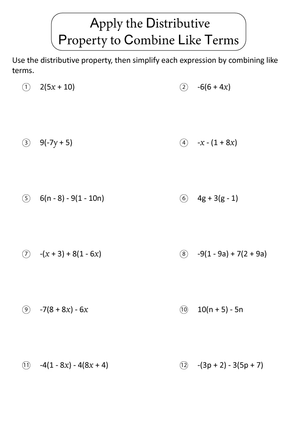
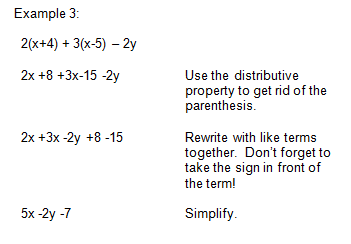
- Level 4: expressions requiring distribution first, such as 3(x + 2) + 4x, which previews the full 7.EE.A.1 expectation.
Moving one level at a time lets you see exactly where a student's understanding breaks, instead of guessing after a mixed quiz. It also gives you a shared vocabulary with students — asking a student to move up to Level 3 is clearer feedback than telling them to try harder problems.
Classroom Implementation
Use these worksheets as short, frequent practice rather than a single long packet. Ten focused problems three times a week beats forty problems in one sitting, because the sorting habit needs spacing to become automatic. A few ways to work them into instruction:
- Open class with a three-problem warm-up pulled from the current level, then review answers as a group.
- Run a station rotation where one station is a Level 2 worksheet and another is a quick self-check with an answer key.
- Assign a half-sheet exit ticket so you can sort students into ready, almost, and reteach groups before the next lesson.
- Turn a completed worksheet into a peer-check activity where partners compare each simplified line and flag any mismatched terms.
Keep an answer key visible during independent practice so students verify each line, not just the final expression. Over a few weeks, that habit of checking line by line is what separates students who simplify accurately from those who guess.
Differentiating Core Practice and Enrichment
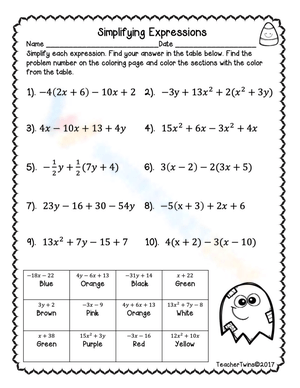
One worksheet rarely fits a whole class. For students who need core practice, keep expressions to a single variable and two or three terms so the matching rule stays front and center. For students ready for enrichment, hand out multi-variable, multi-term expressions that combine several like-term groups in one line, such as 4x + 3y - x + 2y - 5. These stretch students without introducing a new concept, so they build fluency and stamina at the same time.
A simple way to manage this is a single worksheet with a clearly marked challenge column. Every student completes the core problems; students who finish early move into the challenge set. You get one page to copy, three levels of practice, and a built-in way to keep fast finishers productive while you support the group that needs another pass.
Frequently Asked Questions
1. What grade level learns combining like terms, and which standard covers it?
Most US students formally learn it in grade 7 under CCSS.Math.Content.7.EE.A.1, with grade 6 equivalent-expression work (6.EE.A.3-4) laying the foundation. Many teachers also revisit it in grades 8-9 as algebra review. Knowing the exact standard also helps you defend pacing decisions during team planning.
2. How can I tell if a student is combining unlike terms by mistake?
Give them an expression like 5x + 2y that cannot be simplified. If they write 7xy or 7x, they're adding coefficients without checking that the variable parts match — the core misconception these worksheets target.
3. How much practice is recommended before moving to equation solving?
Aim for consistent accuracy across two or three worksheet sessions at Level 2 or higher before layering in equations. Short, spaced practice works better than one long packet. Track accuracy, not just completion, so you know the skill is solid rather than rushed.
4. How do these worksheets fit into algebra readiness screening?
Combining like terms is one of the prerequisite skills identified for Algebra 1 success, so a quick worksheet-based check gives you an early, low-stakes signal about which students need intervention.
5. Can I use these for both classwork and small-group intervention?
Yes. The same leveled sets work as whole-class practice and as intervention material — just start intervention groups one or two levels lower and build up. Keeping the format identical across settings also lowers cognitive load, so students focus on the math instead of relearning directions.