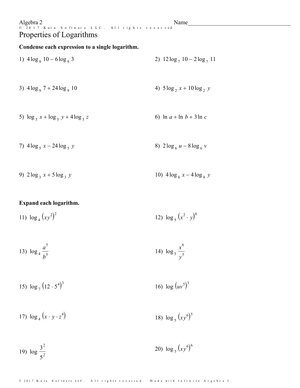
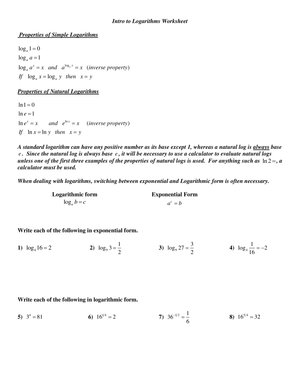
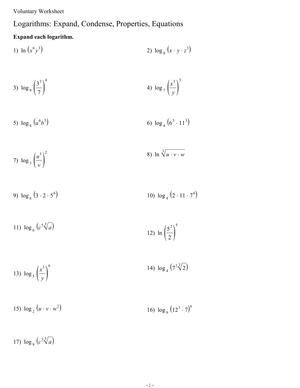
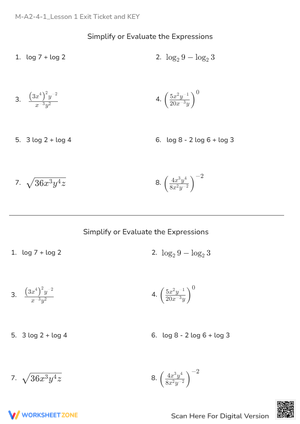
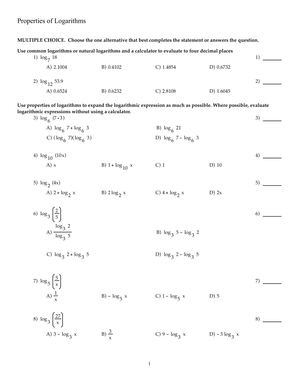
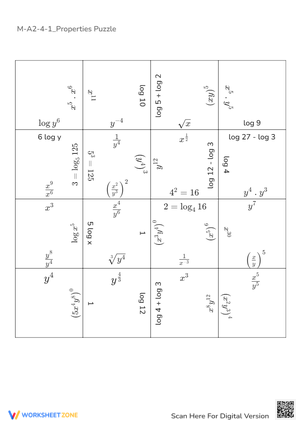
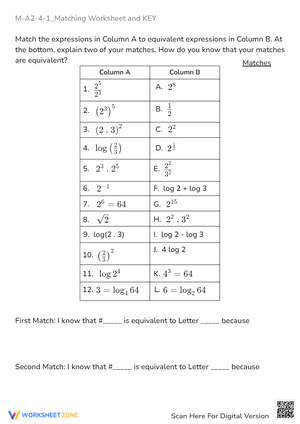
What Properties of Logarithms Worksheets Cover
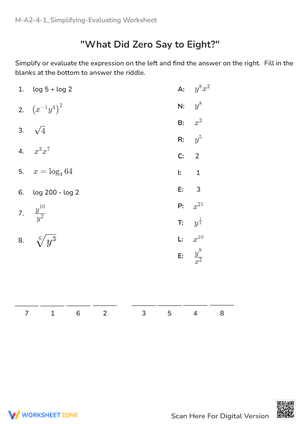
A strong set of properties of logarithms worksheets gives your Algebra 2 or Precalculus students repeated, low-stakes reps with the three rules that anchor the whole unit: the product rule, the quotient rule, and the power rule. Most sheets open with single-property expanding problems, move into condensing, and then mix all three so students have to decide which rule applies. A well-built pack also folds in the change of base formula, since students need it to evaluate logarithms in bases other than 10 or e on a calculator.
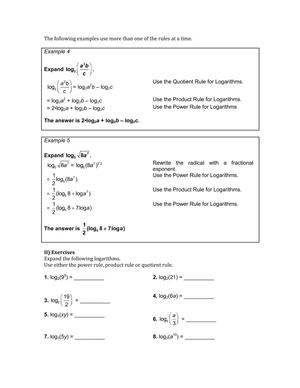
- Expanding single logarithms using the product, quotient, and power rules
- Condensing sums and differences back into one logarithm
- Mixed problems that require choosing the right rule
- Change of base problems for evaluating logs on a calculator
- Short answer keys so students can self-check during independent practice
Look for packs that keep numeric bases friendly—base 2, base 10, and base e—so students aren't distracted by messy arithmetic while they learn the rule. The best sheets also grow in difficulty down the page, starting with two-factor products and building toward expressions that need all three properties in one problem.
Because the properties are procedural, students build fluency through volume, not through one or two demonstration problems. Printable practice lets you assign a scaffolded set for guided practice, keep a second set for homework, and hold a third in reserve for the students who finish early and need a challenge.
Sequencing the Unit: Expand First, Then Condense
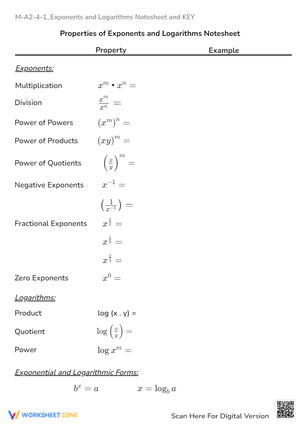
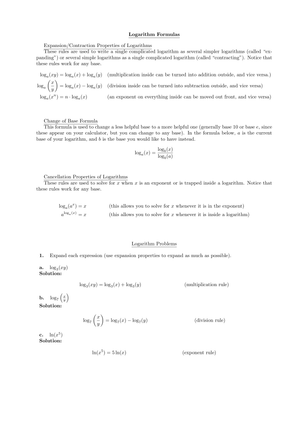
The cleanest sequence for a properties unit is expand, condense, then mix. Start with expanding a single logarithm into a sum or difference, because that direction lets students apply one rule at a time. A problem like log_b(xy) only asks for the product rule; log_b(x/y) only asks for the quotient rule; and log_b(x^n) isolates the power rule.
Once expanding feels automatic, flip the direction and have students condense several logarithms back into a single expression. Condensing is harder because students must apply the rules in reverse and respect order of operations, so give that stage its own worksheet rather than tucking a few problems at the bottom of an expanding sheet. Finish the sequence with mixed practice that pulls in the change of base formula, which mirrors how Big Ideas Math Algebra 2 orders the material in Section 6.5.
Common Student Errors to Watch For
The predictable mistake is inventing a rule for logs of sums and differences. Students see the product rule and over-generalize it, writing log_b(x + y) as log_b x + log_b y, which is not true. Worksheets that deliberately include a few problems with no simpler form force students to slow down and check whether a property actually applies.
In practice, about 3 in every 4 early errors on a properties quiz trace back to just two moves: distributing a log across addition inside the argument, and dropping the coefficient when reversing the power rule during condensing. If you spend one focused mini-lesson on those two errors before the mixed-practice sheet, you usually cut re-teaching time on solving logarithmic equations later, because the same misconceptions resurface there.
A second high-value error to target is base confusion. When students expand or condense, they sometimes mix logarithms with different bases as if the properties apply across them, which they don't. Give a few problems where two logs share a base and one doesn't, so students learn to check the base before reaching for a rule. Circling the base on every term is a simple habit that prevents most of these slips.
Classroom Implementation
Drop these worksheets into a predictable weekly rhythm. Day one, model expanding with two or three worked examples, then release students to a guided sheet. Day two, teach condensing and let students work in pairs so they can catch each other's reversed-rule errors. Day three, introduce change of base and assign mixed practice as homework. Day four, use a short five-problem sheet as a formative check before you move into solving equations.
Exit tickets are the highest-leverage use here. A single expand-and-condense pair at the end of class tells you within minutes who is ready to progress and who needs another day. By Friday, you'll have a clear read on the class, and the students who need reteaching can start the next week with a fresh scaffolded set instead of falling further behind.
Bringing Real-World Context Into Property Practice
Once students can manipulate the rules on abstract expressions, connect the work to the modeling expectations built into the High School Functions standards. Exponential growth, pH, the Richter scale, and decibel levels all use logarithms, so a few applied problems show students why the properties matter. For example, ask students to expand a decibel expression or simplify a compound-interest formula before evaluating it.
You don't need many context problems—three or four well-chosen ones per worksheet are enough. The goal is to link procedural fluency to CCSS.Math.Content.HSF-LE.A.4, where students express the solution to an exponential equation as a logarithm and evaluate it with technology. Keep the arithmetic light so the focus stays on setting up and simplifying the logarithmic expression rather than on calculator entry.
Standards Alignment and What Comes Next
Properties of logarithms sit inside the High School Functions strand of the Common Core and act as a prerequisite for later modeling work. Fluency here is what makes solving exponential equations by logarithm possible.
Big Ideas Math Algebra 2 places properties of logarithms in Section 6.5, immediately after logarithmic functions and before students solve logarithmic equations. This 3-property sequence—product, quotient, and power rules—gives teachers a clear 1-week window to build fluency that CCSS.Math.Content.HSF-LE.A.4 later assumes when students express solutions to exponential equations as logarithms.
Once your students can expand, condense, and switch bases with confidence, the natural next unit is solving exponential and logarithmic equations, where these same properties do the heavy lifting.
Frequently Asked Questions
1. What are the main properties of logarithms students need to memorize?
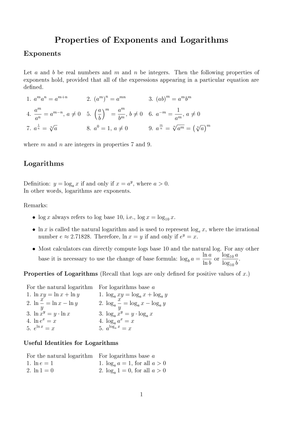
Students need three: the product rule, log_b(xy) = log_b x + log_b y; the quotient rule, log_b(x/y) = log_b x - log_b y; and the power rule, log_b(x^n) = n log_b x. The change of base formula is usually taught alongside them so students can evaluate logs on a calculator.
2. How do these worksheets align with Common Core Algebra 2 standards?
They support the High School Functions strand, especially CCSS.Math.Content.HSF-LE.A.4, which asks students to express the solution to an exponential equation as a logarithm and evaluate it using technology. That skill depends on fluency with logarithm properties.
3. What grade level or course typically covers properties of logarithms?
Properties of logarithms usually appear in Algebra 2 or Precalculus, most often in eleventh or twelfth grade. Curricula like Big Ideas Math Algebra 2 introduce them right after logarithmic functions and before solving logarithmic equations.
4. How can teachers use these worksheets for both expanding and condensing practice?
Assign expanding sheets first so students apply one rule at a time, then switch to condensing sheets that require reversing the rules. Mixed sheets that combine both directions with change of base work well as homework or a review before assessment.
5. What prerequisite skills should students have before starting this unit?
Students should understand the inverse relationship between exponential and logarithmic functions and be able to evaluate basic logarithms. That background, part of the HSF-LE and HSF-BF standards, makes the property rules feel like shortcuts rather than new facts.