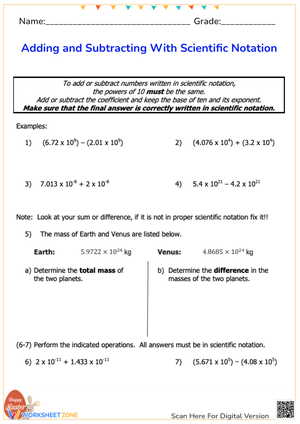
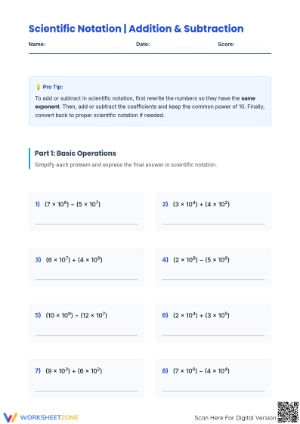
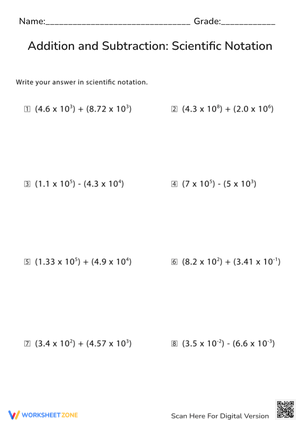
If your students can already apply the laws of exponents but freeze up the moment two numbers in scientific notation land in the same problem, you are looking at the exact gap that adding and subtracting scientific notation worksheets are built to close. This skill sits inside CCSS.MATH.CONTENT.8.EE.A.4, which asks students to perform operations with numbers written in scientific notation, including problems that mix standard decimal form with scientific notation. For most pre-algebra and algebra classrooms, that means this practice belongs near the middle or end of an exponents unit, not at the start of it.
Sequencing Worksheets After an Exponent Rules Unit
CCSS.MATH.CONTENT.8.EE.A.4 depends on 8.EE.A.1, the standard covering integer exponent rules. Students who have not internalized that a negative exponent means a smaller value, or who still guess at exponent operations, will struggle with scientific notation regardless of how the worksheet is designed. Before assigning an adding and subtracting scientific notation worksheet, a quick five-question warm-up on exponent rules can flag which students need a prerequisite review pulled aside for small-group time rather than sent straight into the new content.
Worksheet Progression: Matched to Mismatched Exponents
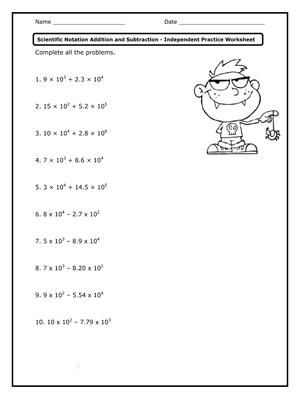
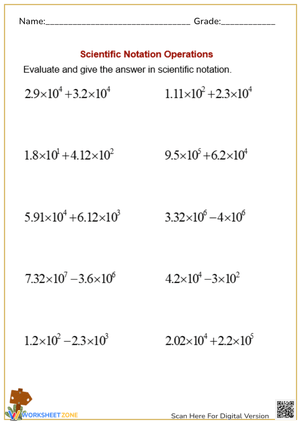
The most effective worksheet sequences move through three stages. The first stage uses terms that already share the same power of 10, so students only practice adding or subtracting coefficients. The second stage introduces terms with powers of 10 that differ by one, requiring a single conversion before combining. The third stage mixes exponents that differ by two or more, and includes at least one problem where the answer needs to be renormalized because the coefficient falls out of range. This progression keeps the cognitive load focused on one new demand at a time.
Connecting to Real-World Quantities
8.EE.A.4 also expects students to choose units of appropriate size for very large or very small quantities, such as expressing seafloor spreading rates in millimeters per year rather than meters. Worksheets that frame addition and subtraction problems around distances, populations, or measurement contexts give students a reason to check whether their answer makes sense, not just whether the digits are correct. A problem asking students to find the combined population change across two regions, each given in scientific notation, does double duty: it practices the operation and reinforces why scientific notation exists in the first place.
Classroom Implementation
Adding and subtracting scientific notation worksheets work best as a short, frequent formative check rather than one long assignment. A five-problem warm-up at the start of class can surface who is still adding exponents directly, letting the teacher pull a small group for a two-minute reteach while the rest of the class moves into independent practice. For intervention groups, printing the scaffolded version with the exponent-matching step already broken into a table gives struggling students a concrete procedure to lean on until it becomes automatic. For whole-class review before a unit test, mixed-exponent worksheets that include at least one real-world context problem give a fuller picture of readiness than pure computation alone.
Frequently Asked Questions
1. What grade level typically covers adding and subtracting scientific notation worksheets?
This skill is most commonly taught in 8th grade pre-algebra or algebra classrooms, though some 7th grade advanced tracks and 9th grade algebra review units cover it as well.
2. What is the first step students need to master before adding or subtracting numbers in scientific notation?
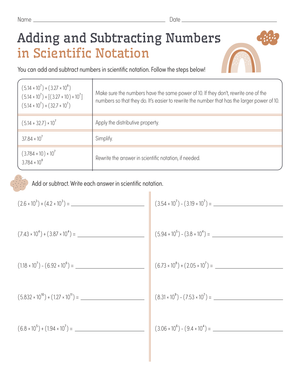
Students need to convert the terms so they share a common power of 10 before combining anything. Only after the powers of 10 match should they add or subtract the coefficients.
3. How do these worksheets align with 8.EE.A.4?
CCSS.MATH.CONTENT.8.EE.A.4 requires students to perform operations, including addition and subtraction, on numbers in scientific notation, and to choose appropriately sized units for very large or very small quantities. Worksheets that combine computation practice with real-world measurement contexts address both parts of the standard directly.
4. What is the most common mistake students make on these problems and how can worksheets target it?
The most frequent error is adding or subtracting the exponents directly instead of first equalizing the powers of 10. Worksheets that include error-analysis items, where students spot and fix this exact mistake, are effective at correcting the habit.
5. How can teachers use these worksheets for small-group intervention versus whole-class review?
For small-group intervention, scaffolded worksheets that isolate the exponent-matching step give struggling students a clear procedure to practice. For whole-class review, mixed-exponent worksheets with real-world context problems give a broader check of readiness before moving to multiplication and division.