


























Views
Downloads



Essential Algebra: Combining Like Terms & Distributive Property
Paste this activity's link or code into your existing LMS (Google Classroom, Canvas, Teams, Schoology, Moodle, etc.).
Students can open and work on the activity right away, with no student login required.
You'll still be able to track student progress and results from your teacher account.
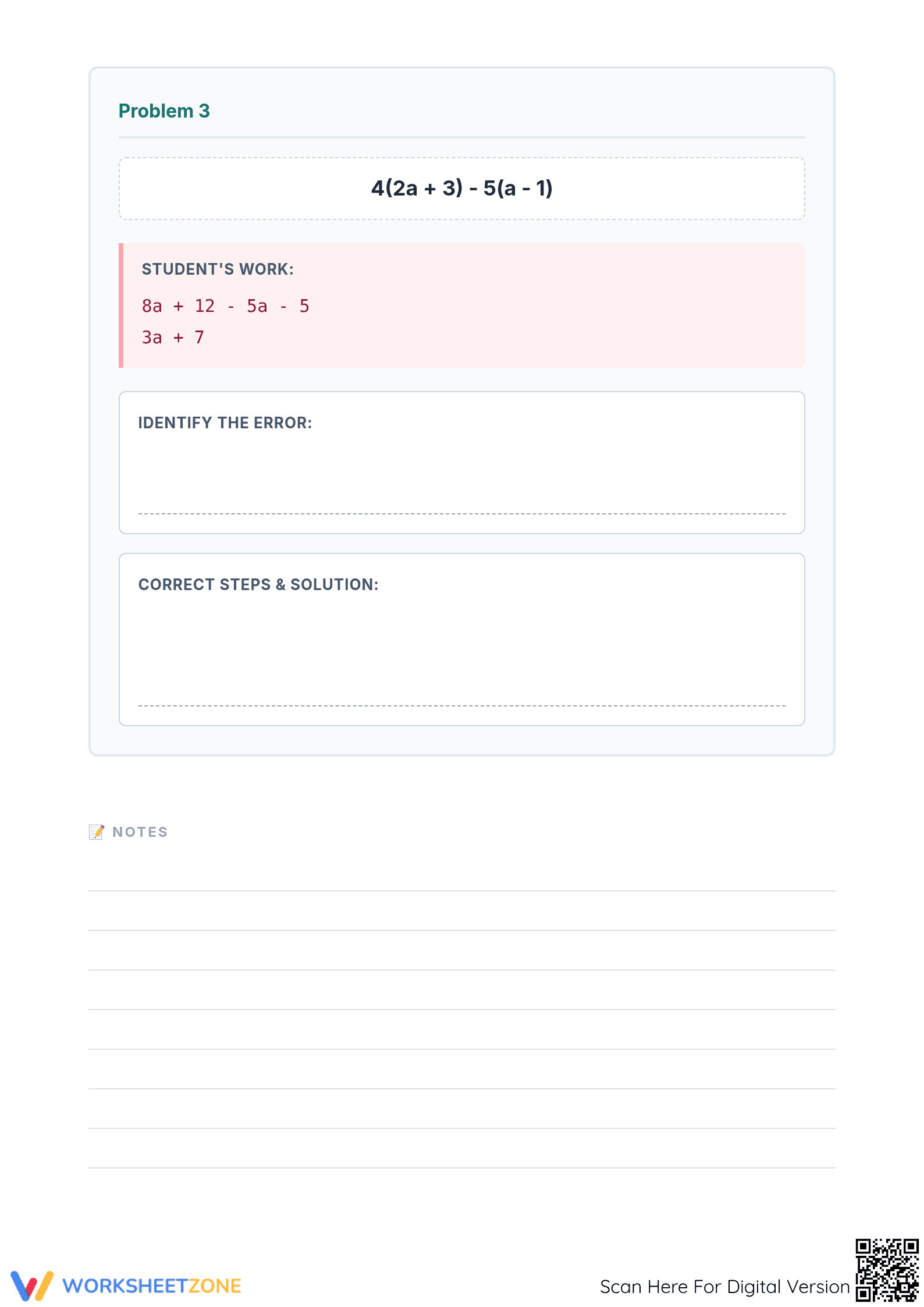
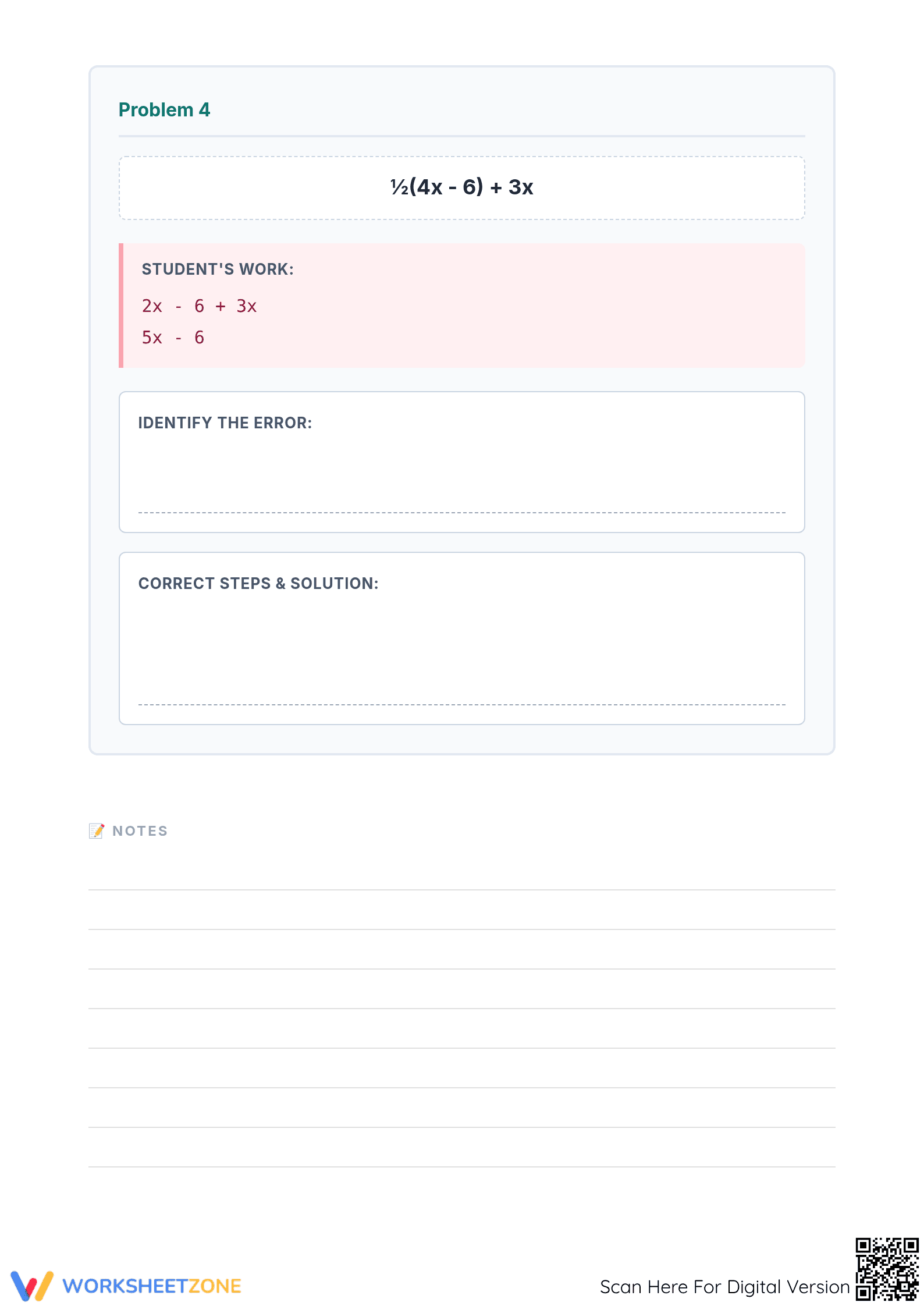
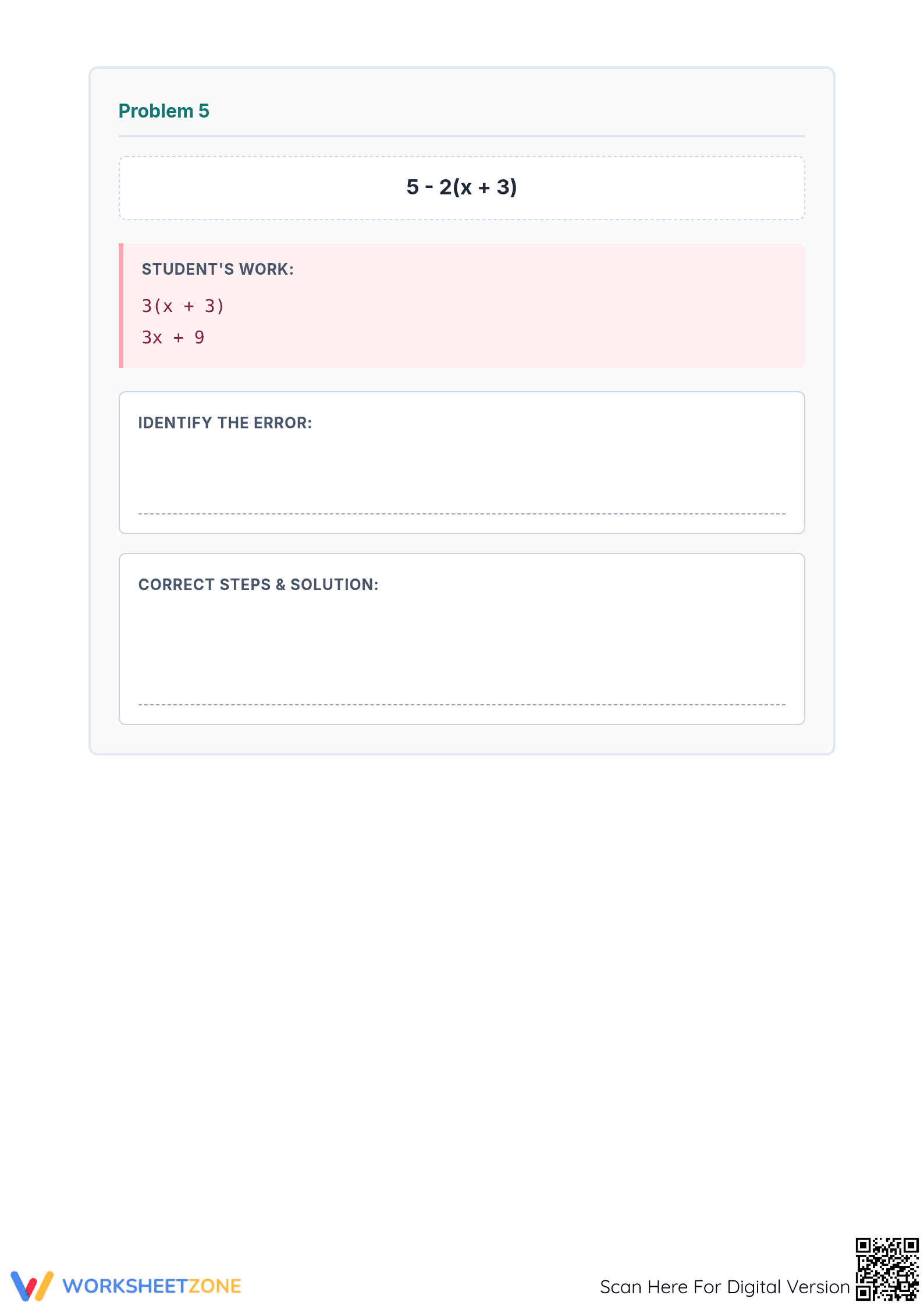
This Grade 7-12 algebraic expressions worksheet helps students master the distributive property and combining like terms through rigorous error analysis. Learners evaluate pre-solved problems, identify mathematical misconceptions, and provide correct solutions. This higher-order thinking activity ensures students deeply understand linear expressions while preventing common algebraic pitfalls.
At a Glance
- Grade: 7-12 · Subject: Math
- Standard:
CCSS.MATH.CONTENT.7.EE.A.1— Expand and simplify linear expressions with rational coefficients using properties of operations- Skill Focus: Advanced algebraic error analysis and linear expression simplification
- Format: 5 pages · 15 problems · Answer key included · PDF
- Best For: Mid-unit formative assessment, independent practice, or collaborative group work
- Time: 30–45 minutes
What's Inside
This 5-page PDF features 15 unique "Find the Error" scenarios focusing on the distributive property and combining like terms. Each problem contains a common mistake, such as incorrect sign distribution or term grouping. Students are provided with dedicated workspace to explain the error and provide a corrected step-by-step solution. A full answer key is included for teacher review or student self-checking.
Zero-Prep Workflow
The "print-and-go" design requires under 2 minutes of teacher preparation. First, print the 5-page packet (30 seconds). Second, distribute the worksheets during the independent practice portion of your algebra lesson (1 minute). Finally, review common errors as a class using the included answer key (15 minutes). This efficient workflow makes it an ideal resource for substitute plans or emergency sub folders with nearly zero setup time.
Standards Alignment
Aligned to CCSS.MATH.CONTENT.7.EE.A.1, this resource requires students to apply properties of operations to expand and simplify linear expressions. By identifying incorrect steps, students demonstrate a mastery of mathematical properties beyond standard drill-and-kill exercises. This standard code can be copied directly into lesson plans, IEP goals, or district curriculum mapping tools to document student progress.
How to Use It
Use this worksheet as a mid-unit formative assessment to identify students struggling with negative sign distribution. Observe students as they analyze errors; if they identify the mistake but cannot articulate the reasoning, provide sentence frames. It also works as a collaborative activity where partners debate the source of errors. Completion time ranges from 30 to 45 minutes depending on student depth of explanation.
Who It's For
This activity is designed for students in Grade 7 through Algebra 1 developing fluency with variable expressions. It is effective for learners who make repetitive mistakes and need to practice evaluating their work. The worksheet pairs naturally with a guided notes session or an interactive notebook entry on the distributive property and combining like terms during direct instruction.
Research from Fisher & Frey (2014) highlights the effectiveness of error analysis as a scaffold for developing metacognitive skills in mathematics. By requiring students to justify why a step is incorrect, this Grade 7 worksheet shifts the focus from rote calculation to conceptual understanding of the CCSS.MATH.CONTENT.7.EE.A.1 standard. This pedagogical approach aligns with the NAEP framework, which emphasizes the ability to analyze mathematical arguments and identify flawed logic. Students who engage in error-finding tasks demonstrate higher retention of algebraic properties compared to those who only perform traditional practice. This resource provides 15 structured opportunities for students to engage in this critical thinking process. The inclusion of a clear answer key allows for self-monitoring, a key component of the gradual release of responsibility model. It provides empirical evidence of student mastery for secondary math instruction.


