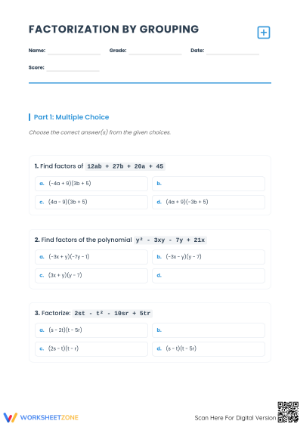
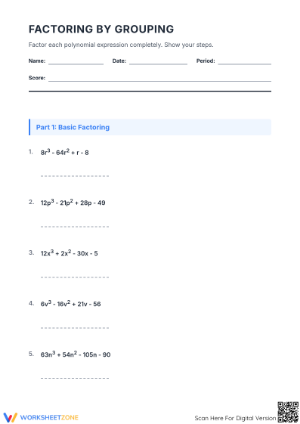
What Factoring by Grouping Worksheets Cover
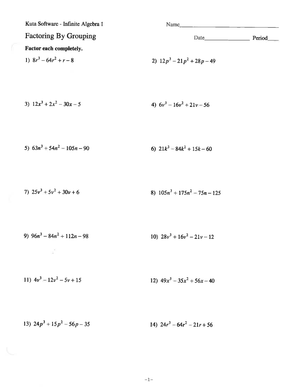
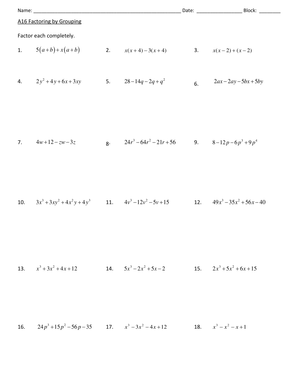
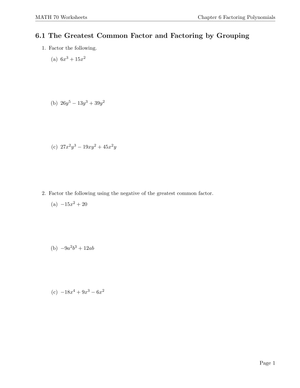
Factoring by grouping is the go-to method when a polynomial has four or more terms and no single greatest common factor pulls out of every term. Good factoring by grouping worksheets give your Algebra 1 and Algebra 2 students repeated, gradable practice on pairing terms, pulling the GCF from each pair, and factoring out the shared binomial. Because the skill usually lands in grades 8-10, the worksheets you assign need clean step structure, room to show work, and an answer key you can trust for fast grading.
These sheets work across the arc of a unit. You can open with expanding practice, move into four-term grouping, and finish with trinomials that students split into four terms before grouping. That progression mirrors how most textbooks sequence factoring, so the worksheets slot into homework, warm-ups, and review without extra prep on your end.
The Step-by-Step Grouping Method
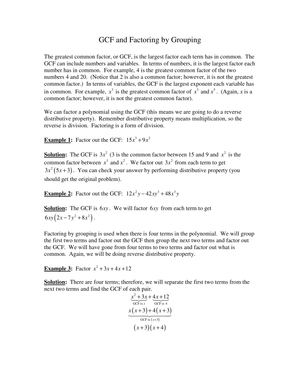
Students factor by grouping in four predictable moves, and worksheets should reinforce each one. First, confirm the polynomial has four terms and check for a GCF across all four. Second, split the expression into two pairs. Third, factor the GCF out of each pair. Fourth, factor out the common binomial that appears in both groups. When the two binomials match, the factoring is correct; when they don't, students know to re-check their pairing or signs.
Take the classic example 3x^3 + 6x^2 + 4x + 8. Group it as (3x^3 + 6x^2) + (4x + 8), pull out 3x^2 and 4 to get 3x^2(x + 2) + 4(x + 2), then factor out (x + 2) to reach (x + 2)(3x^2 + 4). Resources like Khan Academy and CK-12 Foundation walk through this same sequence, which makes them useful for students who miss a lesson or need a second explanation at home.
How Grouping Aligns With Common Core
Grouping is not an isolated trick. It is the inverse of the distributive property, so it doubles as a bridge lesson between multiplying and factoring polynomials. That connection is why the method shows up in standards-aligned Algebra units and in test-prep sequences that ask students to rewrite expressions in factored form.
According to the Common Core standard CCSS.Math.Content.HSA-SSE.B.3a, students should factor a quadratic expression to reveal the zeros of the function it defines. Factoring by grouping delivers exactly that outcome, and it applies to the four-term polynomials and split-middle-term trinomials that make up a large share of any Algebra 1 factoring unit.
When you tie your worksheets back to this standard, students see that grouping is not busywork. Rewriting a quadratic in factored form is the step that exposes its roots, which sets up graphing, solving, and later work with quadratic functions.
When to Use Grouping vs. Other Methods
One of the hardest judgments for students is choosing a factoring method, so build that decision into your worksheets. If every term shares a factor, a simple GCF pull comes first. If an expression is a difference of squares, that pattern is faster than grouping. Grouping earns its place with four-term polynomials and with quadratics of the form ax^2 + bx + c, where students split the middle term into two terms and then group.
A short sorting activity helps. Give students a mixed set and ask them only to label the method they would use, without factoring anything yet. Third Space Learning and similar topic guides frame these method choices clearly, and a labeling drill turns method selection into its own practiced skill rather than a guess.
Common Student Mistakes
Sign errors dominate the mistakes you will grade. When the third term is negative, students often forget to factor out a negative GCF, which flips the sign inside the binomial and breaks the match between the two groups. Watch for x^3 - 4x^2 - 3x + 12 handled as x^2(x - 4) + 3(-x + 4); the groups no longer share a binomial, and students stall.
Here is the diagnostic move that saves the most reteaching time: treat the two intermediate binomials as a matching check, not a formatting step. In every correct grouping, the parentheses after each GCF must be identical before the final factor-out. When they differ by only a sign, the fix is almost always pulling a negative out of the second pair, not restarting the problem. Teaching students to pause and compare those two binomials converts a vague error into a single, repeatable correction, and it cuts the most common source of lost credit on grouping quizzes.
Using These Worksheets In Algebra 1 Classes
Grouping practice fits every phase of a lesson. Use a two-problem warm-up to activate GCF skills before you introduce pairing. During guided practice, run an error-analysis task where students find and fix a planted sign mistake rather than starting from a blank problem. Close with an exit ticket of one four-term polynomial so you get a same-day read on who is ready for homework and who needs a small-group pull the next morning.
For intervention, a Kuta Software-style worksheet with a full answer key lets a co-teacher or aide run targeted practice without needing to re-derive every solution. Because the answer key shows the factored result, you can also assign self-checking practice, which frees you to circulate and coach the students making repeated sign errors instead of grading in real time.
Frequently Asked Questions
1. What grade level typically learns factoring by grouping?
Factoring by grouping is usually introduced in Algebra 1 and revisited in Algebra 2 or Integrated Math II, so it generally targets students in grades 8-10, depending on when your school sequences Algebra.
2. What is the difference between factoring by grouping and factoring a GCF?
A GCF pull removes one factor shared by every term. Grouping is a two-stage process for four-term polynomials: you factor a GCF from each pair, then factor out the common binomial that results.
3. How does factoring by grouping align with Common Core standards?
It supports CCSS.Math.Content.HSA-SSE.B.3a, which asks students to factor a quadratic expression to reveal the zeros of the function it defines. Grouping rewrites the expression in the factored form that exposes those zeros.
4. What are common student mistakes when factoring by grouping?
The most frequent errors are sign mistakes when a negative GCF should be pulled from the second pair, and grouping terms in an order that does not produce a matching binomial. Both break the final factor-out step.
5. How can teachers use grouping worksheets for intervention or review?
Use answer-key worksheets for self-checking practice, error-analysis warm-ups, and exit tickets. In small-group intervention, start with clean four-term problems, then build toward split-middle-term trinomials as students gain fluency.